
This page is also available in / Cette page est également disponible en:
 Français (French)
-
Pentatone3.5
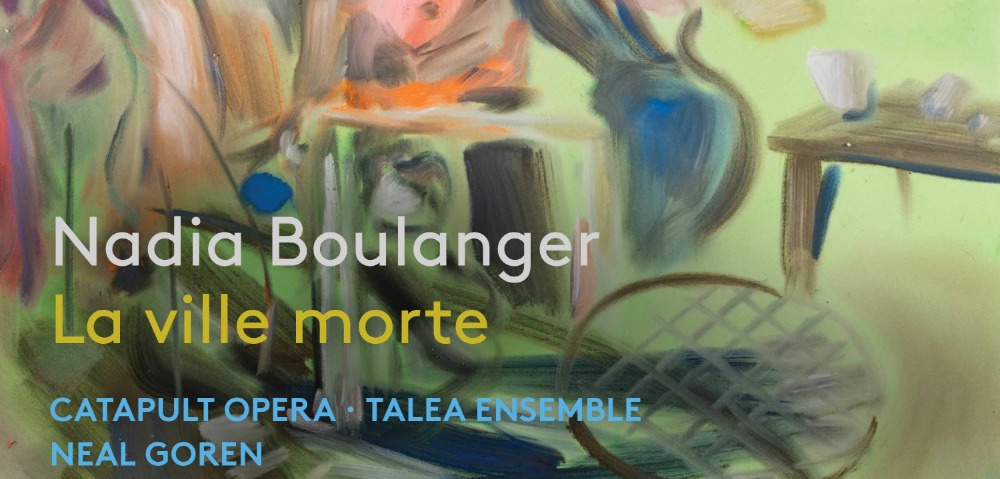
Boulanger/Pugno: La ville morte
Melissa Harvey, soprano; Laurie Rubin, mezzo-soprano; Joshua Dennis, tenor; Jorell Williams, baritone; Talea Ensemble; Neil Goren, conductor
Pentatone, 2025
La ville morte was a collaboration between Nadia Boulanger and Raoul Pugno and was scheduled for its first performance in the summer of 1914. That didn’t happen, for obvious reasons, and as a result of the disturbances caused by the war the orchestration was lost, leaving only a piano score. The tone of the piece is definitely fin de siècle decadence and one can easily see why it didn’t seem appropriate after 1918.
La ville morte has now been revived by Catapult Opera of New York in partnership with Greek National Opera. It has been given staged performances—and now, recorded. The “recreated” orchestration is by Joseph Stilwell and Stephen Cwik and uses a chamber ensemble of two violins, viola, cello, bass, flute, oboe, clarinet, bassoon, horn and piano.
It’s a four-act work lasting a little over 1½ hours. The setting is Mycenae in the late 19th century. Léonard is conducting an archeological dig accompanied by his sister Hébé, his friend Alexandre and Alexandre’s blind wife Anne. Alexandre has fallen out of love with his wife and is pursuing Hébé. Léonard, who has an incestuous crush on his sister, becomes jealous. Anne believes her life is effectively over and is encouraging Hébé to marry Alexandre when she is gone. Unfortunately she explains all this to Léonard, not suspecting his attraction to his sister. This results in Léonard losing control and killing Hébé to maintain her “purity.” Along the way, the women become obsessed with the remains and grave goods of Cassandra and Antigone. So, death and incest. Pretty standard late 19th-/early 20th-century tropes in a certain slice of the artistic world.
The music is about what one might expect. It’s often lush, sometimes a little overripe with echoes of the kind of “mysterious” sound world one finds in Debussy’s Pelléas et Mélisande. The orchestrators have done a good job in evoking the period in the instrumental colours, while not ever overwhelming the singers. The opera is through sung and there’s not really anything one would call an aria, though the music does reflect the characters’ moods. This is most notable in Léonard’s obvious psychological collapse as he tries to come to terms with his jealousy. All in all, La ville morte is well crafted but it’s easy to see why no one wanted it in a post-war world.
The cast for the recording is the Catapult Opera cast supported by the Talea Ensemble with Neal Goren conducting. It’s solid. Melissa Harvey’s bright soprano is ideal for Hébé and she’s especially effective when she is, essentially, invoking the spirits of Cassandra and Antigone. Laurie Rubin, who sings Anne, will be familiar to some readers as she performed in Amplified Opera’s The Way I See It in Toronto a few years ago. Like her character, she is blind. She also has a rather pleasing dark mezzo and she’s very good at conveying the sense that blind people perceive things the sighted don’t. She has absolutely the best (and last) line in the opera. As she stumbles over Hébé’s corpse she exclaims “Je vois! Je vois!” but in what sense we never find out.
Léonard is sung by tenor Joshua Dennis. At first I was wondering why this role had been written for a tenor, but as he disintegrates mentally his music gets much higher. He copes very well. Finally, Alexandre is Canada-based baritone Jorell Williams. In a way he’s a foil for the other characters and only really comes alive when he’s making passionate advances to Hébé. He offers a very solid performance. The ensemble playing is crisp and detailed and Goren makes sure it never covers the singers. If your French is up to it, you won’t need the libretto and translation provided.
The recording was made at NYU’s Skirball Center for the Performing Arts in 2024. It’s well balanced, detailed and solid—at least, in the high resolution version I listened to. La ville morte is being released as a 2CD set and digitally in 96kHz/24bit and 44.1kHz/16bit resolutions as well as in Dolby ATMOS. There’s a useful booklet with excellent notes, bios, a synopsis and full text and translation.
All in all, quite an interesting rediscovery which has been skilfully recreated and given an excellent performance and recording.
This page is also available in / Cette page est également disponible en:
Français (French)