This page is also available in / Cette page est également disponible en:
 Français (French)
Thomas Tallis, Josquin des Prez, Giovanni Pierluigi da Palestrina—these are just a few of the composers whom the Tallis Scholars have brought to an international stage throughout their storied history. “We’ve made [the performance of Renaissance vocal works]a major international activity,” says founding conductor Peter Phillips. “We started in Oxford. We then went to London, and from there, we branched out.”
Since its founding in 1973, the Tallis Scholars have given over 2,500 concerts in over 16 countries and released more than 60 albums on their own label, Gimmel Records. The ensemble also boasts an impressive list of accolades, including multiple Grammy nominations, induction into the Gramophone Hall of Fame (2013), and a BBC Music Magazine Recording of the Year (2021) for their album of the complete Josquin des Prez masses.
The ensemble’s focus on sacred vocal works from the Renaissance has, over its 52-year lifespan, contributed to a musical renaissance of its own. Phillips explains how the Tallis Scholars were one of the first musical groups to dedicate themselves exclusively to works from that historical era. “We were certainly very early in the trend of doing this music outside of church services,” says Phillips.“When we started, that was all that was available. If you wanted to hear a motet by Byrd, you would go to evensong, and then you might hear one.”
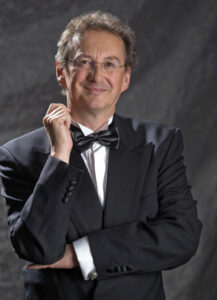
Peter Phillips. Photo: Albert Rosenburg
Until the mid-20th century, Renaissance music was either studied academically or heard as part of church liturgies. During this period, Phillips emerged as a key figure in the early music revival, a movement that sought to bring Baroque, Renaissance and Medieval composers to concert settings dominated by later operas and symphonies. “So powerful were the ideas behind [this]‘revolution’ of the 1970s,” Phillips wrote in a column for The Spectator, “that almost every modern group and festival pays tribute to them, whether it is in the use of vibrato, bowing styles, lightness of textures or tempi.”
The revival not only sought to bring early music to concert programs, but also introduced new approaches to performing these composers. The emotional grandeur and lush, heavy textures that had been the norm in performances of Bach and Telemann were exchanged for a pure, more straightforward sound. Yet the “revival of interest in what was called early music in the 1970s and ’80s,” writes Phillips in the same column, “was a cultural event which went beyond a new way of making sounds.” There were also, he continues, “dress codes and eating habits” that went along with the revival—extensive endeavours to inhabit the worlds of composers and uncover the unadorned origins of their music.
Despite all these efforts, Phillips asserts that authenticity—historically accurate performance—is ultimately impossible. “We have no idea what they sounded like,” he says. Rather, it is the music itself that tells him how it would like to be performed. Like a Renaissance cathedral, the mass settings of Palestrina and Des Prez are intricately detailed, yet cohere into a larger, sublime whole. These qualities have captivated Phillips, guiding him toward the “ideal sound” that has been fixed in his mind since the very beginning.
The Search for the Ideal Sound

In 1973, Phillips was an undergraduate at Oxford when he brought together his fellow students to sing Renaissance vocal music. The Tallis Scholars, he recounts, started out performing “very undergraduate, amateur-style concerts” in and around the Oxford community. It was at this time that Phillips developed what he refers to as the “ideal sound” for performing Renaissance music. “I tried to get [that sound]from the singers who were available 52 years ago,” he recalls, “and I still try to get it every time I go on stage. And nowadays, it’s more likely that I’ll get it than when we started.”
The elusive, ideal sound that got fixed in Phillips’s mind is “clear, bright, agile, and tough. The core of it needs to be really strong,” he notes. While “tough” might not be the first adjective that comes to mind when thinking about early choral music, Phillips points to the vital need for projection when performing it. “We sing in symphony halls, without amplification,” he says, recalling a recent performance at the Sydney Opera House in front of an audience of three thousand. “I want my singers to project, but not like an opera singer. … In projecting, I don’t want to lose the clarity of the music.”
The Tallis Scholars’ hallmark is the purity of sound of unaccompanied—a capella—voices. Consequently, performances require singers with “impeccable tuning,” says Phillips.“The moment parts bang against each other because of bad tuning, you can’t hear the detail. [Renaissance] polyphony is made up entirely of very complicated detail. … That detail is absolutely fascinating when you can hear it all,” he explains. “If you sing in an operatic way, it won’t be [in tune], because vibrato distorts the tuning.”
Phillips recalls that when the Tallis Scholars were starting to perform, there was “no possibility to make a career in singing outside of the big solo stuff.” The operatic style of singing—passionate, and with a lot of vibrato—was the gold standard. Today’s musical landscape, he notes, is shifting. Nowadays, “a young singer can make a good living out of singing what we call straight—in tune, without any vibrato.”
While opera shines a spotlight on the soloist, Renaissance polyphony involves the blending of many voices into what Phillips refers to as a contrapuntal web. “This is very democratic music,” he explains.“The middle parts, tenor and alto, are of equal importance [to the soprano and bass].” This equality of the parts “was not a principle that was carried into the Baroque period.” From that point onward, a more hierarchical conception of musical texture emerged, with the soprano and bass assuming the most prominent lines.
A Democratic Music

Peter Phillips. Photo: Peter Adamik
It is no surprise that a high-calibre vocal ensemble like the Tallis Scholars emerged in England, where the choral tradition stretches back centuries. In England, choirs abound: a wide array of collegiate and cathedral ensembles offer young singers early and sustained exposure to choral music. The tradition is perpetuated by having children placed alongside older and more experienced choir members so they “learn—and learn very quickly.” Phillips remarks that “by the time they are eight or nine,” children who participate in choirs have already developed very strong sight-reading abilities, and are “pretty much professional singers. That’s what the [U.K.] choral tradition is, and it’s unique,” he proudly adds.
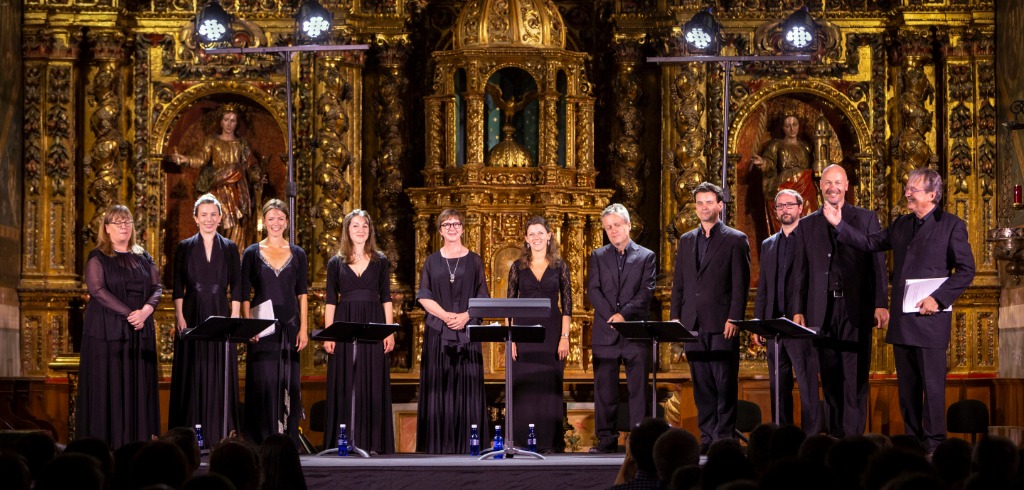
With their impeccable intonation and meticulous attention to ensemble blend, the Tallis Scholars embody the ideals of the English choral tradition. Yet they also differ from other choirs in important ways. A democratic music, it seems, requires a more democratic approach. Phillips explains that while most choirs stand in rows with the conductor at the front, the Tallis Scholars are grouped in a semicircle around their director. The semi-circle placement has become a hallmark of the ensemble, and they were one of the first groups in the modern early music revival to adopt it consistently.
Phillips explains that when singers are arranged in rows, they are unable to see each other. Without the ability to communicate through looks and gestures, “it throws all the responsibility on the conductor.” However, when singers are arranged in a semicircle, the conductor is no longer the sole source of coordination. Instead, he acts more as a guiding presence, whose subtle looks and gestures help to unify the sound. “It’s the communication that’s important,” says Phillips. “What I actually do with my hands is not very important. It’s chamber music. [The singers] look at each other and make it work together—like a conversation, really.”
Crafting the Concert

The Tallis Scholars. Photo: Stephen Boffey
Phillips is not only engaged in conversation with his singers on stage, but with composers as well. “In the past few years,” he says, “I’ve started programming modern composers—people I can actually talk to.” In addition to their performances of Renaissance works, the Tallis Scholars have built an impressive repertoire of contemporary music, including the complete works of Arvo Pärt and a growing selection of pieces by Nicolas Muhly.
As part of the program for their Christmas concerts in Montreal and Toronto, Phillips has commissioned contemporary composer Matthew Martin to set the text of the Salve Regina, the hymn to the Virgin Mary. Phillips notes that the Salve Regina was “set by everybody” during the Renaissance, yet he is particularly excited to see what Martin will bring to it. Martin, he explains, is one of those composers whose “modern religious music fits very well with Renaissance religious music.”
The concert, titled Mother and Child, consists of English vocal music in honour of the Virgin Mary. Other composers in the concert include Thomas Tallis—whose richly sonorous Missa Puer natus est is at its core —as well as William Byrd, Benjamin Britten, John Nesbitt and John Tavener. After all these years of performing this music, Phillips is still in the process of learning new repertoire. Though Byrd’s Votive Mass for the Virgin is new to him, “it’s probably not new to the singers,” he says. “I often program things that I don’t know and that they all know … so the rehearsals become very interesting. Basically, the rehearsals give me the opportunity to learn to conduct these pieces, because the singers have already sung them.”
Britten’s Hymn to the Virgin, which Phillips describes as a crowd favourite that “everybody loves,” was written when the composer was only 16. Both Tavener’s Mater Christi and Nestbitt’s Magnificat are exemplars of the Eton Choirbook, an illuminated manuscript of English sacred music from the early 16th century, and one of the only of its kind to survive the Reformation.
While the Tavener piece is a “very pretty” addition to the Marian concert, Phillips describes Nesbitt’s Magnificat as a “one-off, extraordinary piece.” He has long admired the work, noting that Nesbitt appears not to have written anything else, which makes it all the more remarkable. “It’s sort of medieval,” he explains. “It’s got these rhythms—lots of jumping-around rhythms—that would appeal to everybody.”
The Tallis Scholars perform in Montreal at the Church of St. Andrew and St. Paul on Dec. 13 and in Toronto on Dec. 14 at Meridian Arts Centre’s George Weston Recital Hall.
This page is also available in / Cette page est également disponible en:
Français (French)