
By long-standing tradition, the BBC Proms invite a select number of world-class non-UK orchestras to grace the season. Those orchestras generally bring their A-game, with exciting programs and performances that feed off the sense of occasion generated by the invariably sold-out auditorium.
But there are exceptions. For the first of their two appearances on Sept. 9, the Vienna Philharmonic brought Mozart’s “Prague” Symphony and Tchaikovsky’s “Pathétique”. This being hardly a generous offering in terms of quantity, and not intrinsically as pulse-racing as some, we assumed that quality would compensate, and that Franz Welser-Möst—familiar to London audiences from his unhappy tenure with the London Philharmonic in the 1990s—would have something special to say about both works.

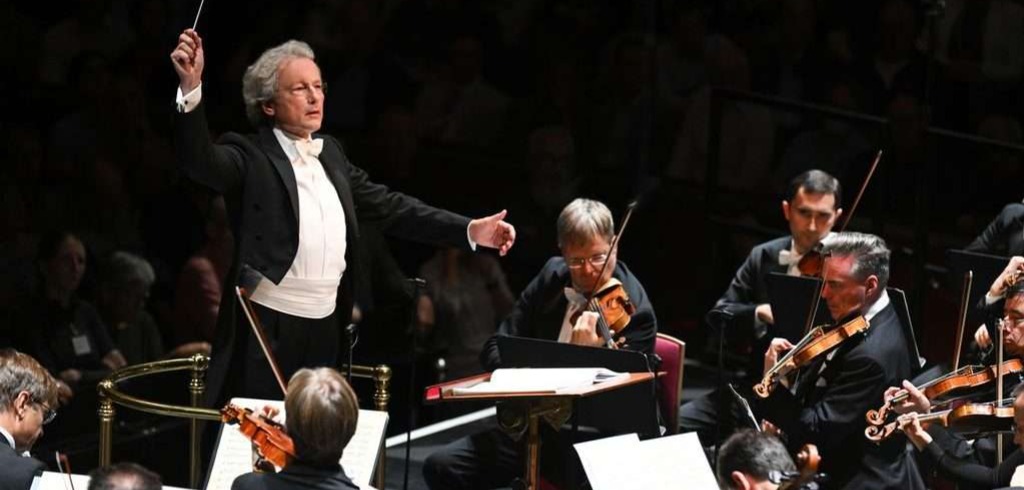
Franz Welser-Möst & Vienna Philharmonic at BBC Proms (Sept. 8). Photo: Chris Christodoulou
No such luck. It took no more than the introduction to Mozart’s first movement to bring expectations down to earth. Not that it was exactly a bad performance; more accurate to say a non-performance. Everything was in place, all textures as soigné as the conductor’s hairdo. But we listened in vain for the music’s operatic resonances (most obviously with Don Giovanni), for subtlety of timing and articulation based on responsiveness to harmonies and musical gestures, in short for anything beyond a routine realisation of the notes on the page. It sounded more like a first play-through, before the work of honing an interpretation had begun, not to mention the excitement of sharing it before a massive audience.
And so it continued. Every tempo was ordinario, every repeat a carbon copy, every special moment at best only half-acknowledged. And it wasn’t as if the technical realisation was perfect. The balance didn’t allow the woodwind writing to blossom as it should, while at other times the famously silken strings actually sounded weedy, with the leader’s contribution looming disproportionately loud, as though he was trying—unsuccessfully—to inject some communicative urgency. Through all this, Welser-Möst remained resolutely aloof.
Surely the “Pathétique” would be a wake-up call. We wished. If anything, the same shortcomings amplified the gap between Tchaikovsky’s expressive agenda and the complacency of its realisation. In the program booklet, Welser-Möst reported being bowled over by his encounter with Mravinsky’s famous recording. Yet you would never have guessed from his standoffish, low-intensity demeanour. How we longed for a conductor of the charisma of a… well, I was going to name names, but in fact almost any conductor on the circuit would fit the bill.

Franz Welser-Möst at BBC Proms (Sept. 8). Photo: Chris Christodoulou
Maybe this kind of thing passes muster in Vienna, or in Cleveland, where Welser-Möst is principal conductor. But it certainly isn’t in London. Last season’s performance of the Tchaikovsky by the Toronto Symphony with Gustavo Gimeno, to take but one example, was in every respect—but especially in its dramatic immediacy—in a higher class.
I found myself wondering whether some unfortunate circumstance had put a dampener on proceedings. Had the players and their conductor had a falling-out? Had they been caught in the underground train-drivers’ strike that left many audience-members hiking across the capital or joining long queues to squeeze into hugely delayed buses? Certainly, those who heard the same team’s Bruckner Ninth the following evening reported a richer musical experience. But on the showing of their Mozart and Tchaikovsky, I would have needed to see it to believe it.