
Women have long had fewer opportunities and have been overlooked in the male-dominated jazz industry. Jazz grew in popularity in the late 1800s, at a time when some men were still proclaiming that women were innately unable to produce music and art as creatively as men did.
When women started to become more involved in the early 1900s jazz scene, it was mainly in the role of featured vocalist. Names like Billie Holiday and Ella Fitzgerald are synonymous with ‘women in jazz,’ particularly in their capacity as singers, but how much does the average person know about the women who composed and shaped jazz to what it is today?
_-_Crop.jpg)
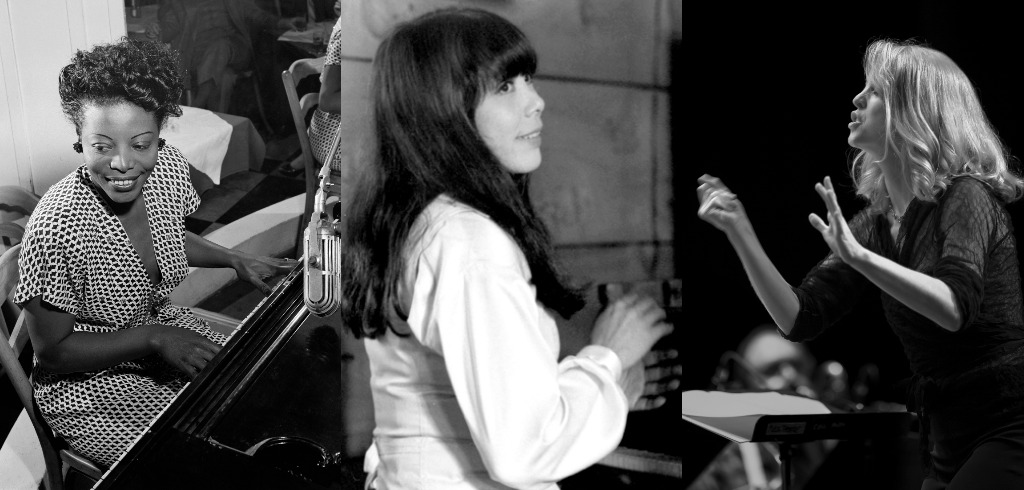
Mary Lou Williams (ca. 1946). Photo: William P. Gottlieb; restored by Adam Cuerden
On Oct. 30, Orchestre national de jazz de Montréal (ONJ) presented a special program at Montreal’s Cinquième Salle in Place des Arts highlighting works by women jazz composers from ‘yesterday’ through today. These six women crossed a ‘panorama of styles,’ with works reflecting different eras, inspirations, and geographical regions. Conducted by Marianne Trudel, ONJ played pieces in mostly chronological order (1900s to 2000s) to highlight the evolution of jazz with works by Mary Lou Williams, Toshiko Akiyoshi, Maria Schneider, Anna Webber, Satoko Fujii, and Trudel herself.
The 17-player orchestra kicked off the night with “Messa Stomp” by American jazz pianist, arranger, and composer Mary Lou Williams (1910-81), a blaring and bouncy piece that was her first attempt at a full composition. With its chipper piano solo, it exemplified a relatively new style of big band jazz.
Williams incorporated a traditional soulful influence into many of her pieces, and was hailed not just as a musician but as a storyteller for the Black community. ONJ also played “Aries Mood (A Portrait of Ben Webster)” and “Lonely Moments” by Williams. “Aries Mood” pays tribute to tenor saxophonist Ben Webster with complex sax melodies, a fuller orchestration, and moodier shifts. “Lonely Moments” switched gears with more obvious tempo changes, a touch more dissonance, and a sultrier, snappier, and cat-like feel.

Toshiko Akiyoshi (1978). Photo: Brian McMillen
Japanese-American Toshiko Akiyoshi, still active in the industry at the age of 95, has had a lengthy and successful career in jazz. Her pieces pioneered Japanese jazz, and “Road Time Shuffle” and “Long Yellow Road” exemplify her trademark woodwind-heavy, bebop style.
The former is brassy, with heavy swing and lush harmonies. The latter is infused with off-beat gallops, slow modulations, wit versatile musicians like André Leroux switching smoothly from flute to piccolo to sax. Akiyoshi is known to incorporate Japanese sounds and instruments into her music, but it was difficult to pick out that influence in these two pieces.

Maria Schneider (2009). Photo: Marek Lazarski
American Maria Schneider, a contemporary jazz composer, has won several Grammys for her work. Her “Aires de Lando” started with a soft and melodic piano solo before expanding to the winds. Along with the heavily syncopated “Dança Illusória,” I was able to grasp the more classical and symphonic technique pervading Schneider’s work. “Dança Illusória” seemed to have a wildly unpredictable and ever-fluctuating time signature, where conduct Trudel’s sharp movements certainly came in useful.

Anna Webber (2023). Photo: TJ Huff
Canadian composer Anna Webber’s “Rebonds” was rife with scattered sounds, experimented with silence and the tonal boundaries of instruments. It was avant-garde chaos and cacophony, with sounds like tinkling and electric guitar screeching and growling sprinkled, amidst an unreliable rhythm before melding back together.
Satoko Fujii. Photo: Bryan Murray
Modern-day Japanese Satoko Fujii’s untitled piece featured a similar gradual build of instruments, but was more melodic with a short trombone duet-turned-trio and cymbals rustling in the background. Fujii made frequent use of mutes in her piece, creating a tinny and faded sound. The improvisational feel was heightened by the instruments seemingly ‘doing their own thing,’ though with some lovely sax and drum kit solos.
The final piece of the night was written by Marianne Trudel herself. “Vent Solaire,” (“Solar Wind”) is the second movement of Dans la forêt de ma mémoire (In the Forest of my Memory). This obviously nature and wind-inspired piece was incredibly evocative of a literal forest. Listening to it was like closing your eyes during a National Geographic short.

Marianne Trudel. Photo Valérian Mazataud
Mellow and controlled at first, the work is dotted with wispy breezes from the flute, an occasional bounce from the piano, a gust of air from the clarinet, and some scratching from the guitar. A captivating piano performance with such lush winds in the background quickly turned into a more frantic rhythm, reminding me again of a movie I couldn’t quite put my finger on. The entire movement felt poetic and shockingly on the nose with its approach — not your typical big band jazz at first, but pleasant nonetheless.
Gripes
There was a blatant irony to the night, within this program celebrating and hailing women in jazz: a 17-man jazz orchestra filled with only men. It was glaringly obvious that the only woman on stage was the one leading them. Trudel appears to be the only current woman musician listed on the ONJ website, so I can only assume this pattern of near-total gender homogeneity extends to their other concerts as well.
The band itself is very talented, but the sound produced occasionally felt as if they were competing for dominance in pieces that required more balance and subtlety. The microphone setup further contributed to a less unified sound amongst the group, with some instruments too loud and too overpowering for a small concert hall. Furthermore, some short entrances and bursts of notes seemed unintentionally asynchronous amongst players, though Trudel did a wonderful job keeping the rhythms snazzy and jazzy.
In the dark yet intimate performance space, Trudel discussed each piece briefly with her reasoning for certain program choices. As broad as jazz is, I appreciated hearing a carefully selected variety of styles.
ONJ’s next concert highlights the ever-influential album Charlie Parker With Strings, with Samuel Blais at the helm.