Sir András Schiff doesn’t make things easy for his audiences. And yet his Toronto recital was sold out, even with well over 100 additional seats on the platform.
For some years now he does not advertise his programs in advance. But three things are virtually guaranteed: that he will include a generous helping of Bach, the composer whose music first brought him fame in the mid-1970s; that he will not include anything by a living composer and most likely nothing composed during his own lifetime; and that he will offer pianism and musical understanding of the highest order.
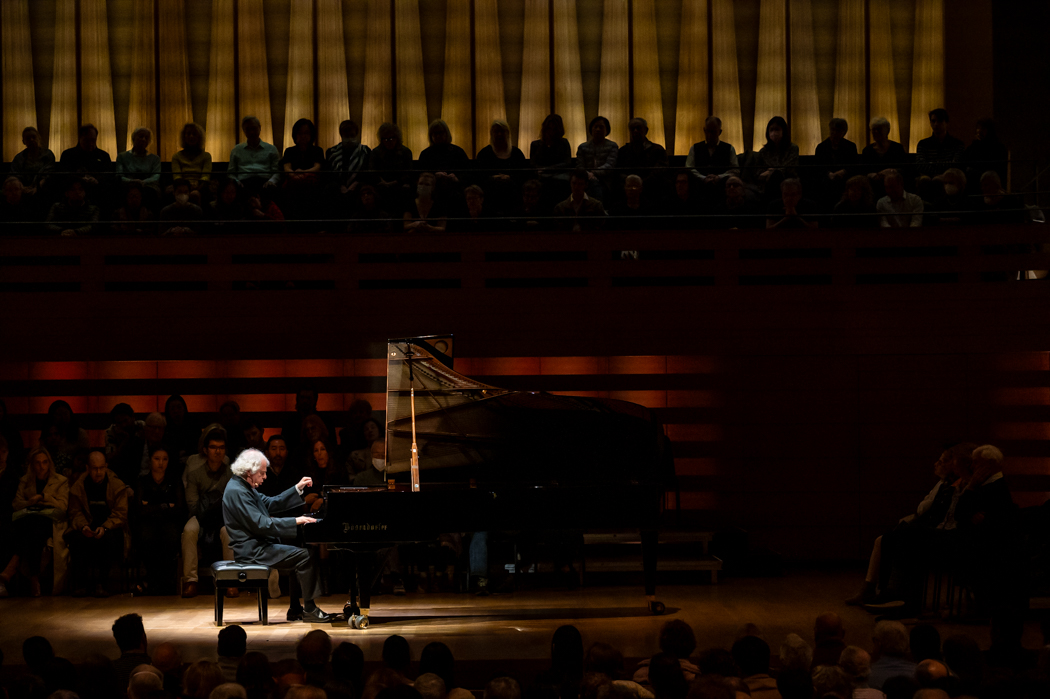
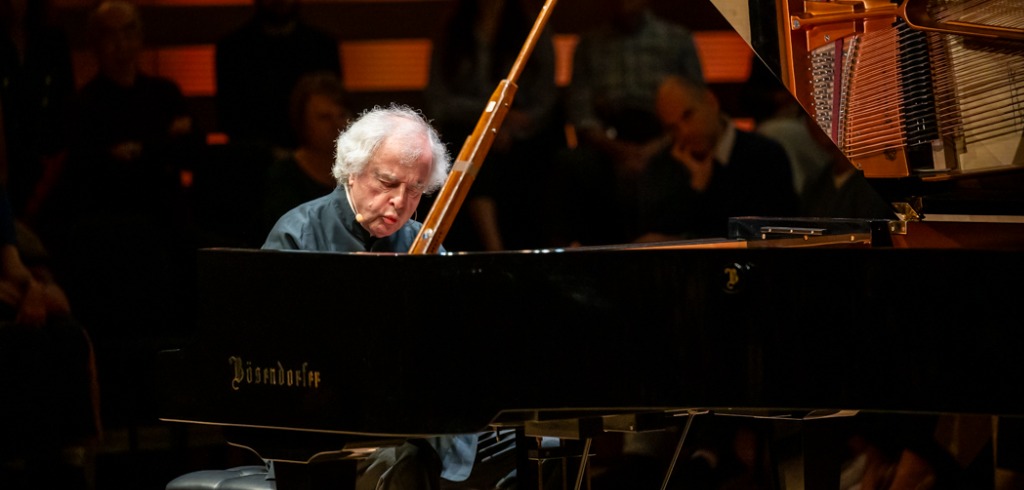
Sir András Schiff at Koerner Hall (2023). Photo: Royal Conservatory/Koerner Hall; Lisa Sakulensky
On Nov. 2 at Toronto’s Koerner Hall, he tuned us, and himself, in with the Aria from the Goldberg Variations—a rendition perfect in its aristocratic poise, yet at the same time mildly experimental with Bach’s ornaments. In fact ornamentation is one of the special joys of Schiff’s playing, as it proved all the way from the Aria to the Chopin A minor Waltz that provided his sole encore. Pedaled or (in Bach) unpedaled, his trills are to die for. Pianists, listen and weep.
Such mastery in turn makes it fascinating to observe him in repeated sections, which were a feature of every piece in the program. Where others offer carbon copies or tokenistic, over-calculated variants, Schiff makes each repeat part of a journey, finding something new to rest his gaze on each time. He can vary his ornamentation as though making it up on the spot, or if not actually vary it then vary the delivery, always with subtlety and the most refined taste.
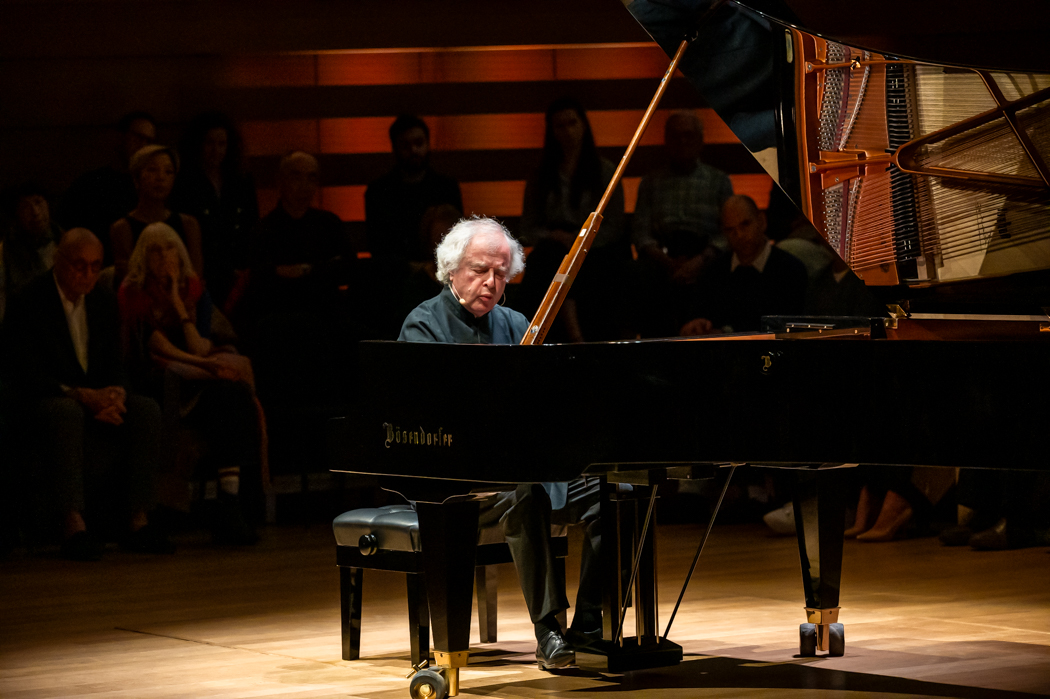
Sir András Schiff at Koerner Hall (2023). Photo: Royal Conservatory/Koerner Hall; Lisa Sakulensky
Bach’s Capriccio on the Departure of a Beloved Brother—reprised from his previous visit to Koerner Hall two years ago—was deliciously light and with the merest raise-of-the-eyebrow wit. Ditto his spoken introduction, which laid out the story of one of Bach’s very few programmatic works with a nice turn in drollery, half way to Peter Ustinov.
With the G major French Suite we entered a purer realm, though Schiff still managed to relate its international roster of dances to his ideal of a united Europe, throwing in a dig at Brexit for good measure. Appending Mozart’s hyper-chromatic Little Gigue prepared us both for the immediately following juxtaposition of Bach’s Book 1 B minor Prelude and Fugue and Mozart’s Adagio and for the classical content of the second half.
And there was still the Italian Concerto to come before the interval: another performance of consummate style and flow. Something about Schiff’s forward-moving tempos conveys not lack of control but a continuity beyond continuity: not routine rhythmic exactitude, and not just expressive variety bending the tempo, but an irresistible flow that can accommodate micro-inflexions without ever losing a sense of directed motion.
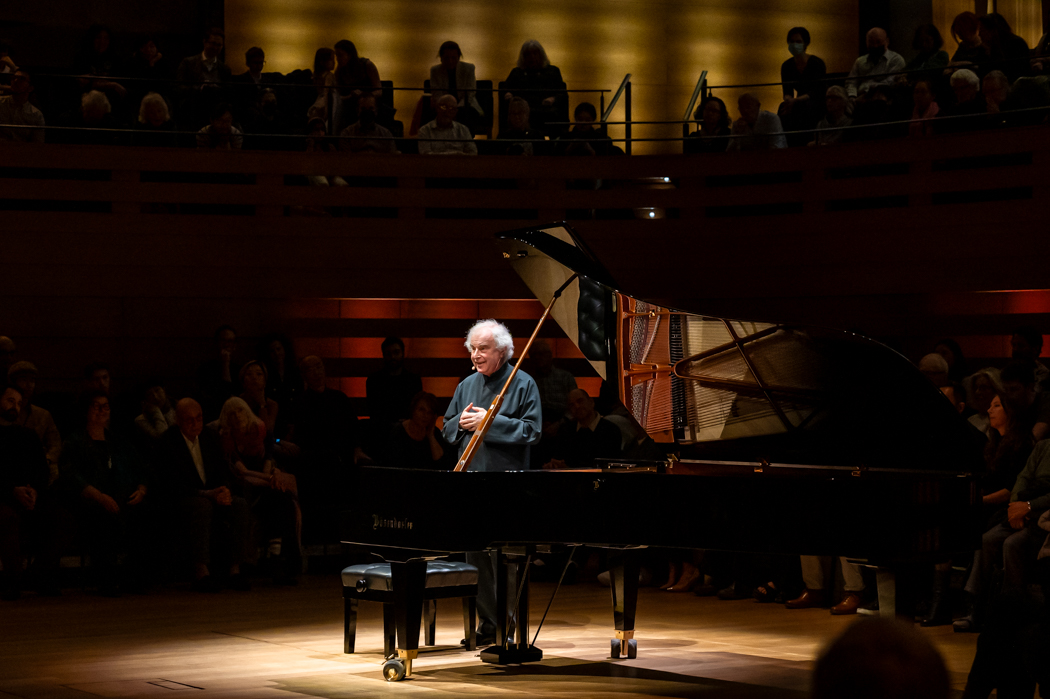
Sir András Schiff at Koerner Hall (2023). Photo: Royal Conservatory/Koerner Hall; Lisa Sakulensky
Halfway there. And no concessions in the second half. Switching from a Steinway to a Bösendorfer, Haydn’s F minor Variations were coaxed and caressed with the utmost discretion. Beethoven’s Op. 126 Bagatelles communed intensely with the master’s late style (though to nitpick, the very explicit pedaling instruction at the end of the Andante E flat was not fully observed, and quite a few of the Presto B-minor’s phrase-endings were swallowed up). Schubert’s Drei Klavierstücke showed that on top of consummate musical insight, Schiff’s technique remains in tip-top shape as he enters his eighth decade.
Finally, his Chopin encore proved—in case anyone was in any doubt—that his sly comment about music going downhill after Schubert—was indeed tongue-in-cheek. Nearly three hours after taking our seats, there could be no complaints over quantity or quality.
For more on Koerner Hall’s season, visit www.rcmusic.com/performance