The 15th triennial Banff International String Quartet Competition (BISQC) began on Aug. 25 at the Banff Centre for Arts and Creativity in the Canadian Rockies, west of Calgary. Nine string quartets (a tenth, Montreal-based group withdrew after being invited) are competing for cash prizes as well as a three-year career development program valued at a half a million dollars.
Each quartet plays four rounds of various repertoire, some prescribed and some they curate, for a jury of seven distinguished string players, including Toronto Symphony concertmaster and founding member of the New Orford String Quartet, Jonathan Crow. Three quartets will be selected on Saturday to perform their own programs on Sunday afternoon in the final round.
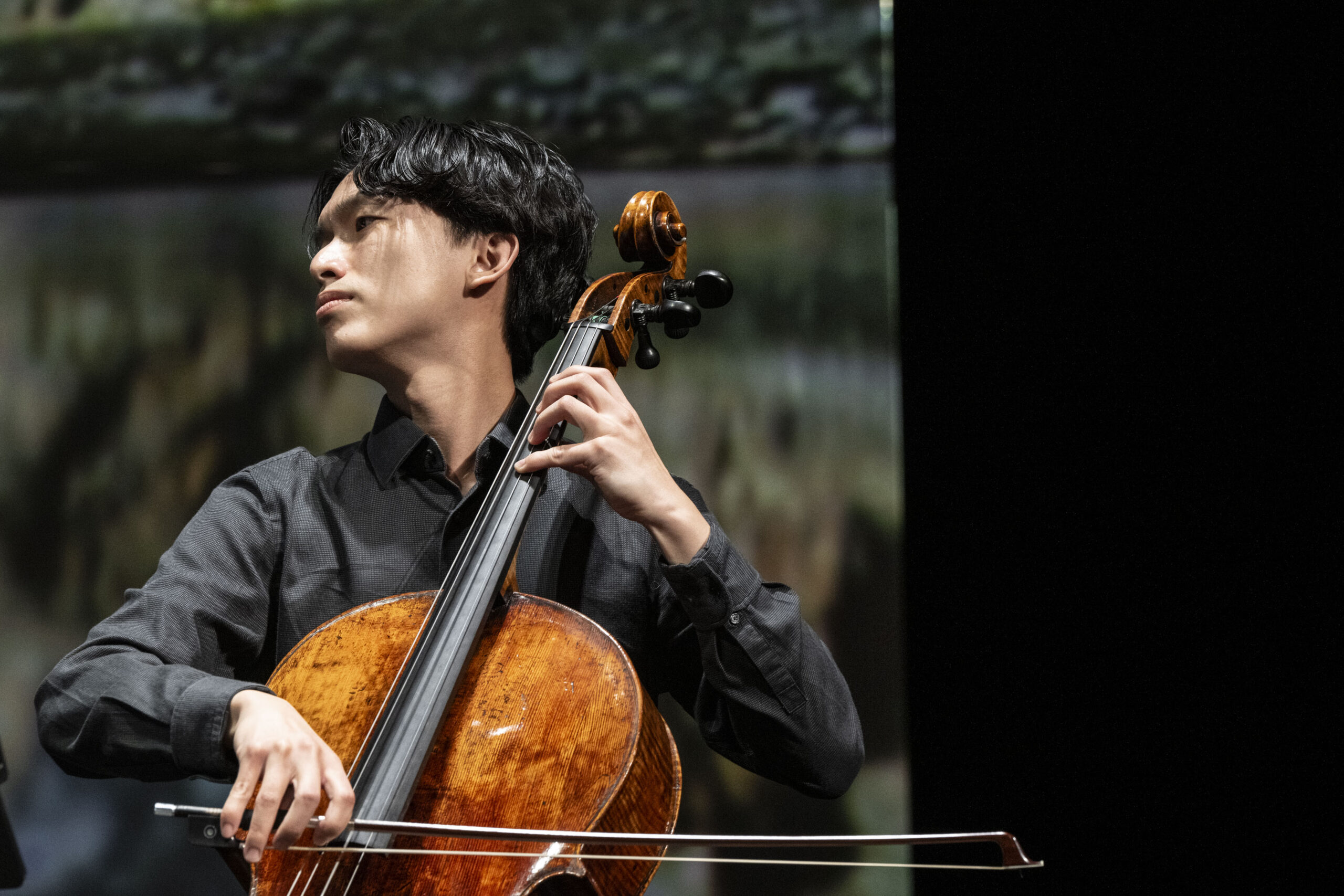
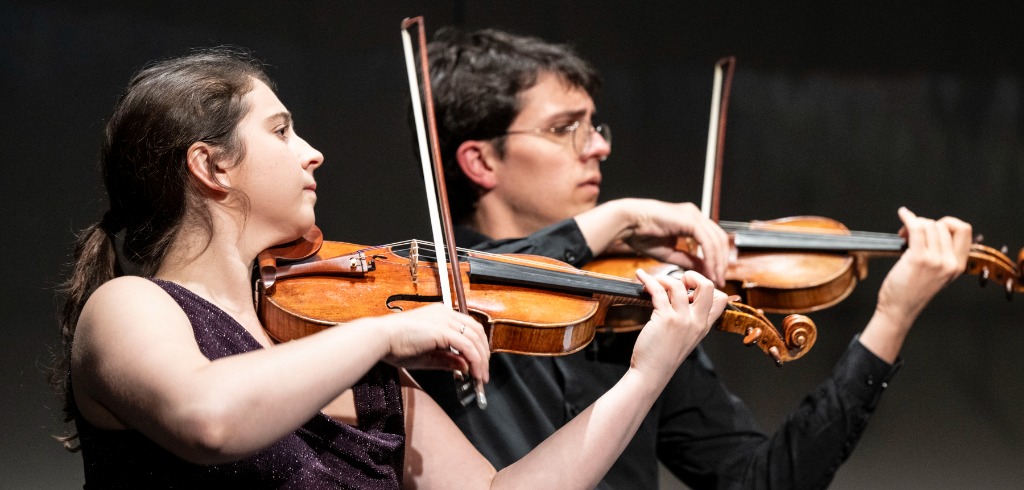
Tzu-Shao Chao of Quartett HANA at the Banff International String Quartet Competition (2025). Photo: Rita Taylor/Courtesy of Banff Centre for Arts and Creativity
The performances take place at the recently renovated Jenny Belzberg Theatre in front of several hundred listeners, mostly seniors, most of whom come for the whole week of the competition. Demand for the roughly 300 resident passes and concert-only tickets sold out late last year in six hours. Many of the patrons are perennial attendees.
Playing Haydn has always been a mandatory test for the competitors, and the first round asks the quartets to choose from one of 44 Haydn quartets. He wrote sixty-eight. Some of the choices showcased Haydn’s most intricate interplay; others chose quartets that showed the composer in a more spacious and melodic vein.
BISCQ gives a $4,000 prize to the Haydn performance the jury deems the best. I found Paris-based Quatuor Elmire’s Op 76, No. 5 the most beautifully played Haydn, a sweetly controlled performance. The coherence of Salzburg-based Quartet KAIRI’s dynamics in Op 71, No. 1 made them the most satisfying. The degree of palpably clear communication among the players was exceptional.
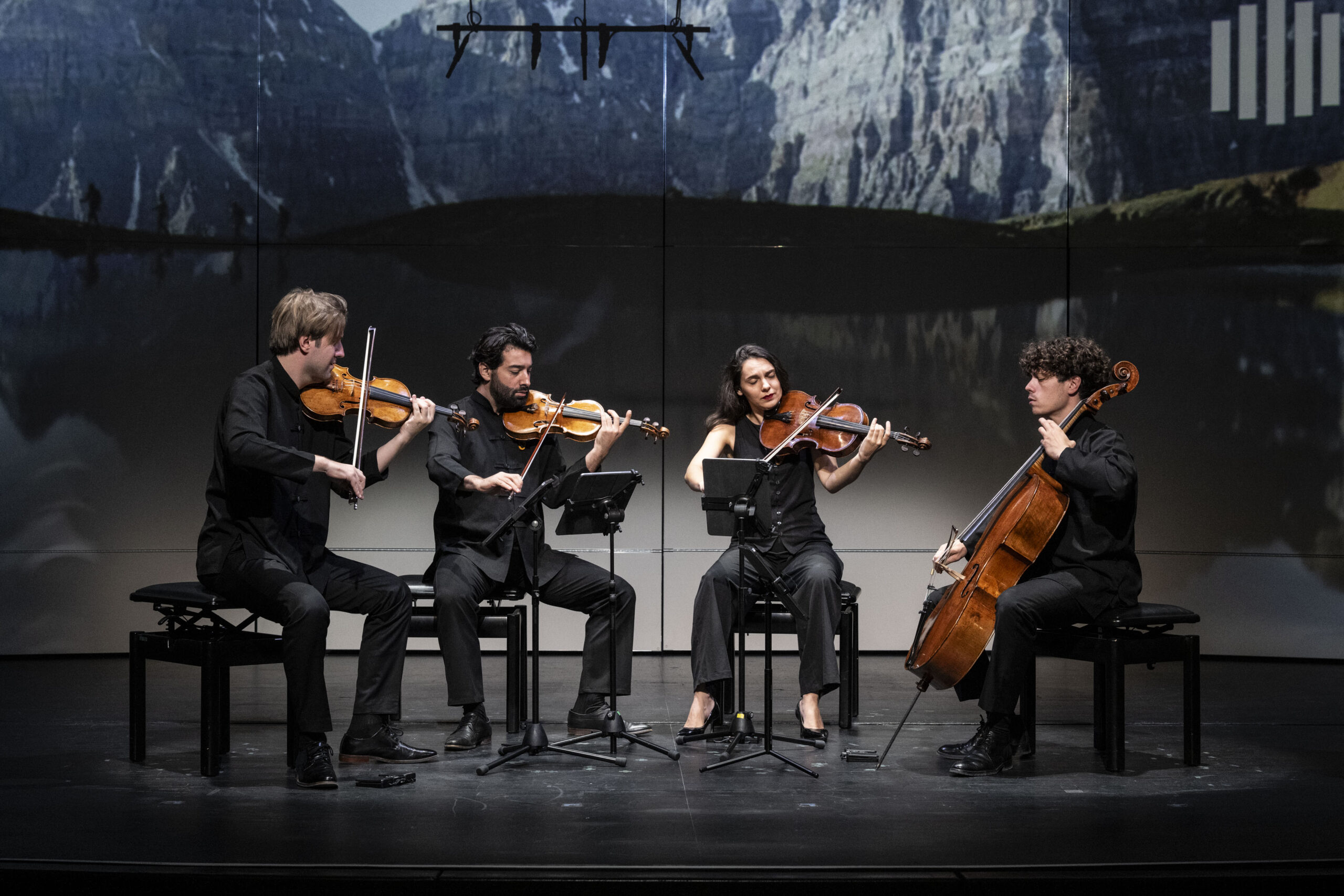
Quatuor Elmire at the Banff International String Quartet Competition (2025). Photo: Rita Taylor/Courtesy of Banff Centre for Arts and Creativity
The first round pairs the Haydn with a piece written in the 21st century. The groups had free rein in choosing their selection. Three of them chose the same piece, Pascal Dusapin’s String Quartet No. 5. Two played the cartoonishly theatrical String Quartet No. 3 by Jörg Widmann. The juxtaposing of the decorous Haydn and typically erratic, often hostile-sounding contemporary works made for an interesting array of recital experiences.
One of the new works, Lawrence Dillon’s Quartet No. 7, Consensus, had an atypical diatonic quality, against the grain of most of the chosen new works. Caroline Shaw’s Entr’acte navigates between some of contemporary music’s more dissonant and technically quirky elements and tuneful music. Bremen-based Nerida Quartet played the Shaw.
BISQC director Barry Shiffman, himself a BISQC winner with the St. Lawrence Quartet in 1992—one of three Canadian quartets who’ve placed first over the competition’s 43-year history—has tried to characterize what jurors often look for in a winner. All the competitors are technically impressive, and each aims for an effect that will impress more than just the jury. They must convey a presence that an audience would pay money to experience, beyond the artificial context of a competition.
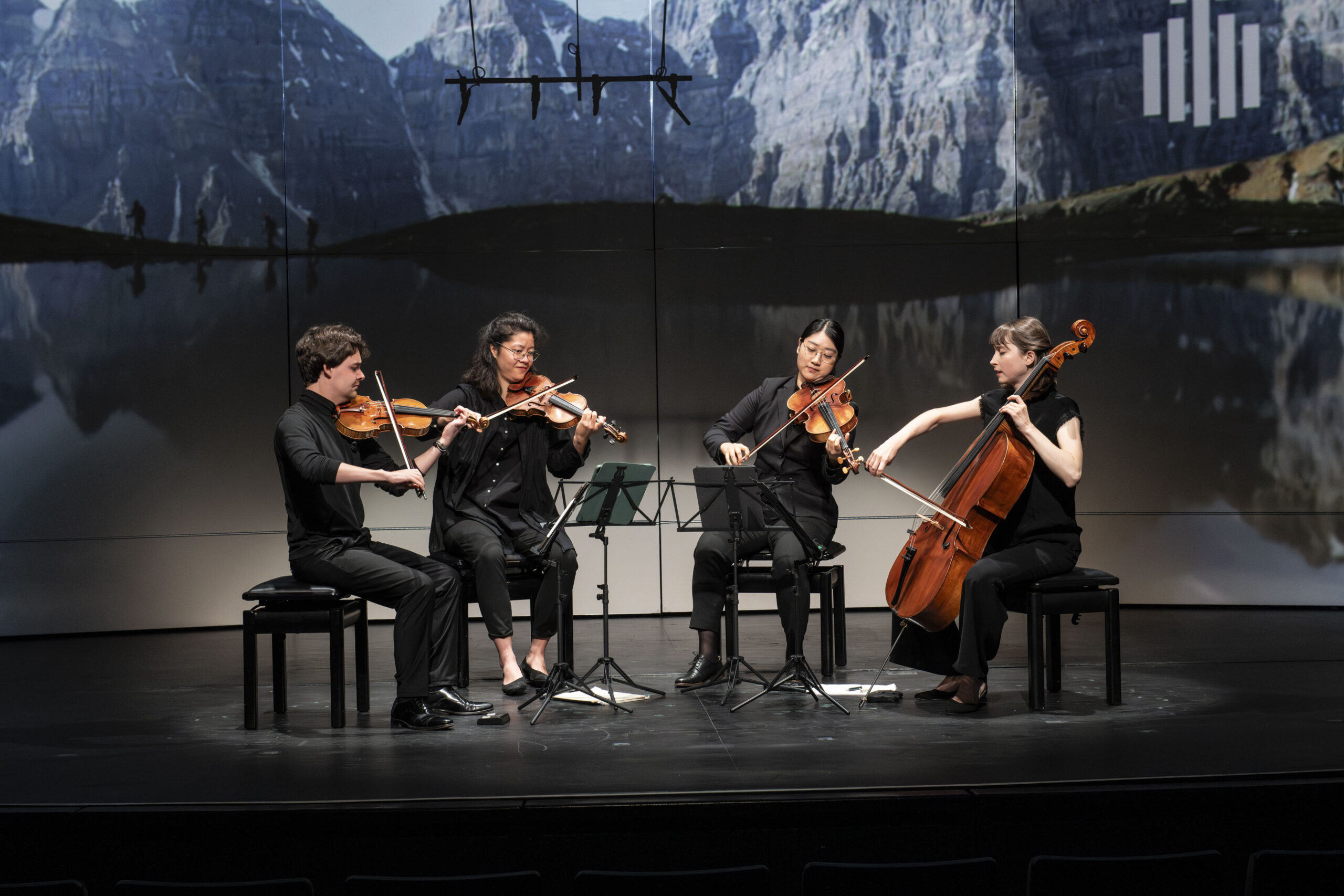
Nerida Quartet at the Banff International String Quartet Competition (2025). Photo: Rita Taylor/Courtesy of Banff Centre for Arts and Creativity
In other words, are they ready for prime time, for a viable professional career after they win BISQC? Many of BISQC’s winners have had sticking power, such as SLSQ, and more recently, the Dover Quartet, which won every prize in 2013. Others, such as Cecilia Quartet, the 2010 winners, disbanded in 2018, and the Afiara, runners-up that year, curtailed a full-time performance schedule in 2016, citing their pursuit of other individual opportunities. There is no question though, winning BISQC will heighten the laureate’s prospects.
The Haydn/21st-century round ended Tuesday night (Aug. 26). The Romantic round begins the afternoon of Aug. 27. The competition prescribed the following mandate for that round:
“Quartets will perform a complete quartet from the romantic or nationalist repertoire of the 19th century, or the Debussy Quartet, Op. 10, or the Ravel Quartet, or the Elgar Quartet, Op. 83, or Sibelius Quartet “Vocesintimae.”
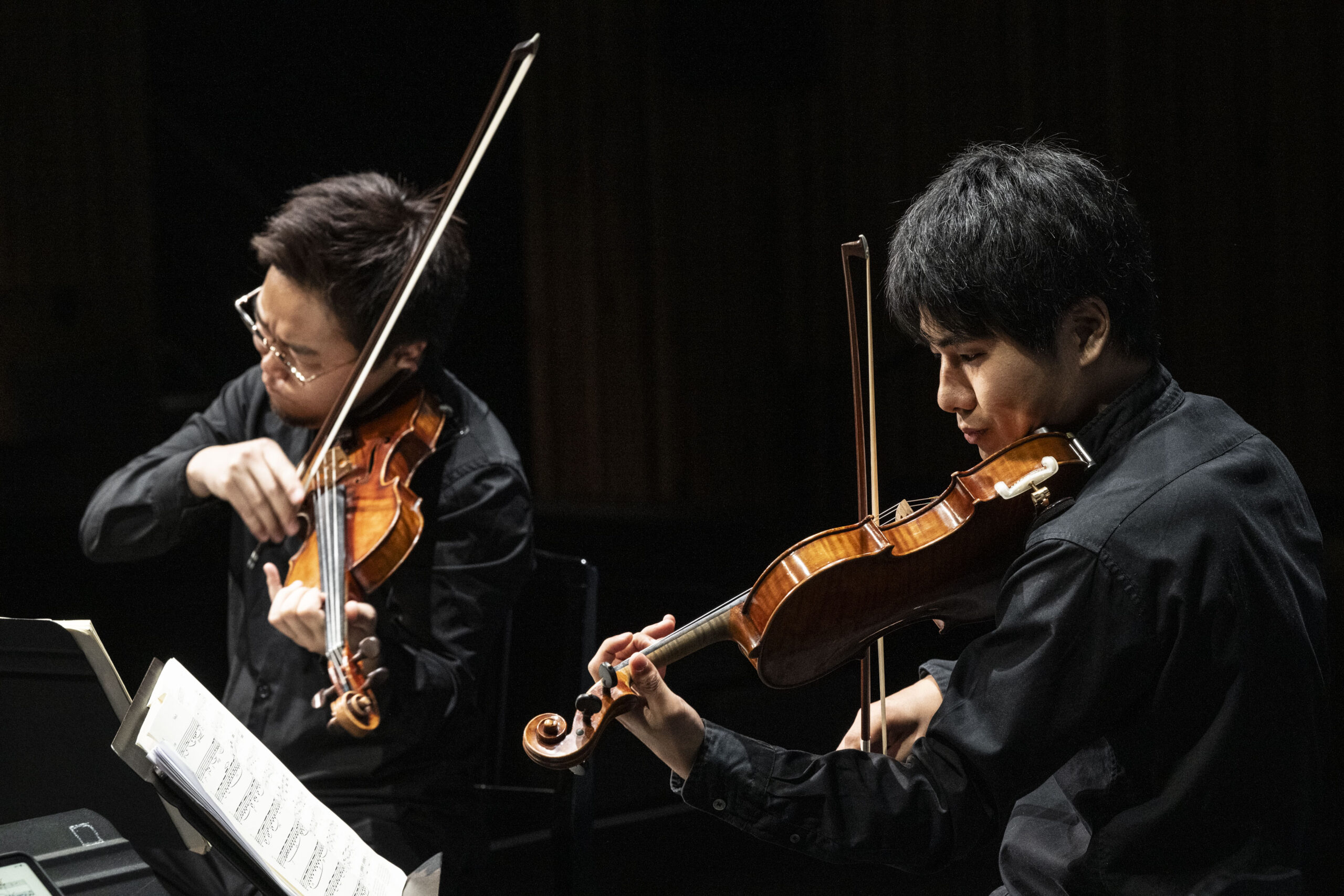
Taiga Sasaki & Yu Mita of Quartet KAIRI at the Banff International String Quartet Competition (2025). Photo: Rita Taylor/Courtesy of Banff Centre for Arts and Creativity
On Friday (Aug. 29), each quartet will play a world premiere of Kati Agócs’s nine-minute Rapprochement. Beethoven and Schubert have been reserved for their own round to conclude the preliminary portion on Saturday (Aug. 30).
Each section of each round is designated a percentage weighting, and a mathematical system has been designed to minimize divisive debates in the jury room. In 2019, the competition had a tie between the American Viano Quartet and the British-based Marmen Quartet. One of the jurors that year had to recuse themselves, bringing the jury to an even six, and each group had its advocates. Shiffman said that will never happen again. Although he isn’t on the jury, he will use his privilege as the director to break a tie.
The competition is being livestreamed on the BISQC Facebook page and The Violin Channel.
For more on the Banff International String Quartet Competition visit www.banffcentre.ca/bisqc