
This page is also available in / Cette page est également disponible en:
 Français (French)
-
La Dolce Volta4.5
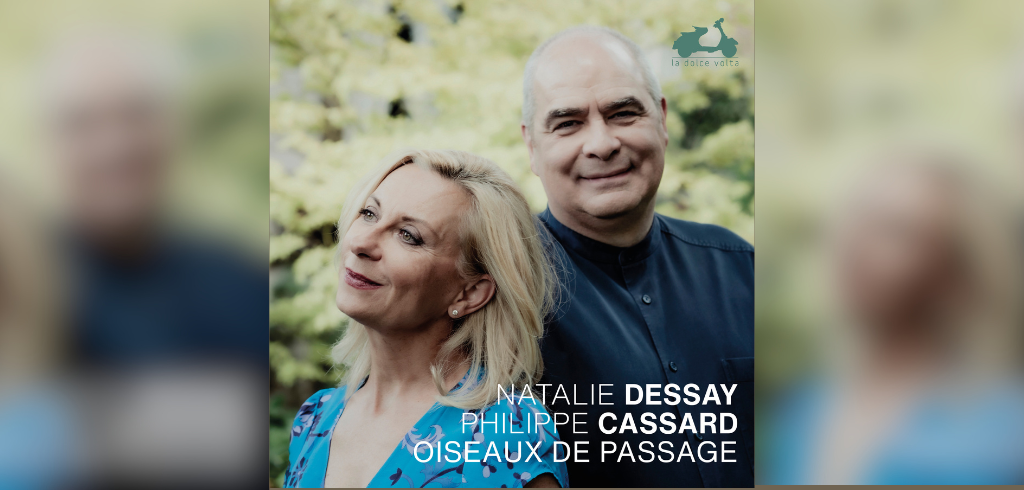
Oiseaux de passage
Natalie Dessay, soprano; Philippe Cassard, piano; André Previn, Stephen Sondheim, Gian Carlo Menotti, Samuel Barber, Ernest Chausson, Reynaldo Hahn, Maurice Ravel, Louis Beydts, Francis Poulenc, composers
La Dolce Volta, 2025
Twenty years ago this year, Natalie Dessay gave a major recital with orchestra in Montreal, invited by Opéra de Montréal as part of its annual benefit concert. The singer, who had just resumed her activities after two episodes of vocal problems, was eagerly awaited. We knew her thanks to many iconic recordings, but also from DVDs, notably in a scathing version of Offenbach’s Orphée aux enfers (Orpheus in the Underworld), Laurent Pelly’s first opera production, in which Dessay interpreted a Eurydice full of bite, with amazing high notes!
That May 2005 performance in Montreal will live long in the memory of the city’s music lovers, who, thanks to the advent of YouTube, have also been able to admire all her past and present roles like the Queen of the Night, Olympia in Les contes d’Hoffmann, Lakmé, an unforgettable Marie in La fille du régiment, right through to her affecting Violetta in La traviata. In 2013, the soprano announced her desire to retire from the world of opera to explore new musical landscapes … and so here we are in 2025, as the artist celebrates her 60th birthday, once again surprised and captivated by a recital that blends inventiveness and nostalgia.
In a program full of the unexpected and the “unheard,” Dessay gives voice to an easy high register and a timbre that is instantly recognizable, still full of freshness despite a few cracks here and there, and sometimes more fragile breaths (especially for those who remember the inexhaustible supply of breath in her heyday).
This short program begins with extracts from lesser-known operas, in which she still reigns as a great storyteller, giving each word and syllable its proper weight and maximum meaning. Then comes a suite of songs devoted to winged creatures, including Chausson’s “Le colibri” (“The Hummingbird”) and Hahn’s “Le rossignol des lilas” (“The lilac nightingale”), pieces often chosen by singing students, which Dessay performs with eternal youthfulness.
She follows this with Ravel’s “Les oiseaux du paradis” (“Birds of paradise”), delivered with a simplicity akin to folk song. Dessay concludes with “La dame de Monte-Carlo” (“The Lady of Monte Carlo”), a seven-minute song that is a kind of opera in miniature, in which the soprano shows off all her current dramatic and vocal qualities.
The title of the recital no doubt refers to the coloratura soprano voice so often compared to that of a bird, but perhaps also to us music lovers, who see all these years of music flash before our eyes, reminding us that we are all just passing through.
Translation: Gianmarco Segato
This page is also available in / Cette page est également disponible en:
Français (French)