A search for the complete artist starts with a complete program. To demonstrate “completeness,” a 60-minute program should carefully balance the emotional, intellectual, analytical, and colouristic dimensions of music. Like sediments under the surface of the earth, the chosen repertoire must allow each performer to reach far below the topmost strata into the depths of the human psyche.
Yet, the freedom given to participants in the Honens International Piano Competition to choose their own repertoire is comparable to a Trojan horse. Gifted with the opportunity to present your best self, your repertoire may reveal you as unidimensional compared to a better-rounded competitor. Aim for too much variety and you risk losing your distinct angle. That is the gamble.
Programming is an art and the first step towards achieving “completeness” lies well within each competitor: their ability to understand and express music in all its rich and varied dimensions. Not everyone may achieve this; the Honens claims to reward the artist that does.
Semifinal I: Derek Wang and Carter Johnson
The first semifinal recital kicked off on Oct. 16 with two North American pianists: Derek Wang (USA) and Carter Johnson (Canada/USA). Wang opened with a little-known Toccata by Roberto Sierra (2008). He demonstrated a comfortable stage presence, a sensitive touch, and the ability to produce a rich sound while respecting the instrument’s capacities. In Liszt’s transcriptions of Schubert’s Schwanengesang, Wang’s lovely rhythmic lilt and musicality charmed without succumbing to exaggerated gestures or expression.

Derek Wang
Yet, one sensed a pattern: Wang doesn’t take risks, he plays by the rulebook. His agreeableness didn’t do justice to Beethoven’s Hammerklavier Sonata op.106: instead of exploding into one of the summits of piano literature, Wang chiselled each phrase carefully and sweetly, without the necessary drive and power. As an illustration, the triple meter section in the Adagio sostenuto sounded like a melancholy waltz instead of a cry of pain. To play such passages well, one must attempt to break their mould and struggle. Only then can you reach their otherworldliness. This sonata should drive the performer to the edge of sanity. It’s an uncomfortable place to be on stage, but it’s the only viable option. It doesn’t take a good boy to play the Hammerklavier.

Carter Johnson
Canada’s Carter Johnson followed next and his experience and maturity were felt immediately. Opening with Schumann’s Davidbündlertänze Op. 6, Johnson played with clear, resonant, and articulated sound that worked well in the hall’s acoustic. From the very first notes, he plunges into the music. In Johnson’s hands, the various moods of “David’s league”—Eusebio and Florestan among them—are interesting and fun to listen to. He is passionate and plays from his gut, yet is stable and lyrical at the same time. Scriabin’s op.74 sounded as if he had composed it himself, drawing the audience into the secret inner world of the Russian genius.
Equally at home in Hanna Kulenty’s Atlantis Solo, composed in 2022, Johnson showed an ear for contemporary expression and impressionistic sonority. Finally, Bartók’s Sonata Sz.80 was riveting, virtuosic, dark, and dramatic. Johnson gets it all: he is a deep and commanding young master.
Semifinal II: Yuanfan Yang and Ádám Balogh
The evening recital on the same day brought two European contestants: the UK’s Yuanfan Yang and Hungary’s Ádám Balogh. Yang opened with Mozart’s Sonata K.330 in C major. His tone was beautiful, his touch lovely and articulated, producing a Mozart of springtime. The music flowed seamlessly, although Yang’s pedalling drowned some passages that ought to be drier and bolder.

Yuanfan Yang
Yang proceeded with Rachmaninov’s Corelli Variations, demonstrating excellent finger work and not much more. His precision and dexterity were not substantiated with wide, generous phrasing that we attribute to the “Slavic soul”: a mixture of whole-heartedness, tenderness, and unharnessed rebellion. The Adagio misterioso should make your guts bleed; instead, Yang stops short at the point where Rachmaninov’s expressivity should begin.
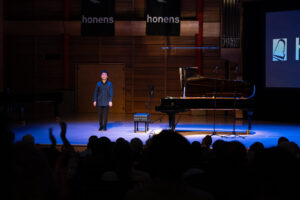 In his own composition, Waves from Three Aquarelles (2011), Yang finally showed his true self. His sound resonated through the hall with a wide dynamic range and nuances. While no masterpiece, the work at least showed his originality. Stylistically, Debussy’s Reflets dans l’eau from Images, Book I, worked for him as well. Yang has the sensibility and the palette of an impressionist pianist. He concluded with Chopin’s Variations on Là ci darem la mano, an awkward work at best. Despite brilliant playing, Yang approaches the piano with the air of a man about to do a good job. He does, then leaves. Nothing to write home about.
After intermission, Hungary’s Ádám Balogh stepped on stage wearing a dark indigo jacket and bowtie almost straight out of The Grand Budapest Hotel (an unfortunate fashion reference). Opening with Schumann’s Fantasiestücke op.12, Balogh proved to be a refined and sincere musician. His spontaneity let us feel he was almost improvising—the sign of a true musician.

Ádám Balogh
While poetic and elegant, the recital stagnated after half an hour: Balogh’s beautiful playing started relying on the same tricks. Medtner’s Forgotten Melodies op.38 proved problematic: harmonically colourful yet overdrawn; melodically ornamented to the point of redundancy and irrelevance. Balogh did not infuse this music with sufficient power, charisma, or passion. A weaker ending than one would have hoped given his obvious musical qualities.
Semifinal III: Élisabeth Pion and Elia Cecino

Élisabeth Pion
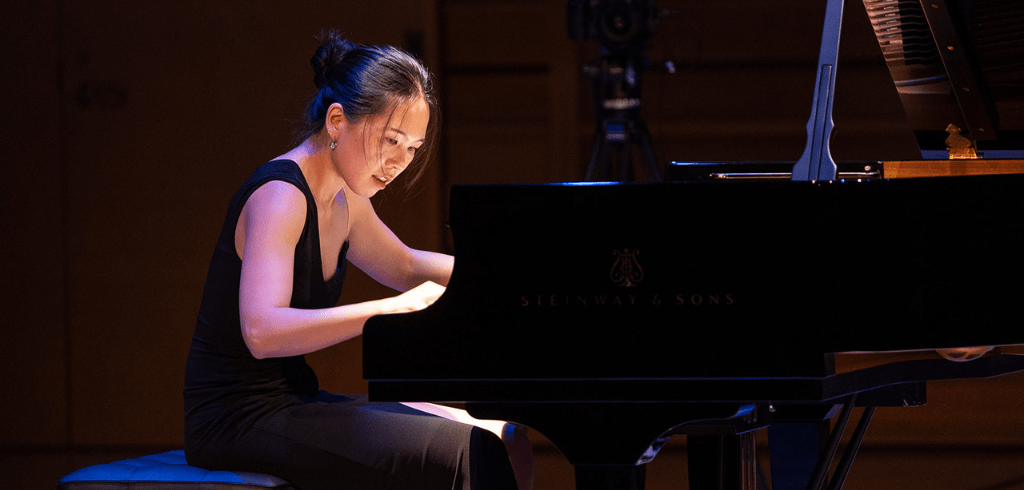
On Oct. 17, the semifinals began with Quebec’s Élisabeth Pion. The audience got a hint of what was about to come from the introductory video: “A complete artist is very serious in [her]aloneness and in protecting the time needed for introspection,” she says. Pion walked on stage with sizzling red heels. A marked entrance. Opening with Grażyna Bacewicz’s Sonata No. 2 in E minor Op.25, Pion plunged into the work with deeply felt, emotional, powerful yet contained playing, commanding attention by her complete understanding of the music.
Her composition, Sept mers éparses (“Seven Scattered Seas”)—inspired by verses of Baudelaire’s Les fleurs du mal which she recited to the public—continued an unfortunate trend at the Honens. Good initial ideas, followed by a loose structure and lack of an original voice. Various passages seemed borrowed from other composers—in her case, Ravel. A true talent, but not a disciplined composer.

Élisabeth Pion
Pion was more than a match for her last selection, Chopin’s Etudes op.25. She rendered every nuance, coloured each harmony, and lifted every phrase towards the next without showing any signs of technical limitations. An impressive feat. The etudes flowed one after the next like the pages of an album. Pion is an intuitive virtuoso: her mind seems to synthesize more than it analyzes. Yet, as natural and authentic as Pion’s playing was, her program did not step outside romantic and post-romantic boundaries—the Trojan horse that might haunt her at later stages.
Next was Italy’s Elia Cecino: the master of puffy shirts. For those who have not followed my Cliburn Competition reviews, read them, you’ll get the reference. This time around, the shirt worked—as did his playing. Opening his program with J.S. Bach’s Toccata in G minor BWV 915, Cecino demonstrated great command of style: subtle pedalling, a light and sharp touch that produced sound with a harpsichord’s bite, yet pianistic and round. Cecino’s stage presence is distinctive: he is a creative, honest, and attentive musician.
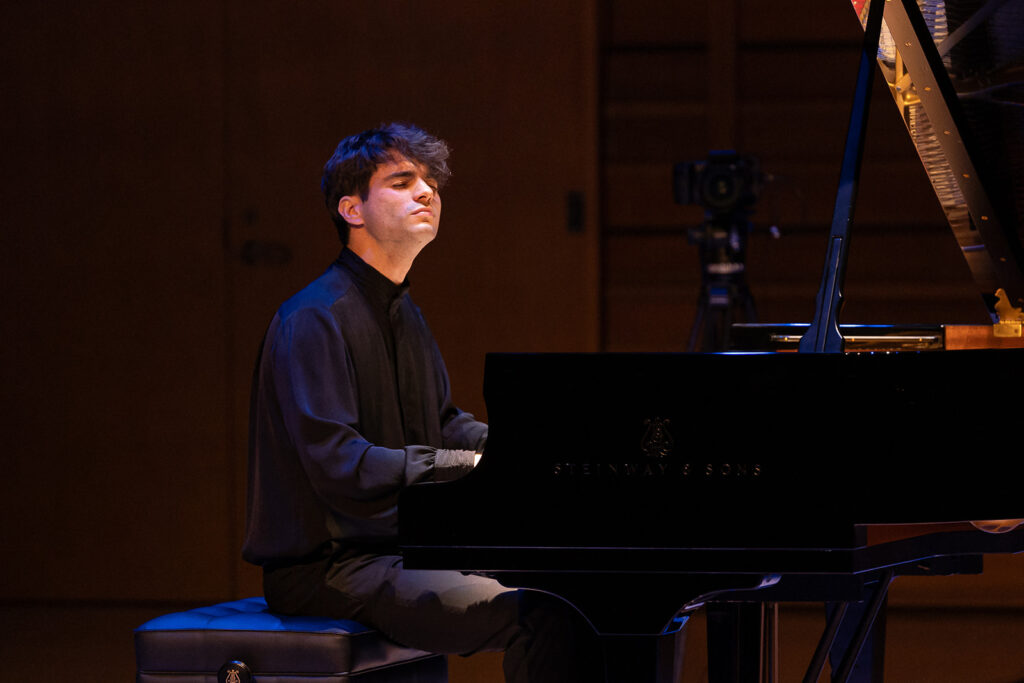
Elia Cecino
Cecino’s Haydn Sonata in E minor Hob. XVI:34 was a rare treat. Stylistically unrestrained, unlike most pianists attempting to play classical repertoire, Cecino’s playing was brilliant, exuberant, lively, delightful, and natural. He combines the lilt of a jazz pianist with the sophistication of a classical period master. He proceeded with an original take on Ravel’s Alborado del Gracioso from Mirroirs: quiet, surprising, elegant, with the taste of someone who doesn’t rush to show off their technique. His ear for suspense worked even in the glissandi, where he displayed as much exciting timing as an experienced jazzman. La vallée des cloches was pure musical creation.
Cecino completed his program with Scriabin’s Sonata No. 3 in F-sharp minor Op. 23. While the work is a tad redundant, Cecino’s performance was effective and inspired. The closing piece, Casella’s Toccata op.6, was borderline ridiculous (possibly on purpose), yet Cecino delivered a good show ender. Overall, he played the most diverse repertoire, demonstrating mastery over the widest musical range of all the contestants.
Semifinal IV: Chaeyoung Park and Anastasia Vorotnaya
The Oct. 17 evening recital featured two female contestants: South Korea’s Chaeyoung Park and Russia’s Anastasia Vorotnaya. Park asserted her commanding stage presence in Unsuk Chin’s Etude No. 1 “in C” (1999 rev. 2003). For the first time at this Honens, we heard the power of silence. Park’s razor-sharp focus and dedication to being “in the moment” utilized both sound and rests as building blocks of musical tension.
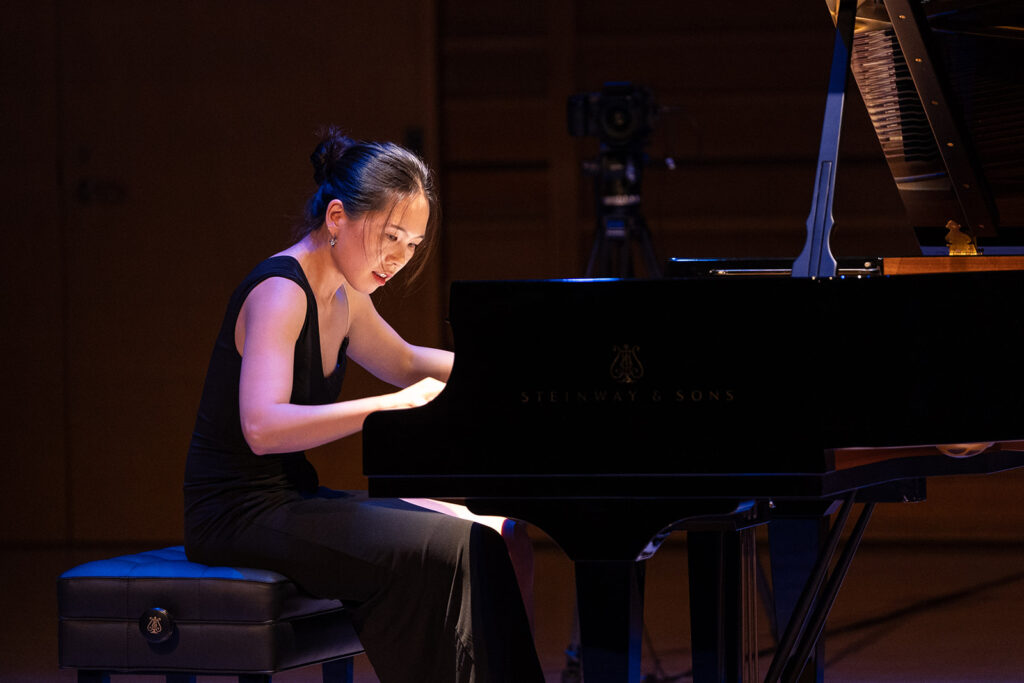
Chaeyoung Park
Park approached Messiaen’s Le Baiser de l’Enfant-Jésus from Vingt Regards sur L’Enfant-Jésus with the devotion of a Madonna with the Child. She produced drama even in the quietest moments: her touch light as a feather and her attention intense. Despite some weaknesses in the compositional development of the work, Park’s dedication was exceptional.
Then, came the most powerful performance of the entire recital round of these semifinals: Park’s rendition of Beethoven’s Sonata Op. 106 “Hammerklavier.” From the opening chords, Park played with bold energy and power. A true Beethovenian player, Park’s struggle was Olympian: there was a conflict inside her which rendered her performance so compelling. She paused before each movement, like Sisyphus about to start a new ascent to the top. In the Adagio sostenuto, Park produced unbelievable pianissimos and a fascinating exploration of the keyboard’s tonal possibilities. Across countless moments of pure creation, Park brought the audience into the depths of heaven and hell through her sublime musicianship. A tour de force.

Anastasia Vorotnaya
What followed next could only fall short. Anastasia Vorotnaya played the opening transcription of Franck’s Prélude, Fugue et Variation Op. 18 by Harold Bauer beautifully and with singing touch. Her rendition of Ravel’s Jeux d’eaux demonstrated her wise control of climaxes and intelligent tension building. Yet, for all her charms, Vorotnaya plays like a diligent student: everything is neatly packed, nothing strays beyond a well-defined frame.
The rest of the program reiterated Vorotnaya’s virtuosic abilities and lack of artistic scope. From Fanny Mendelssohn’s Notturno in G minor H. 337 to Medtner’s Piano Sonata Op. 25 No. 2 “Night Wind” and Vladimir Ryabov’s Echo of the Mephisto Waltz Op. 42-bis (1990)—we heard one redundant romantic racket after another. Medtner’s sonata morphs into one overdrawn and irritable whole, providing plenty of options for the performer to hide behind obvious romantic sentimentality. Ryabov’s attempt at composition was even worse: empty, shallow, futile. This repertoire exposed Vorotnaya as a virtuoso with little artistic substance. Better play Cage’s 4′33″ and give the audience a rest.
Semifinal V: Giorgio Lazzari and Sandro Nebieridze
The last day of solo recital semifinals kicked off on Oct. 18 with two distinct characters: one bionic man and one jester—Italy’s Giorgio Lazzari and Georgia’s Sandro Nebieridze.
Lazzari showed an unusual combination of serious musicianship and breathless, machinelike execution starting from Schubert’s monumental Sonata No. 19 in C minor D. 958. Hunched over the keyboard, playing with extraordinary precision, Lazzari sculpted each phrase with careful, intelligent intent, absolute confidence, and complete lack of artifice. Yet, his phrasing was so tightly packed that it did not allow for silence, rest, and contemplation—important elements of “negative space” in Schubert’s last three sonatas. The sonata’s final movement was played with unbelievable accuracy and speed—warranting the question, is he even human?

Giorgio Lazzari
Following the Schubert, Ustvolskaya’s Sonata No. 1 was a perfect match: brutal, precise, and pointillistic textures played staccato and forte. It quickly became obvious that Lazzari has the most perfect mind at this competition, but no lungs or heart. Lazzari leaves virtually no space for improvisation; everything is completely predetermined and performed as planned. If someone told me he was an AI model, such is his level of perfection, it wouldn’t surprise me.

Liszt’s Ricordanza from Douze Études d’exécution transcendante S. 139 was played impeccably, probably outmatching Liszt’s own pianism, whatever it may have been. However, the absence of charisma and generosity in his phrasing and emotions was detrimental to forging a deeper connection between the artist and audience. A fact illustrated by the increasing number of programs being scrutinized by my neighbours over the course of the recital. Lazzari ended with more impeccable banging in Shostakovich’s Sonata No. 1 Op. 12. A monster piece for a monster performer, and an unfortunate aural assault for the audience.
After a most welcome intermission, Sandro Nebieridze walked on stage wearing an outfit that could easily pass at a 70s disco club—shining pants, wide open collar, shimmering belt. A John Travolta in black, and a refreshingly human presence after the previous contestant. Nebieridze opened with Beethoven’s Piano Sonata Op. 28 “Pastorale”: this was the work of an artist who listens to his own sound and creates music on the spot. The Andante revealed Nebieridze’s searching and inquisitive mind. His jester side came through in the Scherzo, while surprising breaths and deviations in timing contributed to a rich aural experience.

Sandro Nebieridze
Nebieridze followed his exquisite Beethoven with two repetitive and relatively uninteresting pieces, Chopin’s Polonaise in E-flat minor Op. 26 No. 2 and Polonaise in F-sharp minor Op. 44. In the latter, he delivered a powerful performance in the tradition of Artur Rubinstein, with some wrong notes, appropriately. Despite the beautiful playing, Nebieridze seems to fall back on a sweet and beautiful mould as an anchor, which can be a bit dull. Nevertheless, Scriabin’s Piano Sonata No. 7 Op. 64 “White Mass” proved an excellent selection for him: wild and original talents from both composer and performer. He ended with his own Toccata (2017): a fun, gestural piece that quickly turned into a nonsensical, technical circus. Still, Nebieridze is an interesting and likeable musician. While the program is not too deep, one is curious to hear more from him.
Verdict 1: The Soloists
After a long first solo-recital semifinal round, my verdict is set to four finals candidates, four sure return ticket holders, and two maybes.
As the most complex performer, Chaeyoung Park went the furthest in pursuit of transcendence; Carter Johnson may be the most experienced, intellectual, and stable contestant; Élisabeth Pion is musically very natural and spontaneous, if not too diverse; and Elia Cecino shows rare authenticity and the blossoming of great potential.
Unfortunately, Wang, Yang, Balogh, and Vorotnaya did not convince me, despite their qualities. Finally, both Lazzari and Nebieridze are wildcards: how they will play in the next round may determine their chances.
You can watch the Honens live on YouTube here.