Friday, June 6: The Redeem Team and the Maestro
After a lackluster first concerto performance, USA’s Evren Ozel and Stanislav Angel Wang were on a mission tonight. Not unlike the 2008 Kobe Bryant-led USA basketball team seeking to avenge their 2004 bronze medal. Granted, Ozel and Wang had to come back from way further back than a bronze medal performance. And they came back swinging.

Evren Ozel and the Fort Worth Symphony in the finals of the Seventeenth Van Cliburn International Piano Competition. Photo: Ralph Lauer
Walking with confidence and a large smile, Ozel settled in at the piano before the opening chords of Beethoven’s Concerto n.4 in G major. Within the first phrase, the audience witnessed the rebirth of Beethoven at these finals. With maturity, depth, patience, and his most refined sound, Ozel inspired the Fort Worth Symphony Orchestra to play above expectations. This was clearly his music.
Ozel played to his strengths: exquisite pianissimi, pearly sound, and gorgeous phrasing resulting in moments of pure inspiration. Throughout it all, Ozel threaded a fine line between focused, internalized emotion, and outbursts of passion. A wise Beethoven player, he maintained intensity without giving it away cheaply. A magical opening of the second movement revealed Ozel as an artist capable of lifting everyone to another level.
As a collaborator to Maestra Marin Alsop, Ozel played chamber music that allowed the orchestra to take a lead role at times even more than the solo part. This was the only weakness of his performance: it was a little on the soft side for this hall. His first movement cadenza sounded Mozartian, adopting a fortepiano approach in terms of touch and dynamics. Overall, his Beethoven was contained, poetic, and a touch too lovely and more sweet than one would expect. This may play to his disadvantage at this stage in the competition.
Yet, Ozel stayed true to his convictions and delivered his own interpretation convincingly and movingly. This is a performer you learn to love and appreciate for his infinite refinement and constant listening. Following an exciting and unpredictable cadenza in the third movement, Ozel received a well-deserved standing ovation. My respects to an exquisite musician.
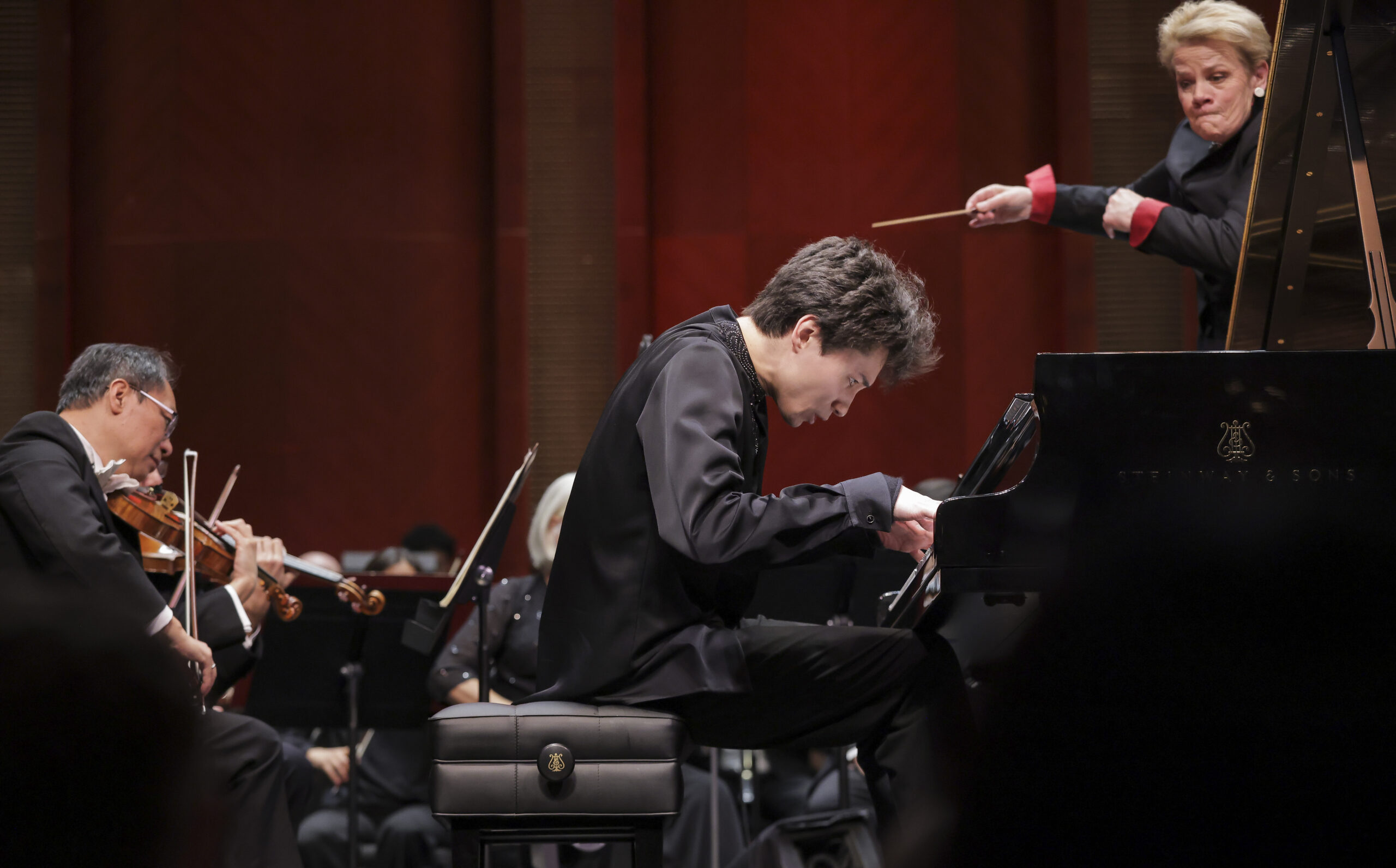
Angel Stanislav Wong with Conductor Marin Alsop and the Fort Worth Symphony in the finals of the Seventeenth Van Cliburn International Piano Competition. Photo: Ralph Lauer
Wearing a long black shirt, bordering on a robe, with a shiny collar and shoes, Angel Stanislav Wang made a fashion statement. Picture an Orthodox priest with a touch of Michael Jackson. Curious statement, to say the least, which made more sense once he started to play.
From the very opening phrase of Rachmaninov’s Third Concerto, a competition staple and one of the hardest in the repertoire, Wang was clearly at home. This was his sound, his power, his charisma. At only 22, this young tiger has all the chops to deliver this beast. Reveling in the excitement, the adrenaline, the recklessness, Wang showed his star power tonight.
Yet, much like the glitter adorning his monastic robe, his playing left a confused impression. Starting with an unnecessarily conspicuous rubato in the opening theme, one got the feeling that Wang played to impress. His explicit show of emotions became distracting, ineffective, and led to ensemble issues with the orchestra. As brave and ferocious as Wang’s inner tiger might be, his youth prevailed and led him into the classic Rachmaninov trap: adding sugar to the strawberry pudding. Wang’s interpretation leaned to the schmaltzy side, disrupting a masterpiece with a facile display of showmanship. This was Wang’s Third, rather than Rach’s Third.
Despite these faults, Wang delivered some truly exciting moments. The first movement’s short cadenza was interesting and surprising. In the second movement, he showed his character, personality, and charisma. Stunning with a brilliant transition into the third movement, Wang erupted and delivered a home run of an emotional performance. Showy but effective. The local audience ate this up.
Wang should have everything to play this concerto. Yet, he is sometimes best listened to with eyes shut. At times, he is brilliant, playful, exciting, and courageous; at others, his exaggerations leave a mixed impression. He plays in the tradition of Van Cliburn. Minus the class.
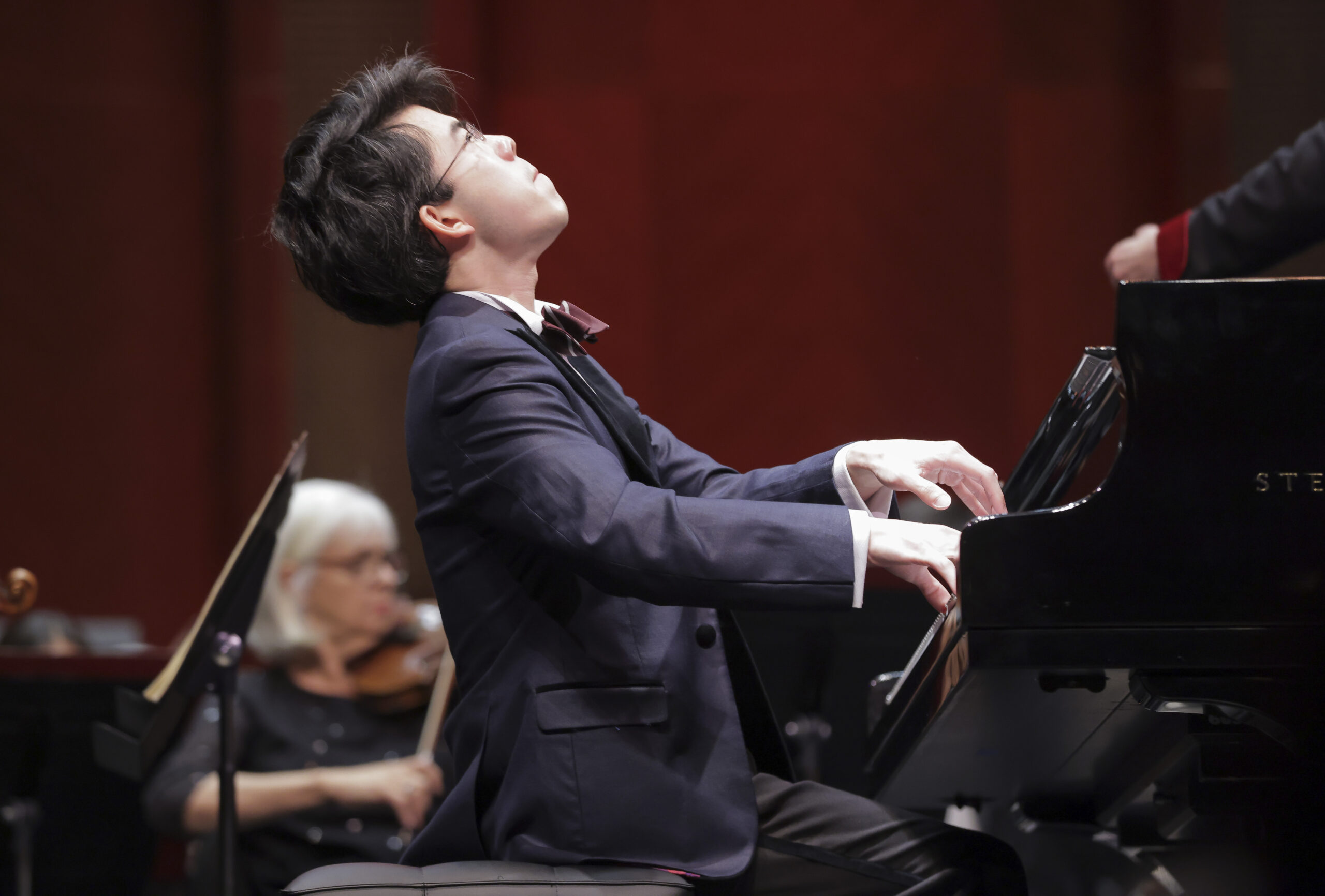
Aristo Sham and the Fort Worth Symphony in the finals of the Seventeenth Van Cliburn International Piano Competition. Photo: Ralph Lauer
Then came Brahms’ Second Piano Concerto in B-flat major played by Hong Kong China’s Aristo Sham. His performance combined everything we’ve heard previously and more: refinement and power; intensity and lyricism; grandeur and lightness. David Duval once called Johannes Brahms the “pound for pound best composer,” a phrase usually attributed to Sugar Ray Robinson, the great boxing champion. The same can be said of Aristo Sham at this competition: by and large, the most reliable and consistent performer since the semi-finals.
Every instance of Sham’s performance was thorough, strong, and brilliant. He had power and total focus. He handled the most knuckle-breaking passages with complete assurance and gave the most mature and musically satisfying performance. He showed his endurance and passion in the second movement, a gorgeous lyric handling of the third, impeccable taste, and lightness in the last. Sham also had the best chemistry with Alsop and the FWSO. And he wears stylish outfits and colorful socks—what’s not to like?
NEW as of 6 PM Texas time
Saturday, June 7: And Then There Was Lynov

Vitaly Starikov with Conductor Marin Alsop and the Fort Worth Symphony in the finals of the Seventeenth Van Cliburn International Piano Competition. Photo: Ralph Lauer
Opening this final day of Cliburn finals was a highly anticipated performance of Schumann’s Piano Concerto in A minor op.54 by Vitaly Starikov. The 30-year-old Russian-Israeli began with an exquisitely shaped theme, interesting layers, voicing and phrasing. Starikov’s keen attention to detail in his solo part transferred to his ensemble playing. At his best, he was relaxed, listening to his sound blend with that of the orchestra and producing effective chamber music.
However, something soon seemed out of place. His energy began feeling unnatural, his sound over-projected and his music making, over romanticized. Starikov seems to have two sides: one that gets the music and allows it to happen almost by itself; the other, which is in overproduction mode. This was the case today. Schumann’s Concerto needs a much more intimate treatment than was given by Starikov. His playing was distracted by outward gestures and constant rubato. Too little tempo stability, too much head bobbing and waving. Too ego-centred.
Despite lovely moments in the second movement, his performance lacked poetry in the abstract, intellectual sense. The last movement was played on autopilot in full Bartók mode, rushing away towards the finish line. Exhaustion or nerves may have played a role. Either way, it did not live up to the very high expectations that he set for himself after the Bartók Concerto.
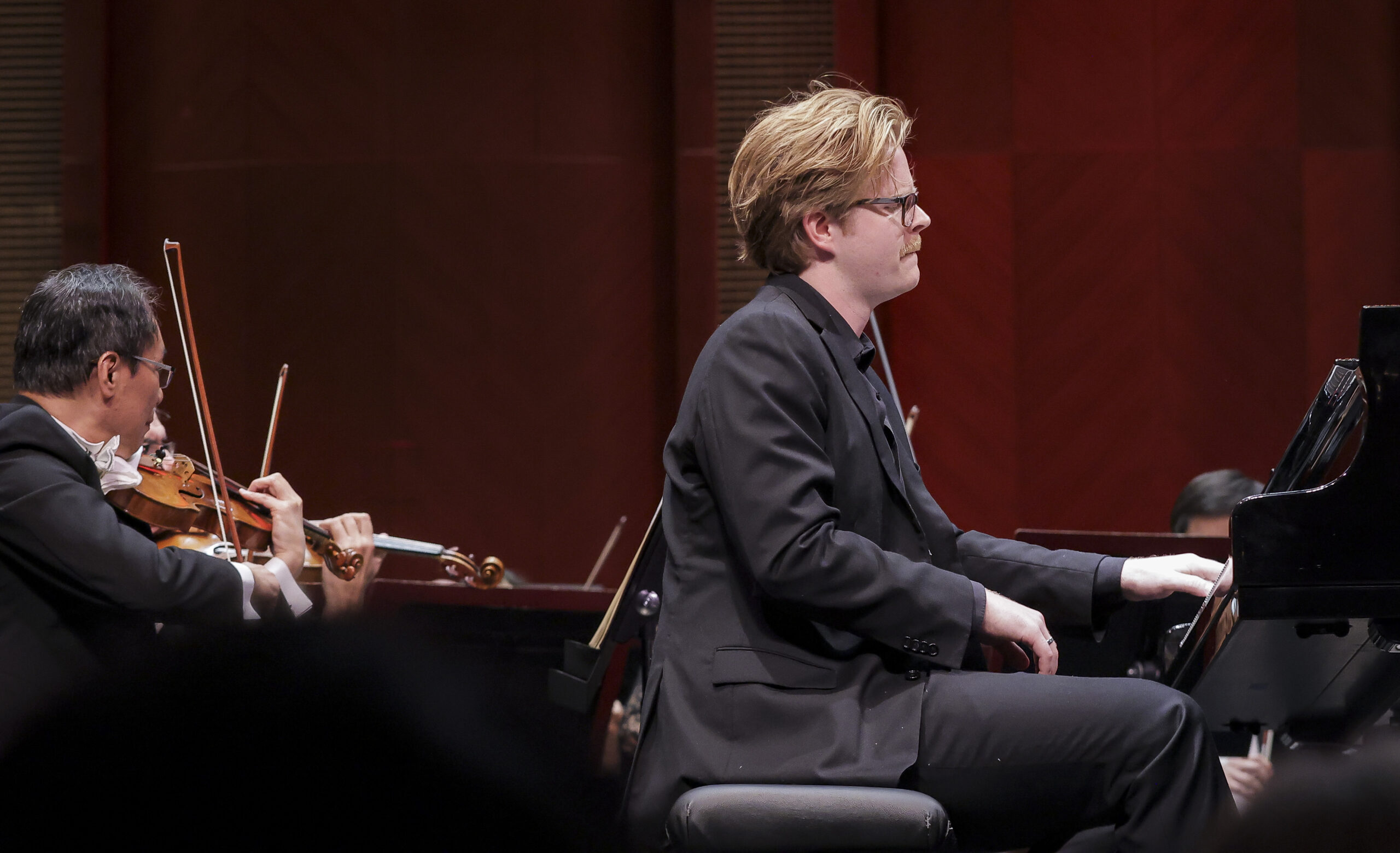
Carter Johnson with the Fort Worth Symphony in the finals of the Seventeenth Van Cliburn International Piano Competition. Photo: Ralph Lauer
Then came Canada’s Carter Johnson who performed Ravel’s Piano Concerto for the Left Hand. A bold and unusual choice: structured in one movement form, it was originally composed for a one-handed pianist, Paul Wittgenstein, brother of the great philosopher, Ludwig. The first impression came not from the soloist, but from the Fort Worth Symphony Orchestra (FWSO), whose sound seemed too naïve for this highly complex and depictive music.
Johnson took command of the stage with an assertive beginning. However, soon appeared what might have been weaknesses in his preparation: minor flops in the first cadenza, insecure entrances, and an over-projected sound. A thoroughly solid and accomplished pianist, Johnson delivered a good performance, but didn’t hit the mark in terms of the atmosphere, the colours, and the humour. Surprisingly, his sound opened up during the long, beautiful solo middle part: he started listening to the feedback in the hall, and played with quiet, natural beauty. After a very well-paced build up, he completed the performance with brio.
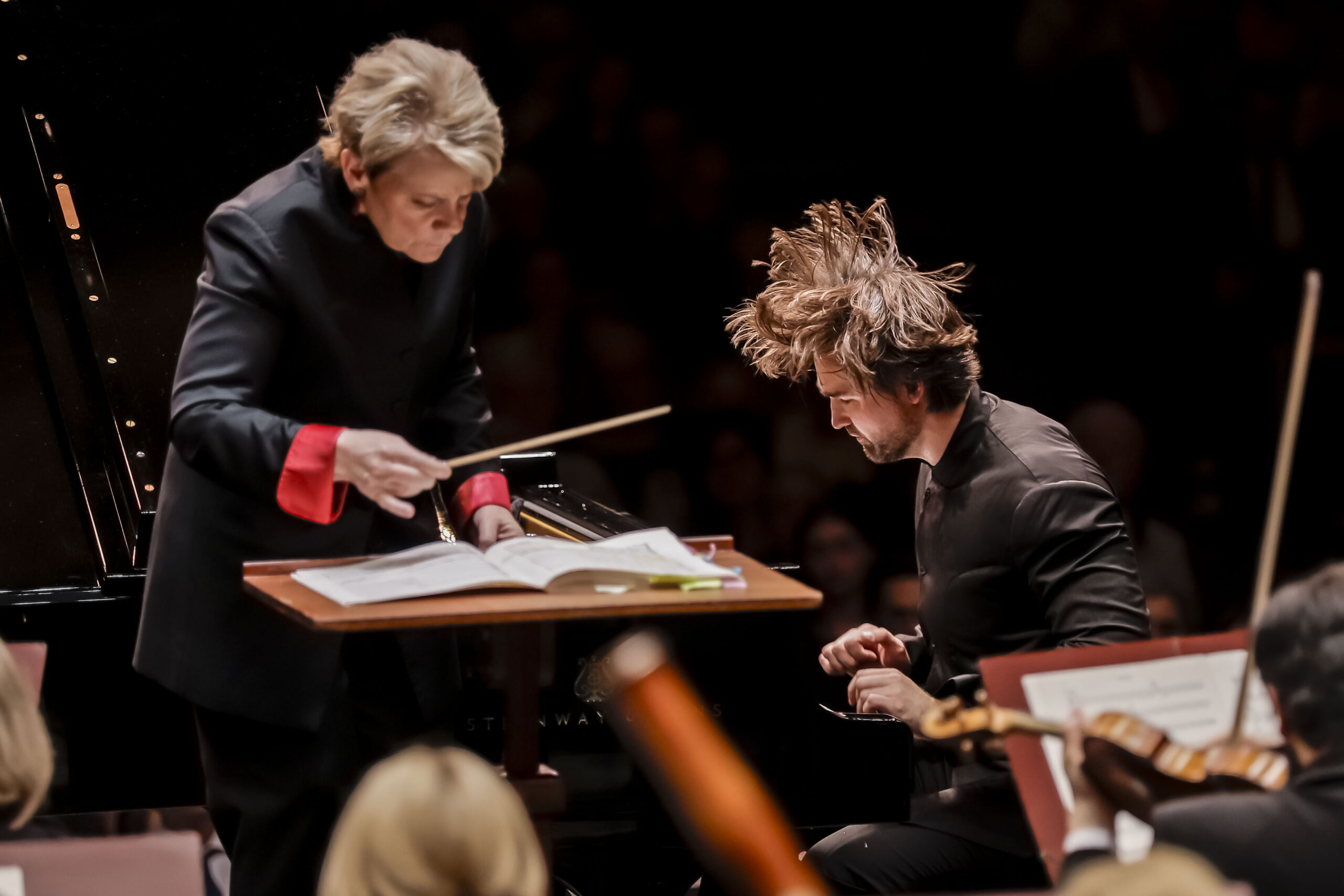
Philipp Lynov with Conductor Marin Alsop and the Fort Worth Symphony in the finals of the Seventeenth Van Cliburn International Piano Competition. Photo: Brandon Wade
And then, came Russia’s Philip Lynov. An idiosyncratic performer with an awkward stage presence: partly confident, partly out-of-place. Despite some reservations left from his previous concerto performances, Lynov transformed the moment he began playing Prokofiev’s Second Piano Concerto in G minor. Lynov completely understood the style, the emotion, the darkness, and the vulnerability perceptible through the glass of the composer’s intellect. This was it.
Lynov’s first movement cadenza ripped not only through the music, but through our guts. This was music making of the highest calibre: present, committed, focused, selfless. Without being the most sensitive ensemble player, Lynov showed more engagement with Maestro Alsop and the FWSO. Lynov liberated his inner demons through cascading passages and brought us down to hell and back. He showed all the nuance, drama, and expressivity necessary without ever sounding forced or untrue. A phenomenal performance and a cathartic experience.
Overall, one candidate demonstrated absolute command of solo and orchestral performances: Hong Kong China’s Aristo Sham. A worthy gold medallist, in my opinion. Then, came two extraordinary, but much less reliable and constant performers: Russia’s Philipp Lynov and Russia/Israel’s Vitaly Starikov. Both mercurial at their best, irritating otherwise. Both tied for second place for my taste. Finally, Canada and the USA’s Carter Johnson demonstrated high levels in all situations, both solo and ensemble, daring repertoire choices, as well as strong intellectual and musical traits. A strong third place.
Prediction
- Gold Medal: Aristo Sham
- Silver Medal (Tied): Philipp Lynov and Vitaly Starikov
- Bronze medal: Carter Johnson
For all of our Cliburn reports, articles and videos visit Spotlight | Cliburn 2025