
Update: The Vancouver Symphony Orchestra musicians had yet to issue a strike notice at the time of writing this review. On Monday evening, the Vancouver Musicians’ Association (VMA), Local 145 of the Canadian Federation of Musicians, filed the 72-hour notice on behalf of the orchestra’s more than 70 members. Read more about this job action here.
From Sept. 19 to 21, American classical pianist Anne-Marie McDermott joined the Vancouver Symphony Orchestra (VSO) to perform Beethoven’s Second and Fourth Piano Concertos. The orchestra also performed Louise Farrenc’s Third Symphony and Mozart’s overture to his comic opera Così fan tutte. While the orchestra and McDermott delivered exquisite performances, this concert also highlighted the current unrest between the VSO musicians and their employer, the Vancouver Symphony Society.
Upon arriving at the Orpheum, each audience member was greeted outside the door by musicians handing out blue pamphlets. These pamphlets summarized ongoing contract negotiations and the value of investing in the VSO musicians. Since June 30, the musicians have been working on an expired contract as they try to negotiate higher salaries on par with comparable symphonies in Toronto, Montreal, and Ontario. On Aug. 1, more than 97% of VSO union members voted to authorize a strike.
This tension was palpable during the concert I attended on Sept. 20. Aside from the pamphlets handed out beforehand, the musicians also returned after the intermission wearing blue t-shirts with “VSO Musicians” written on them. The blue t-shirts, which the musicians had worn when handing out the pamphlets, signaled a solidarity between the musicians and their willingness to take action.
Nevertheless, the show went on. Opening with Louise Farrenc’s Third Symphony, the orchestra appeared like a well-oiled machine, offering a united and even sound. Conductor Otto Tausk guided the musicians with intention and composure. When the pace of the piece picked up, the orchestra began to move expressively as Tausk swayed on the podium. Again, every motion felt deliberate as if the orchestra had choreographed the performance like a dance.

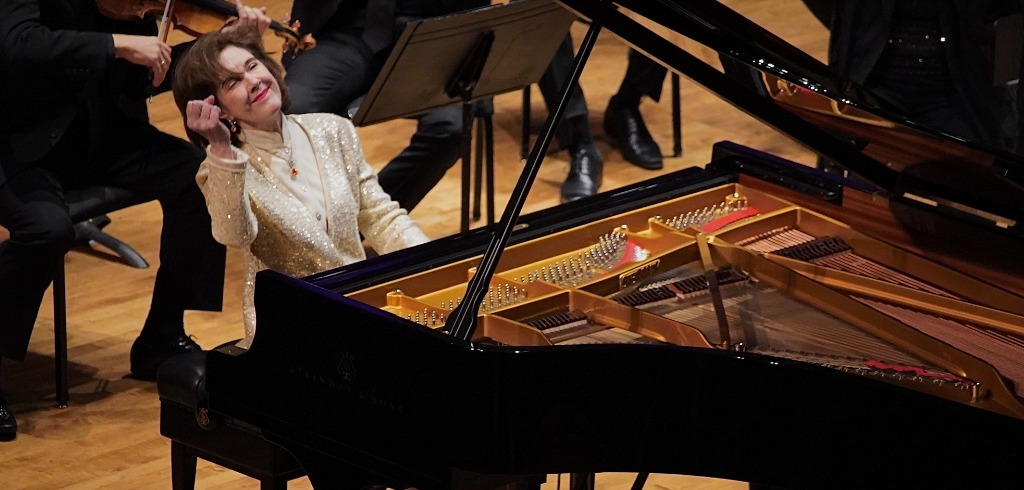
Anne-Marie McDermott with the VSO conducted by Otto Tausk. Photo: Courtesy of the VSO
When McDermott joined for Beethoven’s Piano Concerto No. 2, the audience seemed to hold its breath. The pianist glided across the stage dressed in a sparkling blazer and matching glittery high heels with a wide smile stretched across her face. She seated herself at the piano and her warm expression turned to one of sharp focus.
My eyes stayed trained on her agile fingers which flew across the keys. Her presence demanded attention as she dazzled on stage among the sea of musicians dressed in black. Occasionally, the pianist would lean into the piano as if the instrument were whispering secrets to her that only she could hear.
The orchestra matched McDermott’s passion, showing more emotion in their faces and playing than before. However, they never stole attention away from the pianist. McDermott had her moments to shine and so did the orchestra, each blending into one another like a conversation.
After the intermission, the orchestra played the Così fan tutte overture with the necessary technical ability. McDermott then returned for the final piece, Beethoven’s Piano Concerto No. 4. This finale demonstrated the excellent collaboration between the orchestra and McDermott. The orchestral sections felt like a grand expansion on the hopeful, light, and complex piano sections.
The concert ended, unsurprisingly, with a standing ovation. McDermott returned for four stage bows, each time gesturing to the orchestra and humbly holding her hands to her chest. With this beyond impressive performance, McDermott cemented her stellar reputation. And with their masterful playing, the orchestra makes a case for compensation that reflects their high caliber.
For more concerts by the VSO, visit www.vancouversymphony.ca