This page is also available in / Cette page est également disponible en:
 Français (French)
One month apart, Orchestre symphonique de Laval (OSL) is presenting two concerts with dissimilar repertoires and moods, but they are linked by a name that resonates: Brahms the Romantic. These concerts are also an opportunity to get to know two young conductors with complementary visions.
Symphonic Jazz
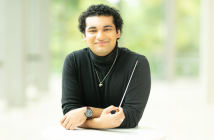
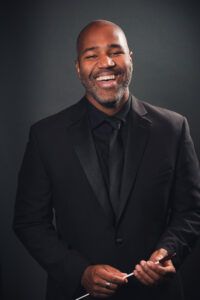 Daniel Bartholomew-Poyser grew up in Montreal and then moved to Calgary. His professional career has taken him to the United States, Ontario and Nova Scotia, among other places. His April 16 OSL concert at Salle André-Mathieu will mark his second return to Quebec in just over a year. On the program are compositions for jazz sextet and orchestra based on themes by Brahms and Ravel, an eclectic marriage that the conductor is looking forward to celebrating.
At the time of the interview, Bartholomew-Poyser had just reviewed the scores of Yannick Rieu and Lionel Belmondo, two well-known saxophonists in the jazz field. “It’s like looking at classical music through a jazz lens,” he says.
“The result is different from what you might expect. It’s not exactly a jazz sextet with an orchestra, but rather an orchestra transformed into an ensemble of jazz musicians. In terms of orchestration, the music becomes a palette of colours to be exploited. Lionel Belmondo, for example, wanted the sound of the tuba in a high register, in duet with the flutes, his other instrument. He also chose to form a saxophone-horn duet. You’ll hear a contrabassoon solo as well, which never happens. Everyone gets a chance to express themselves. That’s what makes it so interesting and a pleasure to conduct and play.”
When leading an ensemble, Bartholomew-Poyser seeks above all to create an atmosphere conducive to the work of the composer-performers and their partners, in this case, Stéphane Belmondo (trumpet and flugelhorn), Jonathan Cayer (piano), Rémi-Jean Leblanc (double bass) and Louis-Vincent Hamel (drums).
“My aim is to transmit to the orchestra the style of communicating and music-making that all these experienced artists have, so that they feel at home and the OSL can learn from them too. After all, they’re the ones who bring their expertise, they’re the ones who created the music, and we need to hear what they have to say,” says Bartholomew-Poyser, who sees himself as a unifier and advocate in the interests of creators.
The Montreal native is delighted with the above-average rehearsal time he’ll get with the OSL. “It gives the orchestra’s musicians a chance to understand this language so that they can use it more effectively during the concert, acclimatize to the new style and get to know the world of the guest artists.”
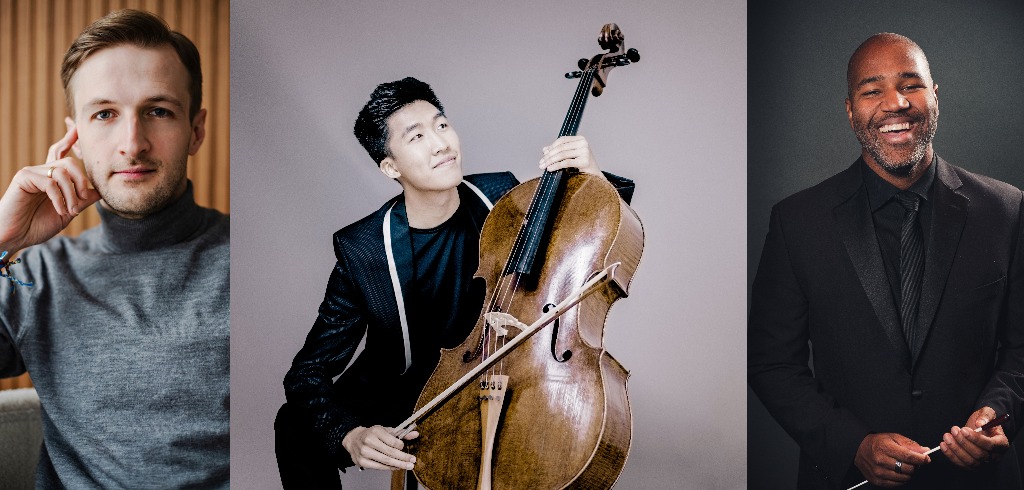
Bryan Cheng plays Jaëll

Photo: Hilary Gauld
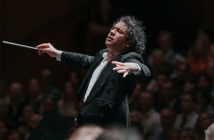
This may be Bartholomew-Poyser’s first concert with the OSL, but it’s the orchestra’s second collaboration with Andrei Feher. On May 14, Feher will offer a program in the Romantic style, including the Cello Concerto in F major by Marie Trautmann (1846-1925).
“My choice, in discussion with the OSL, was Brahms’ First Symphony. After that, I tried to find something that would go well with it musically. By chance, I came across this French composer’s concerto. First performed in 1882, it was rediscovered not long ago. I thought it would be a good opportunity to play it. (Cellist) Bryan Cheng said yes, and we were able to go ahead with the program.”
Trautmann was a contemporary of Brahms. Her husband, the virtuoso pianist Alfred Jaëll, was said to have been a friend of Joachim, Brahms and Liszt. The link with German music seemed obvious to Feher, as the composer herself had pursued her musical education in Stuttgart, not far from her native Alsace.
The Romanian-born conductor Feher, now domiciled in Quebec, is well aware of the technical difficulties of Brahms’s symphonies. “The balance of sonorities required is not as obvious in terms of orchestration as with Richard Strauss or Ravel,” he says. “In certain passages, you have to bring out the right details, otherwise you get lost. There are a lot of challenges, and I always find it interesting to go a little further or in different directions each time we play them again. These are works that make us progress and will always make the orchestra progress.”
The difficulty is such that, even after 200 years, young string players are still put through their paces by regularly performing excerpts from Brahms symphonies at auditions, he explains. A violinist by training, Feher has developed a particular sensitivity to conducting this all-important section of the orchestra. “It helps me to evaluate bow strokes, speeds and tempos, but also to know that certain ideas, given a day’s work or a rehearsal session, can produce something musically interesting.”
Also on the program is Schumann’s Genoveva Overture. “He is one of my favourite composers,” says Feher. “Perhaps you don’t hear it often enough among orchestral works, but it really is the Romantic soul par excellence, like Chopin on the piano. This overture is almost never heard.”
Translation: Kaitlyn Chan
This page is also available in / Cette page est également disponible en:
Français (French)