This page is also available in / Cette page est également disponible en:
 Français (French)
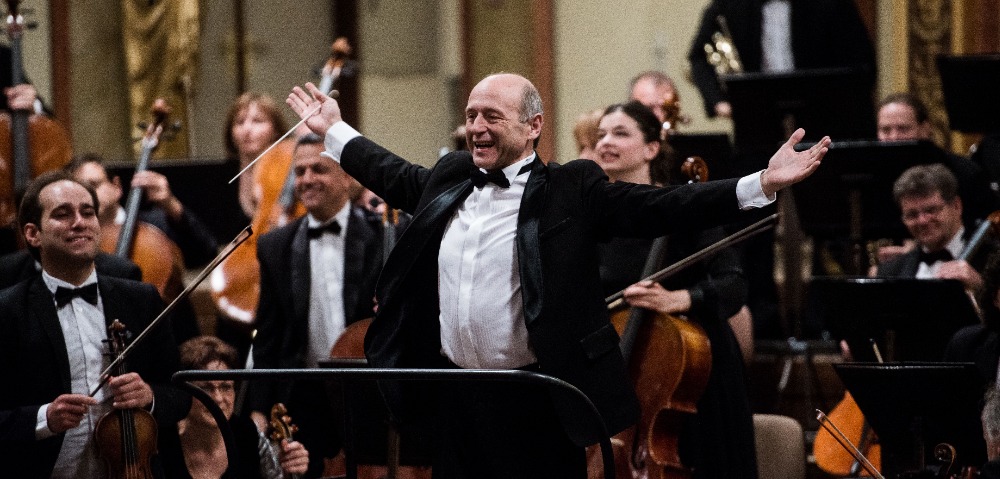
The Budapest Festival Orchestra (BFO) is an anomaly when it comes to the other elite ensembles that share its top-10 world ranking. The Vienna Philharmonic (established 1842), Berlin Philharmonic (est. 1882), Royal Concertgebouw Orchestra (est. 1888) and Chicago Symphony Orchestra (est. 1891) have each been around for 100 years plus. BFO only sprang to life in 1983 when Iván Fischer, the orchestra’s music director to this day, co-founded it with fellow Hungarian conductor and pianist Zoltán Kocsis. But it is not just its relative youth that sets it apart. In a world where orchestras continue to be run from the top down, BFO centres its musicians. Under Fischer’s leadership, it is the players’ artistic ambitions that spark the innovative programming for which the ensemble has become world-famous.
Iván Fischer & the Budapest Festival Orchestra. Photo: Marco Borgrreve
Forty-two years into the great experiment that is the BFO, it continues to eschew tradition. Musicians work on freelance contracts with about 70 core members, and a supplementary secondary circle of players who are also hired regularly. Season programming is prolific and vast-ranging. Core orchestral repertoire, often played alongside major works by contemporary composers, is presented at Müpa Budapest, the acoustically-superb concert hall opened in 2005 that is a 20-minute tram ride along the Danube outside Budapest’s centre.
This “big” repertoire is also heard at other cities throughout Hungary, and forms the centrepiece for the orchestra’s many foreign concerts. This season alone BFO’s tours include Paris, Vienna and Cologne in November; Baden-Baden in December; Toronto, Boston and New York in February; Milan and Berlin in March; Amsterdam, Bruges and cities in Spain in May, finishing with Bad Kissigen in June.
For most orchestras, performing core programming at home, and extensively on tour, would be more than enough to sustain a season. But BFO is able to delve into repertoire more deeply because of the central role its musicians play in directing programming. Reflecting on his orchestra’s history thus far, Fischer says: “There have been many changes—in fact, we constantly evaluate innovations and continue them only if they are successful. Widening the repertoire into other activities than orchestral works has remained: we are developing our baroque ensemble, folk-music group, we sing regularly, and recently started with improvised music. The idea of input of the players happens automatically because we embrace their hobbies. When I learned that two of them are good tango dancers, we incorporated their dance performance into a concert program.”
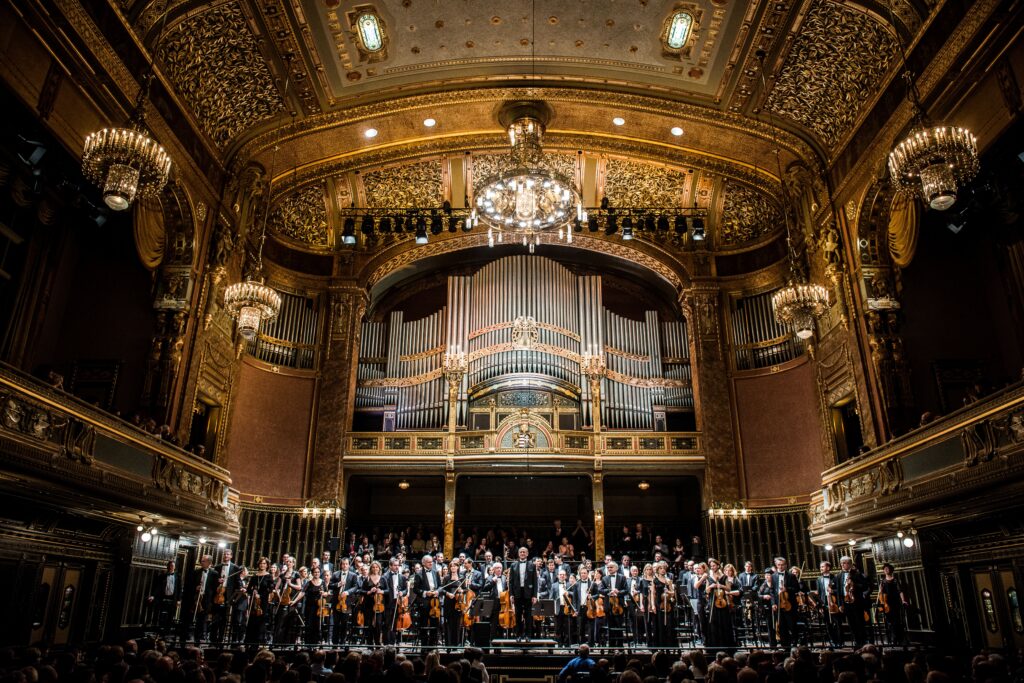
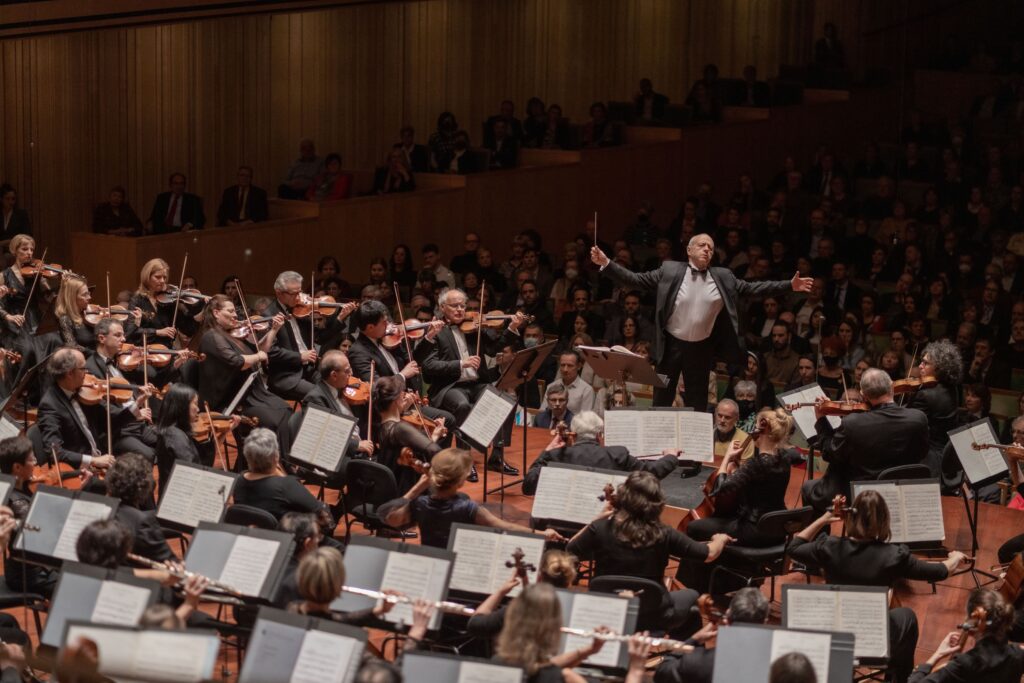
Iván Fischer & Budapest Festival Orchestra at Franz Liszt Academy of Music. Photo: Ákos Stiller
The results are ancillary concert series inspired by such special interests. “When planning the season we plan concerts or cycles for these specialists. For example, the concertino cycle is a chamber orchestra led from the [principal]violin featuring orchestra members as soloists,” says Fischer. These concerts take place at one of Budapest’s most stunning venues, the gilded main hall of the Art Nouveau Liszt Academy. In June 2025, I had the pleasure of hearing this chamber version of the BFO there in a program that included a Haydn symphony, C.P.E. Bach’s Cello Concerto No. 1 and Janáček’s Idyll. Winnowing down the number of musicians offers players and their audiences the chance to explore repertoire that is often missing from the purview of most large ensembles.
From here, BFO programming gets even closer to what Fischer sees as the orchestra’s core mandate: community service. And so, on the home front, the BFO goes out to people who cannot come to the concert hall with outreach to schools and hospitals. During the pandemic it famously gave serenades in the streets of lockdown Budapest. Informal midnight concerts find beanbag chairs strewn among the musicians for the ultimate up-close musical experience. The Cocoa Concerts series for children offers steaming mugs of hot chocolate and, since 2015, has added autism-friendly performances.
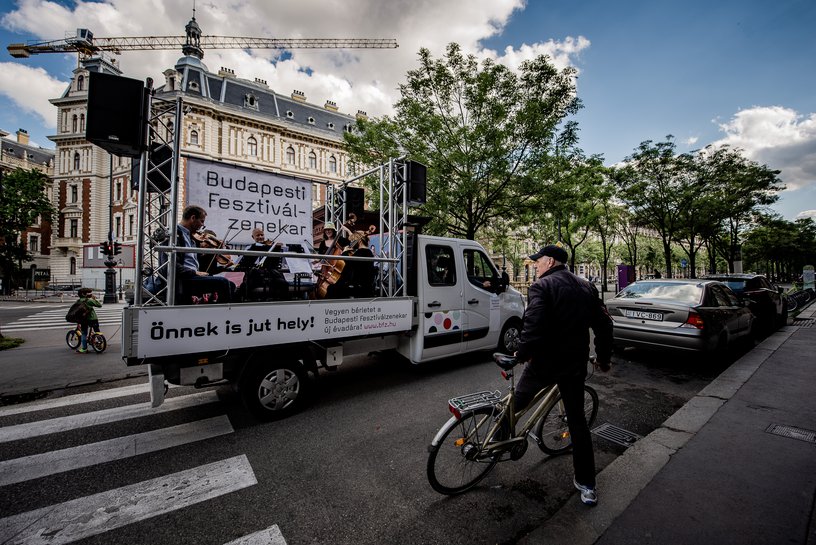
Budapest Festival Orchestra Bandwagon in Budapest, 2021
Fischer believes the orchestra’s overarching purpose is to serve the community with culture. This idealistic aim is intrinsically tied to his musicians being granted agency in terms of what, and how, they play. The maestro stresses he didn’t create BFO to compete for supremacy over other ensembles, but for its musicians to share their joy of music. “Playing personally means playing more freely,” says Fischer. “For example, the rhythm is rigid in most orchestras: they are trained to play an eighth note or a 16th note and nothing in between. But some melodies sound more personal if you stretch or rush a note here and there. We encourage this liberty: so sometimes we hear a ninth note or a 10th note. It only works if people discover their freedom and are allowed to play from the heart.”
This type of flexibility stretches beyond the technicalities of music-making into the orchestra’s overall operations. Unlike the rigid, unionized structure found at most European and North American ensembles, the BFO’s players are freelance—although its sheer number of concerts and touring certainly imply at least something close to full-time employment. Fischer is outspoken with regard to unions which he feels often go too far to protect
players who are past their prime, rather than looking out for the musical interests of the entire orchestra. “The unions have a very noble function: they defend musicians,” he says. “Sometimes they make a mistake: by creating strict rules and limits they also limit room for the creativity of musicians. I like to promote individual qualities of musicians, which are often unusual. I hope one day the unions will understand that it is great that they defend the welfare of musicians but they should also defend their individual artistic ambitions.”
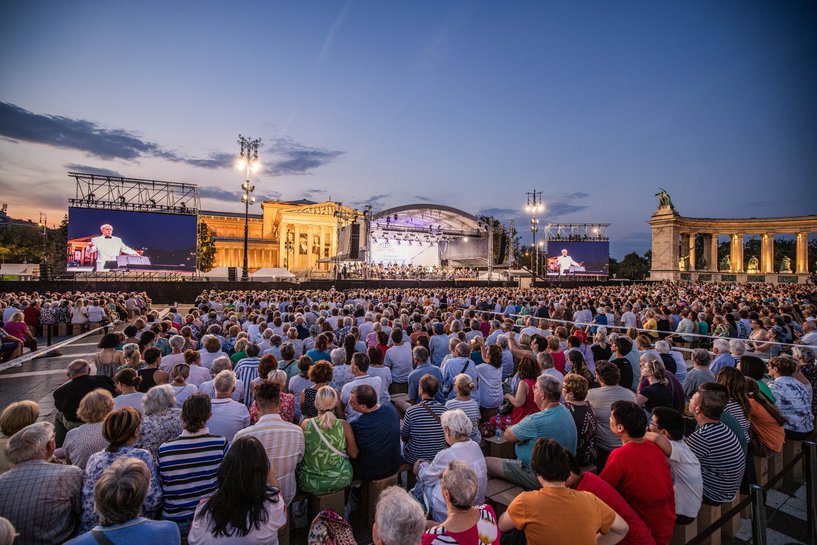
BFO at Plea for Peace concert, Heroes’ Square, Budapest, 2024
Such views might ruffle feathers in a North American context which, in recent years, has seen strike action at Vancouver Symphony Orchestra in 2025, unrest at the Metropolitan Opera during the pandemic lockouts, and a seven-week walkout at Chicago Symphony Orchestra in 2019. But in Hungary at least, Fischer was working in a much different context when BFO was founded. In a 2006 interview for the Orange County Register, he noted how “in Hungary, it was possible to start an orchestra with a complete sense of idealism, where the musicians didn’t find it important to have any committees, or unions, or anything like this. Everybody joined purely for the sake of the artistic, for the achievement. And on the other hand, I remember I encouraged them in the first years to form committees, and go in the direction of a self-governing organization, but they didn’t find it necessary, because everybody had a certain thirst for a high artistic level.”
If you are lucky enough to attend performances in Budapest, what becomes immediately apparent is the physical joy players display as they perform. To Fischer, this is part and parcel of a creative environment that encourages individual creativity; it is “the joy [that]comes naturally when people are allowed to express themselves with music.”
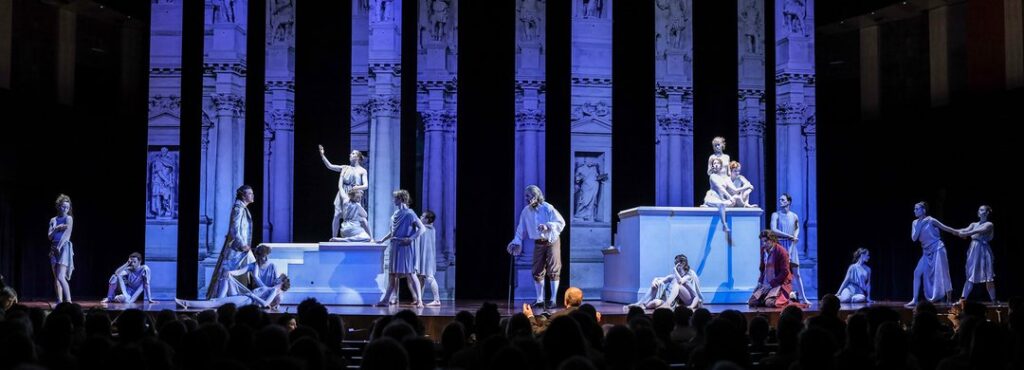
BFO’s Don Giovanni at 2025 Vicenza Opera Festival. Photo: Judit Horváth
Another aspect of BFO’s activity that sets them apart is the large presence of opera in their repertoire. Key to this is the Vicenza Opera Festival founded by Fischer and the BFO in 2018. They perform in that northern Italian city’s Teatro Olimpico with its fabulous, permanent, trompe l’oeil stage designs by the great Renaissance architect, Andrea Palladio. Fischer stages the operas himself within the confines of these unchanging, 16th-century classical architectural backdrops.
Similar to his views on the confining effects of unionization on orchestras, Fischer has not shied away from criticizing opera company management. When asked if he would consider taking on a leadership role in opera again as he did at Opéra de Lyon from 2000-03, he says that “nobody invites me because I disagree with their basic system. All opera directors work the same way: they maintain an infrastructure of orchestra, choir, technique, they employ famous singers who have learned their parts at home and sing the same way from Vienna to New York, and in order to modernize this routine troupe, they employ a stage director who turns the operas upside down. I don’t fit in this system.”
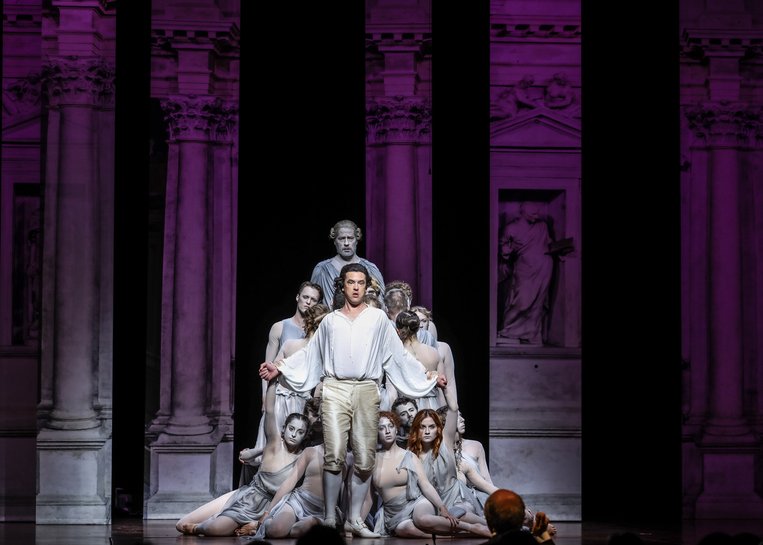
BFO’s Don Giovanni at 2025 Vicenza Opera Festival. Photo: Judit Horváth
Rather than rely on directorial concepts to breathe new life into old operas, Fischer is “fascinated by a different way of performing opera. Nowadays stage directors dominate opera houses, they reinvent the masterpieces, while singers and musicians keep the tradition. What you get is an opera performance that is visually innovative but musically always the same. I am interested in a different way: I call it organic opera in which the stage action, acting, singing, all express the same thing. That is why I stage operas myself.”
Fischer feels that the director-centric Regietheater which has dominated opera for decades “is in retreat because it is a dead end. Audiences like to hear Tosca, Rigoletto or Don Giovanni. They are increasingly angry when they get instead a new concept of an overly egoistic stage director. People didn’t buy tickets for that, they bought tickets for the original masterpiece.”
For their Feb. 12 Toronto concert at Koerner Hall, the BFO will perform Mahler’s Symphony No. 3 with German mezzo-soprano Gerhild Romberger, the women of the Toronto Mendelssohn Choir and the Toronto Children’s Chorus. Mahler is central to BFO’s repertoire. They have recorded most of his symphonies, winning awards along the way, and Fischer is founder of Hungary’s Gustav Mahler Society.
When asked about his special connection to Mahler, Fischer says the Austrian master was “next to being a genius. Mahler stands out among composers because his music is the most personal, most honest. There is nothing calculated, everything flows out of him. He had a big heart.”
More than most composers in the big symphonic tradition of the late 19th and early 20th centuries, Mahler incorporates a lot of vocal music, as he does in the Symphony No. 3. Fischer traces this back to Beethoven who “needed the human voice to embrace the world, to express humanism. Mahler is naturally a lied composer in the tradition of Schubert and Schumann. He composed beautiful songs and in the symphonies where he needed a more personal voice, he imported Beethoven’s innovation.” As far as his own history with Mahler goes, Fischer recalls how “in Vienna I listened to Leonard Bernstein rehearsing Mahler. …Bernstein had a deep understanding of Mahler’s music. Everybody should listen to his videos sitting at a piano and explaining this music.”
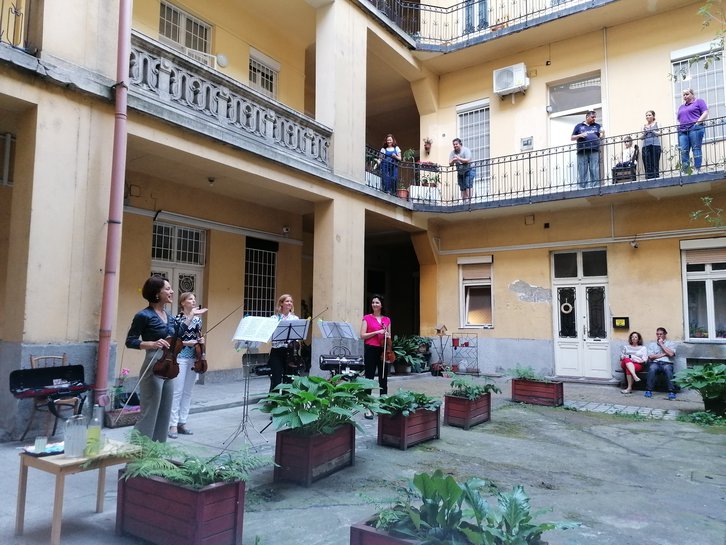
BFO Serenade in Budapest, June 2020
Given the extent to which BFO tours, it is difficult not to consider the symbolic role it plays in representing Hungarian culture abroad. Fischer has been an outspoken critic of the rise of authoritarianism under Viktor Orbán in his home country. He sees the orchestra’s role as being “more than an ambassador for a country. We promote international understanding, tolerance, and friendship. Of course we represent Hungary, but we also represent Europe and we represent transatlantic contacts and harmony.
“Music is more important than politics. Politics come and go, but music stays with us. A musical performance can elevate us, take us to another world of the present, without past and future. It is the ultimate happiness, only comparable to love. Listening to a symphony of Gustav Mahler is a much more lasting experience than watching the evening news.”
Budapest Festival Orchestra and Iván Fischer tour Mahler’s Symphony No. 3 to three North American venues this winter: New York City’s Carnegie Hall, Feb. 7; Boston’s Symphony Hall, Feb. 10; and Toronto’s Koerner Hall, Feb. 12. www.bfz.hu/en/
This page is also available in / Cette page est également disponible en:
Français (French)