
This page is also available in / Cette page est également disponible en:
 Français (French)
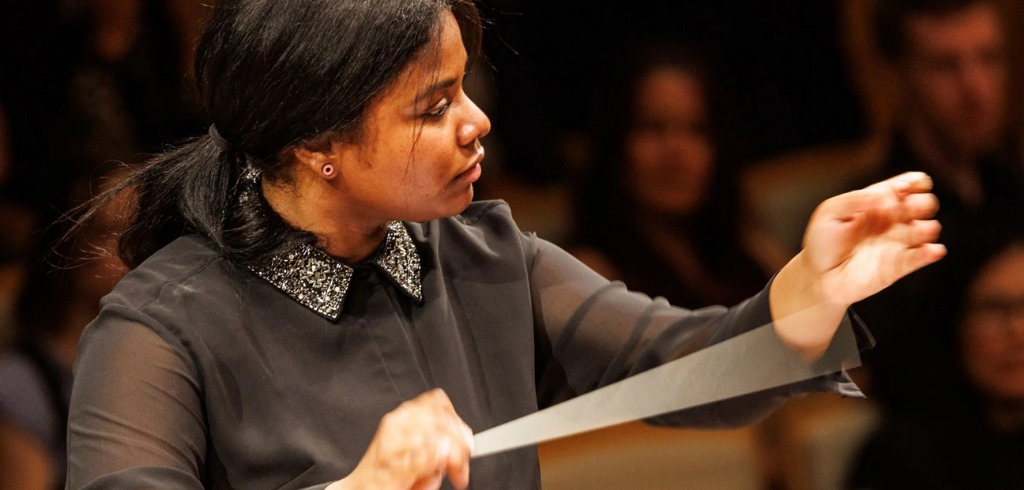
This is one of those beautiful yet improbable stories ignited by El Sistema: the story of Glass Marcano. In less than a week, the charismatic conductor went from struggling to make ends meet in Venezuela to winning prizes at La Maestra, the prestigious French competition for female conductors. Since then, she has emerged as one of the most compelling young conductors of her generation on the European scene.
We met in November 2025 following a concert she conducted with Orchestre Métropolitain in Montreal. We are both dissidents who had left the country to build a life elsewhere. A hug, a shared cerveza, and an immediate sense of recognition followed.
Born Gladysmarli Del Valle Vadel Marcano, she was raised in the small town of San Felipe, in the state of Yaracuy. She began her musical studies as part of Venezuela’s National System of Youth and Children’s Orchestras, better known as El Sistema. At the age of five, she started violin lessons.
The idea of becoming a conductor came later. “I remember a particular concert,” she recalls. “I was maybe 17 or 18. We were in the middle of a symphony full of energy and character, Shostakovich’s Seventh. The conductor was cueing the trumpets, and suddenly his face changed. It was very surprising, very shocking. I could not stop staring. When I got home, I could not stop imagining myself conducting.”
Driven by that vision, she pursued her musical training and became a member of various national orchestras. Her natural gifts led her to study conducting with Teresa Hernández and later with Alfredo Rugeles at the Universidad Experimental de las Artes, where she graduated in 2017. Aware of how difficult it was to make a living as a musician in Venezuela, she also enrolled at the Universidad Central de Venezuela, earning her law degree alongside her musical training.
The decisive rupture came later, during the COVID pandemic. Scrolling through her phone, she came across an ad for La Maestra. “Wow,” she thought. “That’s got to be the only competition in the world for female conductors.” On a whim, she decided to apply.
After graduation, she was struggling to make ends meet in Caracas. Firm in her decision, she returned to San Felipe to work at the family frutería, a small fruit shop, in order to save money. To apply, she needed to raise the “modest sum” of 150 euros. Through a collective fundraiser among family and friends, combined with countless extra hours behind the counter, she eventually managed to gather the sum. A feat in itself in a country where the monthly minimum salary hovered around $2.50 per month.
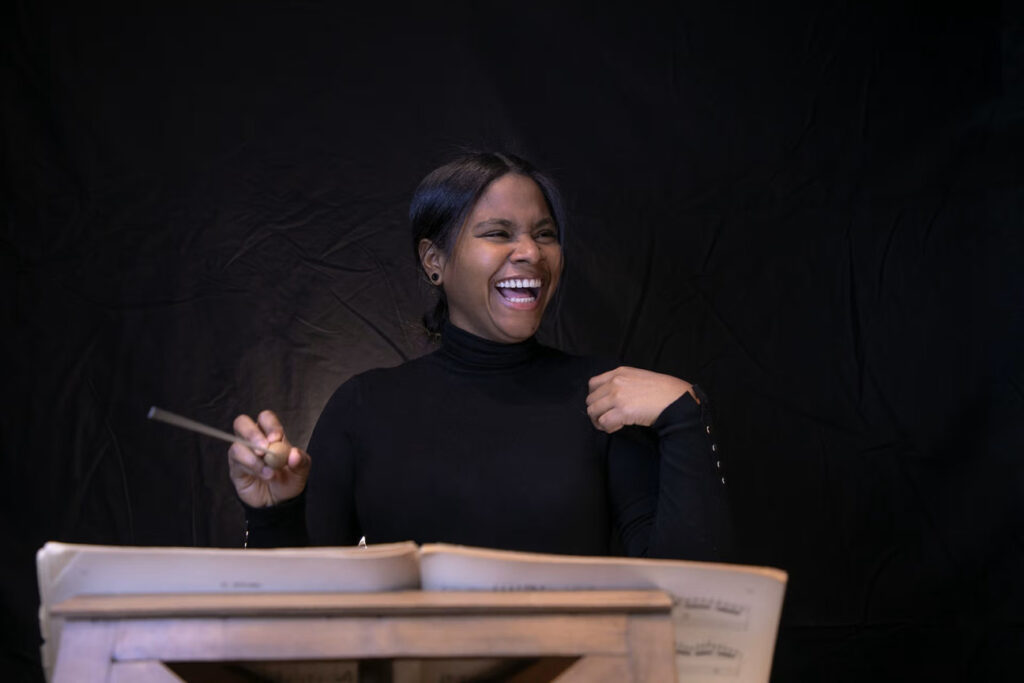
“I practised every minute of free time I had back at the shop,” she said. “Sometimes I would greet clients with grand gestures, as if I were guiding an orchestra.” She bursts into laughter: “Welcome to the shop, avocados this way, mangos that way.”
Behind the humour was exhaustion. “I had it all planned,” she confides. “After the competition, I was going to leave everything behind and go. I could not take it anymore. I was ready to do anything—work in a restaurant, start a small business, make some money. I was exhausted by the [political]crisis.”
After she was selected for the competition, another problem emerged: how to get to Paris in the middle of a global pandemic. The organizers eventually intervened, arranging a humanitarian flight that allowed her to travel.
With no knowledge of French or English, clothes for barely a week in her suitcase, and having never left the country before, Marcano boarded the plane in Maiquetía. As the aircraft lifted into the night sky, she thought of her family, unsure of what awaited her, but convinced that something important would come.
During the competition, she set language aside and let her baton do the talking. Her physicality, energy, and charisma quickly caught attention. Although she did not win, she took the Audience Prize, and she received what many consider an even more meaningful distinction: the Orchestra Prize, awarded by the musicians of the Paris Mozart Orchestra. Her international career then began to take shape.
 Today, she is acutely aware that recognition alone is not enough. While she feels at home in the romantic repertoire, she knows she must deepen her work in baroque and contemporary music in order to become more versatile and secure steady engagements as a conductor.
Since leaving Venezuela, Marcano has not gone back. Like many Venezuelans who have rebuilt their lives abroad, she watches from a distance as others return—while some, including foreign nationals, enter the country only to be accused of crimes they did not commit.
“Now that I’m known,” she asked quietly, “what if I go back and they ask me to conduct a concert? And if I refuse, will they take it out on me, or on my family?”
Glass Marcano will conduct the Wiener Concert-Verein in works by Koetsier, Dvořák and Carreño on June 19 at Vienna’s Musikverein.
This page is also available in / Cette page est également disponible en:
Français (French)