It’s no secret that Opera Atelier has wanted to present Debussy’s Pelléas et Mélisande for many decades, and finally, the results were unveiled last week at Toronto’s Koerner Hall to close the company’s spring season (seen Apr. 18). A “period” Pelléas is an intriguing prospect and in many ways, this was one of the group’s more memorable productions in recent seasons. Extremely strong casting and high musical values proved that Opera Atelier really should be producing operas outside their usual baroque/classical wheelhouse on a more regular basis. The inclusion of some of the company’s more typical “period” elements, however, threatened to undo what was an otherwise gripping interpretation.
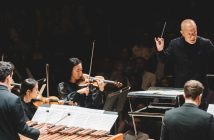
Musically, the score was reimagined by OA Associate Music Director Christopher Bagan for much smaller forces—a 14-piece ensemble (string quartet, wind quintet, trumpet, harp, piano and percussion)—compared to the original 80 piece orchestra. Given Tafelmusik was in the pit, gut strings were played, entirely appropriate as Bagan notes in the booklet given they were the standard in orchestras well into the 20th century (the opera premiered in 1902). Under conductor David Fallis, the musicians played with beautiful transparency. Instrumental solos emerged clearly and after an initial aural adjustment, one didn’t really miss the larger forces especially in such a warm acoustic as Koerner Hall’s. Fallis maintained a natural, forward momentum closely tied to the speech rhythms of the poetic text.
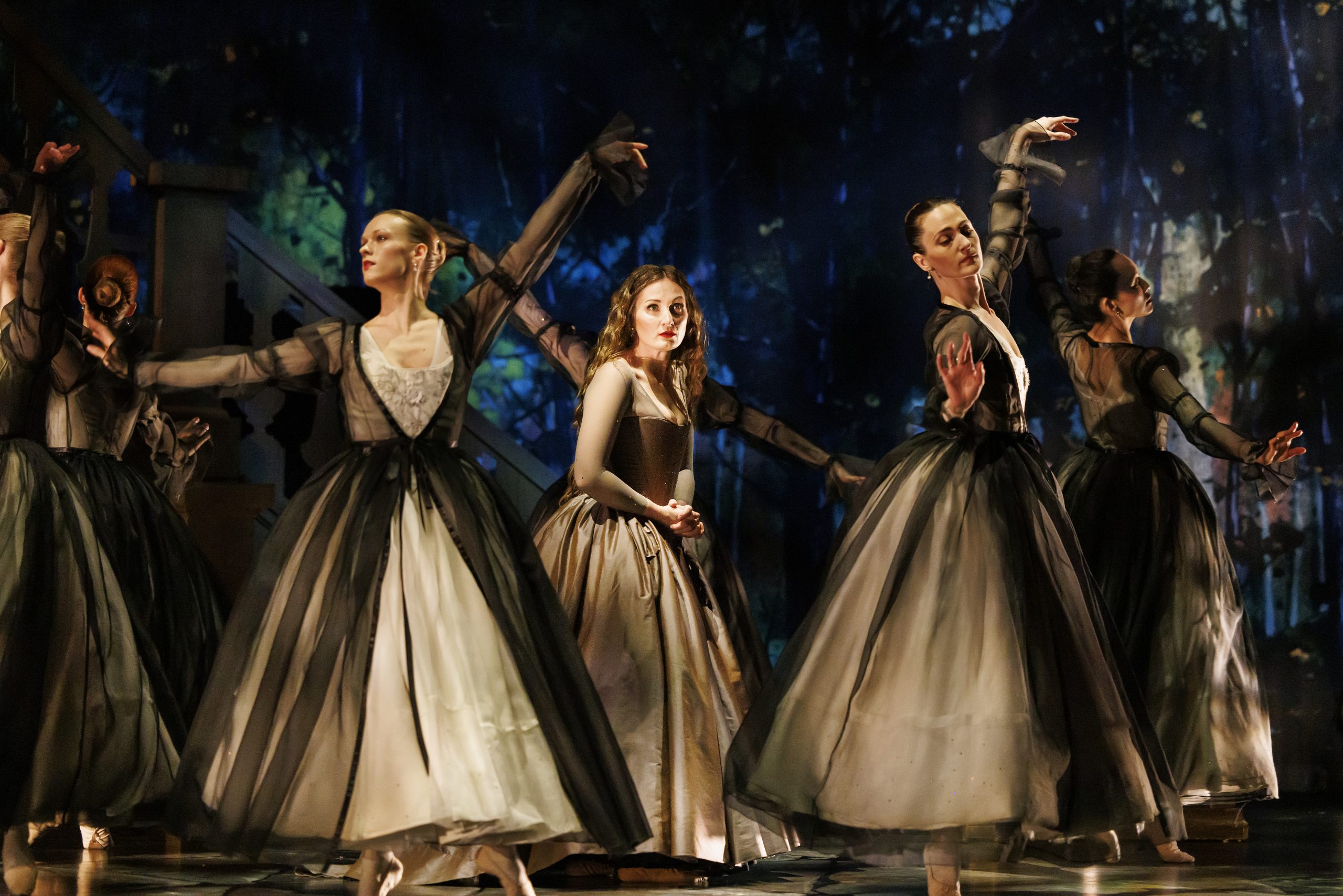
Meghan Lindsay (Mélisande) with artists of Atelier Ballet in Opera Atelier’s Pelléas et Mélisande
Photo: Bruce Zinger
What might have surprised committed Debussians however was the addition of snippets of baroque music by Charpentier and Rameau, here interwoven as short preludes choreographed for the Artists of Atelier Ballet by the company’s founding co-artistic director Jeannette Lajeunesse Zingg. So, the first sounds one heard were 17th-century baroque rather than early 20th-century impressionist. Much is made in the program of Debussy’s place in the lineage of French music. His opera’s alternating structure of sung scenes and purely orchestral interludes certainly seem to relate to the tradition of the grand “opéra-ballet” with its many opportunities to include dance.
Given that Debussy already included purely orchestral interludes in his score, the sudden excursions into an entirely different soundworld were jarring and seemed unnecessary. As Zingg notes, her dances for this Pelléas are meant to intensify the dreamlike quality of the story with the dancers representing forces that drive the protagonists. In large part, the choreography achieved its goal, the dancing seamlessly integrated into the drama. The “baroque” additions added little, and indeed, wrenched us out of the drama. This robbed the apex of the drama of its ultimate effect with Golaud’s murder of his brother Pelléas completely deflated by the music from an incongruous era that followed it.
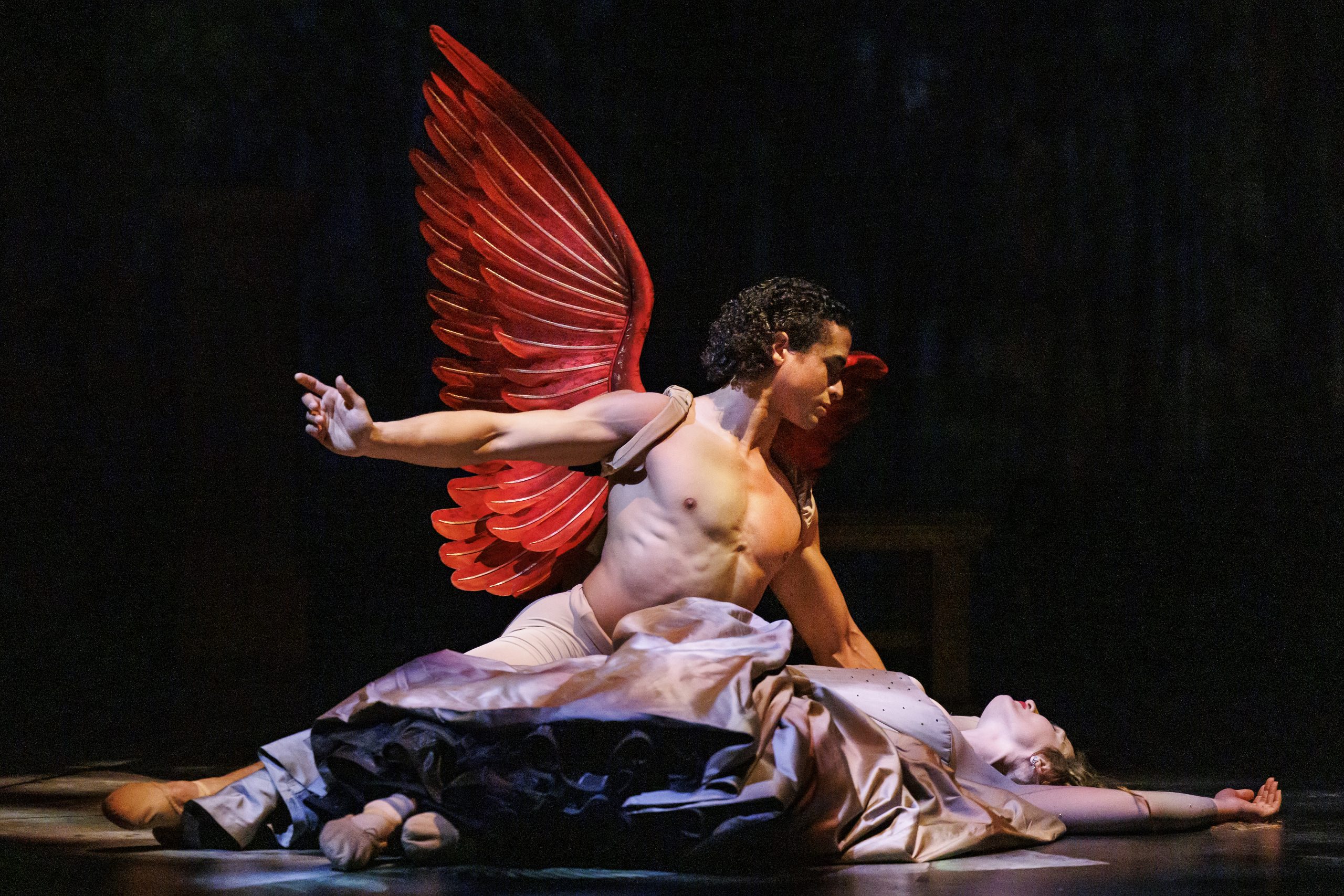
Eric Da Silva (Eros) and Meghan Lindsay (Mélisande) in Opera Atelier’s Pelléas et Mélisande
Photo: Bruce Zinger
Perhaps even more intrusive was the introduction of a danced character, Eros (Eric César De Mello Da Silva), a full-on winged Cupid who acted as a sort of protagonist who awakens Mélisande with a kiss in the forest at the start, and likewise seals her death at the end. Debussy’s adaptation of Maurice Maeterlinck’s symbolist play retains all of its textual ambiguity. The status of the title characters’ relationship is never entirely clear. Even after Golaud kills Pelléas out of jealousy, one of his last statements is that the pair kissed like a brother and sister. The Eros character compartmentalises the relationships too much within the realm of conventional romantic love. That Da Silva has played a similar role in other OA productions added to the feeling of something tacked-on for aesthetics sake.
But within this at times jarring framework, there was company founding co-artistic director Marshall Pynkoski’s superb direction of the principals. Relationships were clearly choreographed; interactions were intense and body language expertly expressive. The confounding drama in which we are never sure of Mélisande’s true motives or feelings was about as well delivered as one could imagine.
This success was in large part due to a top notch team of singing actors. Soprano Meghan Lindsay is a company stalwart, but here showed that she is more than ready to break out beyond the baroque and classical roles for which she is most well-known. This was a fully thought-out portrayal that encompassed expressive text delivery, voluminous tone, restrained soft singing and dramatic excursions into emphatic chest voice. Her characterization took a fascinating turn in the second half where Mélisande has a series of disturbing encounters with all the men including a harrowing scene of abuse by her husband Golaud, and a creepy encounter with her father-in-law Arkel that ends in a kiss. Lindsay became a blank slate here, making Mélisande tantalizingly inscrutable.
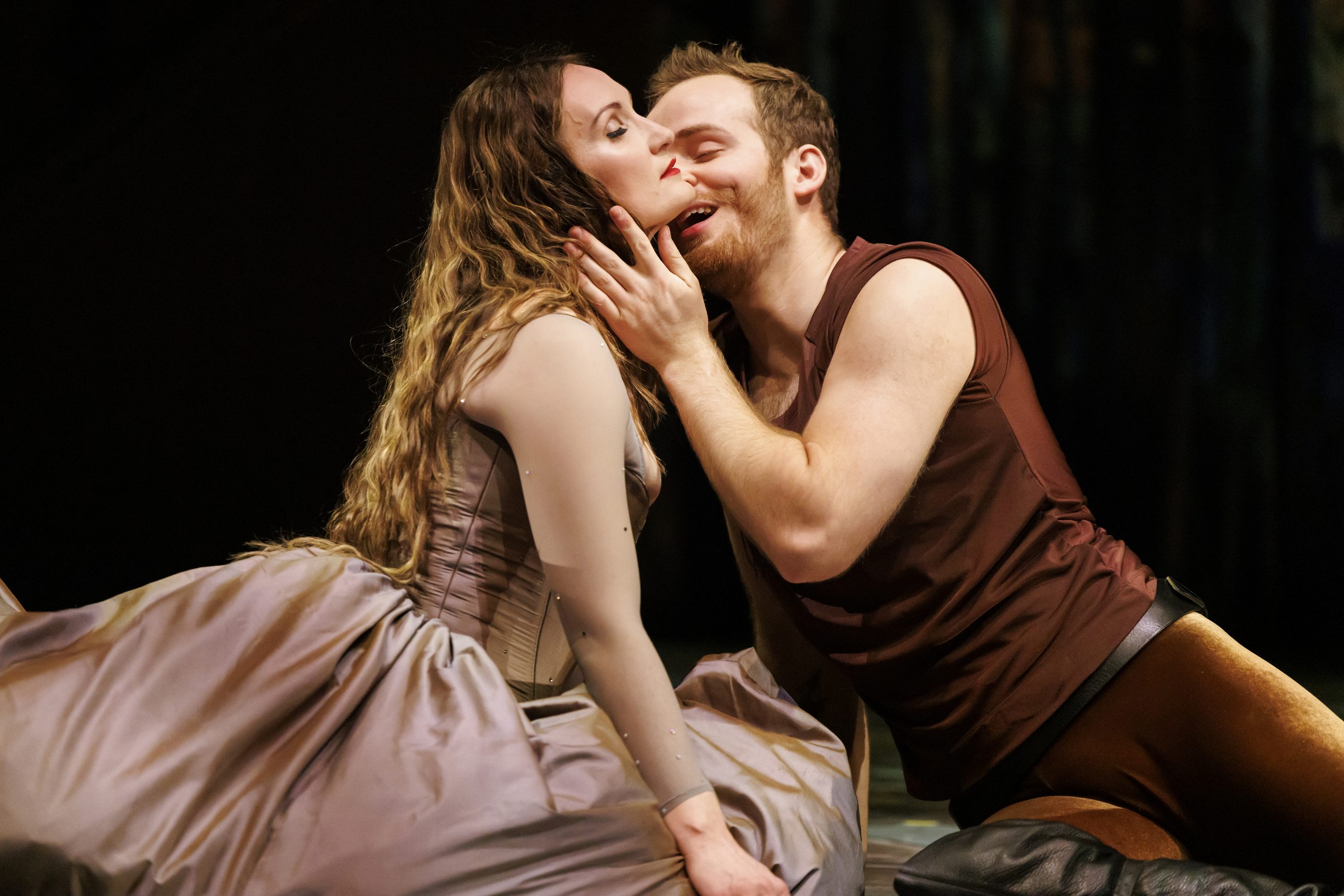
Meghan Lindsay (Mélisande) and Antonin Rondepierre (Pelléas) in Opera Atelier’s Pelléas et Mélisande
Photo: Bruce Zinger
The role of Pelléas is more generally given to a high baritone. French tenor Antonin Rondepierre sang idiomatically but in his lower and middle range, wasn’t always able to project over even the smaller orchestral forces used here. Casting a tenor rather than a baritone means that the role’s upper reaches are relatively easy, especially for a higher-placed voice like Rondepierre’s who is used to singing haute-contre roles of the French baroque. The dramatic tension of hearing a baritone at the top of his range was missing.
Bass-baritone Douglas Williams was a menacing, vocally dominant Golaud. His portrayal ran the full gamut from tender love, to jealous fury, to ultimate regret. His bronzed instrument commanded the role’s wide range. Like Lindsay, we are used to hearing Williams in baroque and classical roles like Figaro and Papageno. Here, he showed his mettle to tackle a more dramatic repertoire.
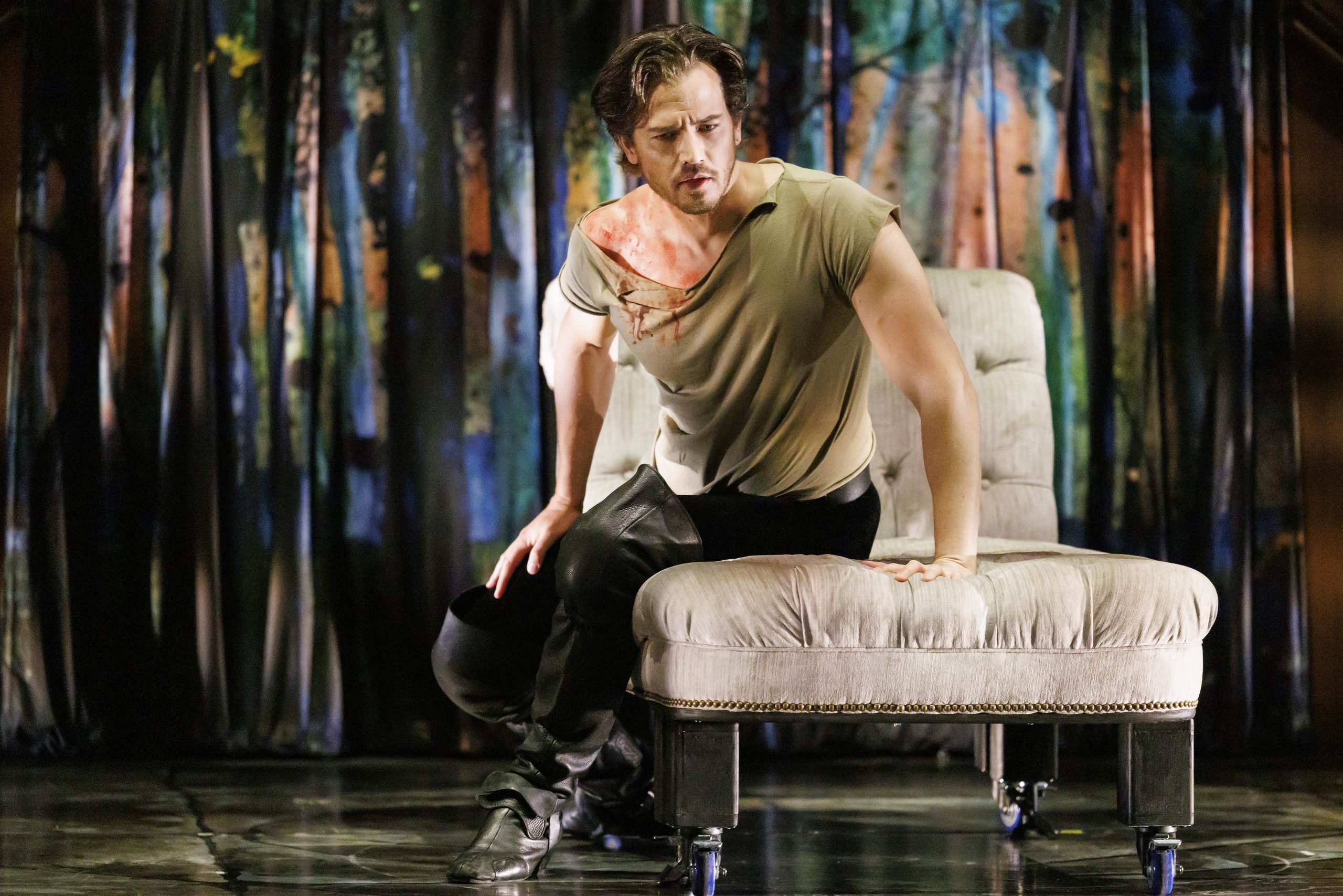
Douglas Williams (Golaud) in Opera Atelier’s Pelléas et Mélisande
Photo: Bruce Zinger
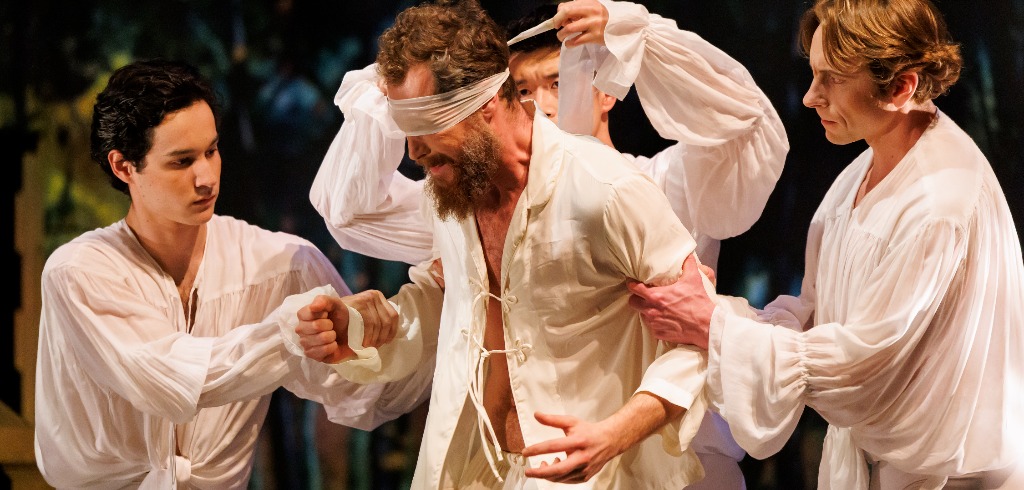
Canadian bass-baritone Phlippe Sly made a welcome company debut as the elderly, blind Arkel showing off the world-class sound that explains his appearances on the great stages of Europe. In a stroke of choreographic genius, Arkel is accompanied by four dancer attendants who guide the blind man to create a fascinating onstage dynamic. Sly’s beautiful sound is tied to superb, idiomatic diction making his portrayal satisfyingly complete.
Soprano Measha Brueggergosman-Lee sang the cameo role of Geneviève, mother of both Pelléas and his half-brother Golaud. Her reading of the letter announcing the latter’s marriage to Mélisande was a model of dramatic, sung recitation. Soprano Cynthia Akemi Smithers convincingly portrayed Golaud’s son Yniold, who is tricked by her father into spying on the pair of lovers, ultimately leading to Pelléas’s murder.
Set designer Gerard Gauci provided symbolist-inspired projections that mirrored the changing moods and locations. As wonderful as it is to hear the company perform in Koerner’s renowned acoustic, it does mean some compromise in what they can achieve scenically. Both of their productions next season will be staged in what is ultimately a converted concert hall. One can’t help but miss Gauci’s superb trompe l’oeil sets of yesteryear.
Despite misgivings about some of the presentational and musical choices, Opera Atelier’s Pelléas et Mélisande offered a fully-immersive account of one of the most revolutionary operas in the canon. Hopefully this will spur the company into further explorations of the 19th and 20th-century repertoire.
For more on Opera Atelier’s 2026-27 season visit www.operaatelier.com