Toronto Operetta Theatre’s annual holiday production offers local audiences the all-too-rare chance to experience golden age operetta. This delightful corner of the lyric repertoire, full of soaring melodies and lively dance rhythms, is all but otherwise ignored on the national scene. Imre Kálmán’s The Czardas Princess returned to the Jane Mallet Theatre stage on Dec. 30, bursting with Hungarian spice and toe-tapping Viennese waltzes, showcasing a superb, young Canadian cast.
Kalman’s piece has remained popular since its 1915 Viennese premiere, never far out of the repertory in Hungary, Austria and Germany. Outside of those borders, The Czardas Princess has been presented in a myriad of versions. It reached Broadway in 1917 as The Riviera Girl, an intriguing iteration with additional songs by Jerome Kern. This version was revived in 2017 for the opening of the Budapest Operetta’s cabaret space, named the Imre Kálmán Theatre. That eclectic staging included appropriate nods to Dixieland jazz, swing, Weill-esque accompaniments and tango.
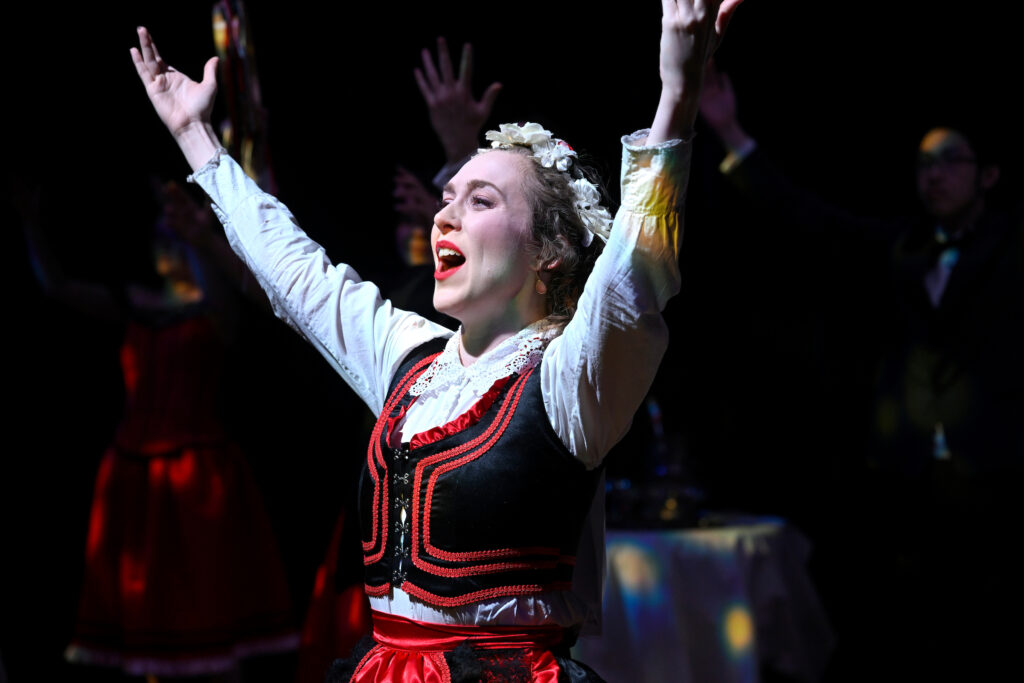
Maeve Palmer (Sylvia) in TOT’s The Czardas Princess. Photo: Gary Beechey
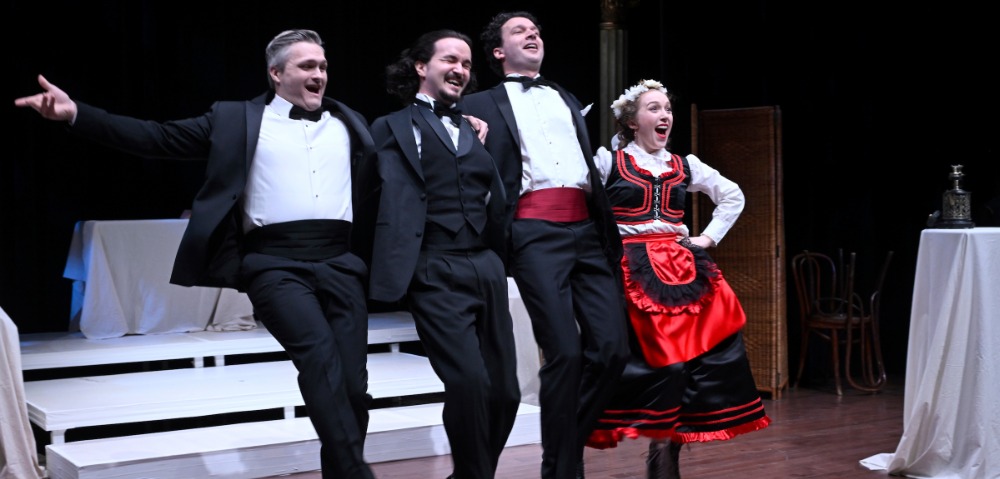
TOT’s General Director Guillermo Silva-Marin, who also acts as the company’s stage director, makes the most of a modest-sized chorus and orchestra, simple costuming and some basic props. He gifts the young, nimble cast with choreography that is completely within their talents, resulting in high-energy movement that is always polished. Simple spins and kick lines work well to give the illusion that more is happening than might actually be the case!
As is often the case in operetta, the plot has a lot of twists and turns, all of which were well-telegraphed here. This was largely due to some very fine declamation of the copious spoken dialogue of Nigel Douglas’s 1983 English version. Despite its vintage, none of the text sounded particularly dated, eliciting genuine chuckles out of the full house crowd.
Operetta really tests the performer’s ability to deliver on multiple levels. There are musical moments that require full-out, ‘operatic’ delivery, while others ask for a more vernacular musical theatre style. Spoken word isn’t an area in which operatically-trained singers always excel. But this Czardas Princess was blessed with artists who were comfortable with the idiom and knew exactly how to adjust their approach to the task at hand.
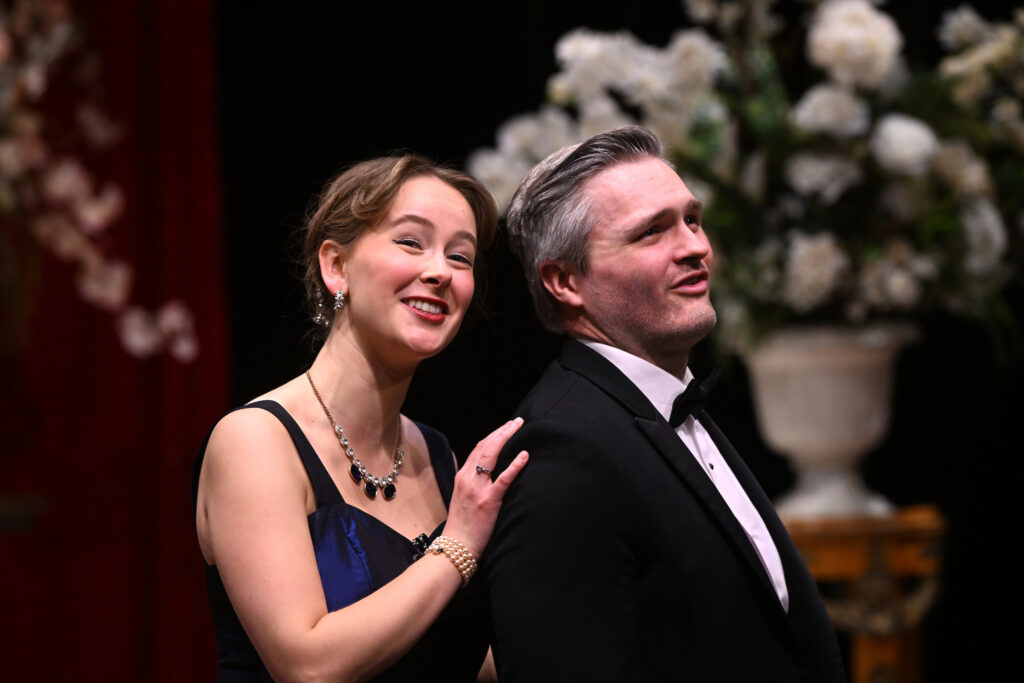
Patricia Wrigglesworth (Stasi) & Scott Rumble (Edwin) in TOT’s The Czardas Princess. Photo: Gary Beechey
Soprano Maeve Palmer made her company debut as the mercurial Sylvia Varescu, the cabaret singer whose ‘lowly’ origins prevent her being accepted by the titled family of her paramour, Prince Edwin. Palmer projected flamboyance in her opening cabaret number, recalling the highlands of her homeland. As the tempo accelerated, she twirled, sang, and stomped with authentic Hungarian fervor. When, after an impromptu marriage to Edwin, she mistakenly believes he is engaged to another, Palmer effectively switched to a more acidic delivery. The demanding role requires a fair amount of singing in the lower and middle ranges which was sometimes an audible struggle, but thankfully Palmer had multiple opportunities to let loose with some spectacular high notes that are her obvious sweet spot.
TOT is very fortunate to have tenor Scott Rumble return regularly in these luscious romantic lead roles. As Edwin, he had complete command of his instrument, and was the singer who most consistently delivered the sung text with clarity and pointed humour. He’s also a mean twirler as he got to demonstrate at several key moments. To hear Rumble release a torrent of golden tone in some of the piece’s grander melodies was worth the price of admission.
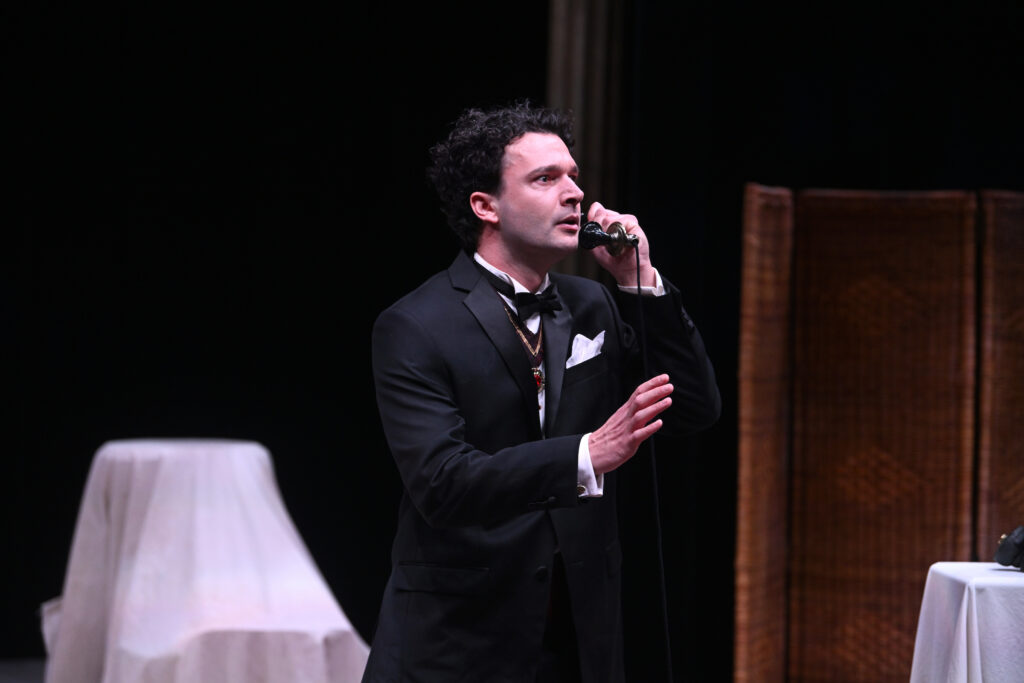
Sebastien Belcourt (Boni) in TOT’s The Czardas Princess. Photo: Gary Beechey
The artist who best exemplified the definition of ‘triple threat’ was baritone Sebastien Belcourt as Boni, Sylvia’s manager and all-round bon vivant. He is the comic relief, and Belcourt had great success firing on all cylinders with copious amounts of dialogue, nimble-footed choreography and comic sung patter. Boni enters every encounter with a slippery “are we friends” which Belcourt knew exactly how to finesse.
Soprano Patricia Wrigglesworth returns after last year’s Countess Maritza, once again in the secondary female lead. As Countess Stasi, she confidently projected an aristocratic air, but also some proto-feminism, making it clear that in any relationship, she’d be wearing the pants. Wrigglesworth continues to impress with a lovely, lyric instrument that she already uses with confidence and finesse while in the final stages of her studies at McGill.
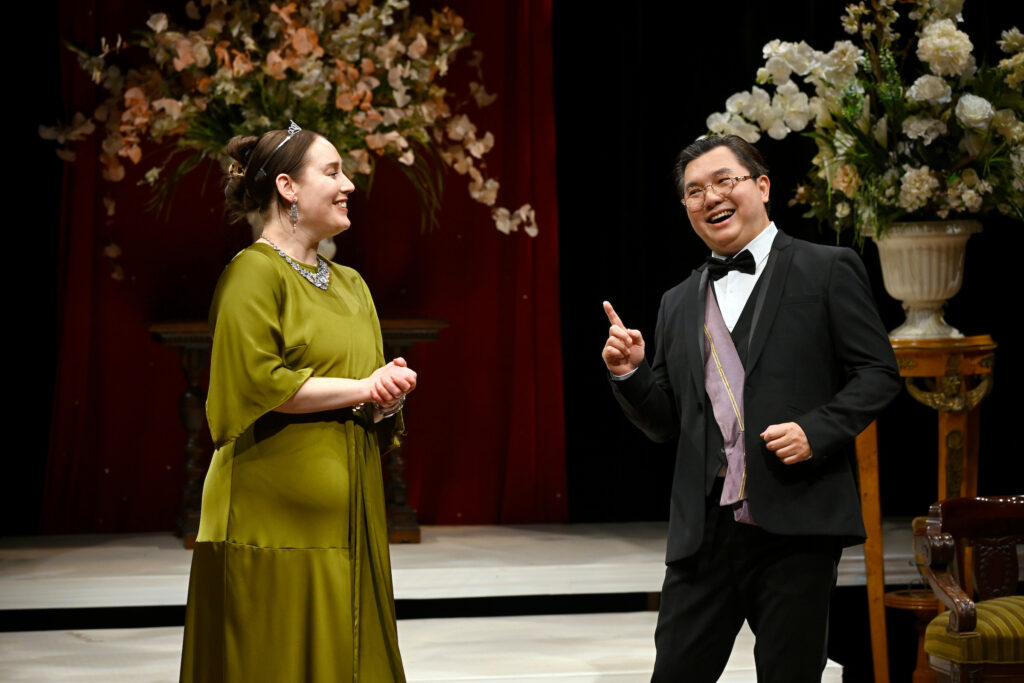
Meghan Symon (Princess Anhilte) & Handaya Rusli (Prince Leopold) in TOT’s The Czardas Princess. Photo: Gary Beechey
Another operetta trope is the older aristocratic couple who turn out to be lynchpins in the final unfurling of the drama. Czardas Princess is no exception in this regard, but I won’t give away the twist ending. Meghan Symon now reigns supreme in these types of roles for TOT and brought understated comedy to her turn as Princess Anhilte. Handaya Rusli was likewise commanding and blustering as her husband, Prince Leopold.
Key to the smooth-running of the entire machine was Joseph Ernst as cabaret habitué, Feri, who eventually reveals the crucial secret that allows Sylvia to marry Edwin. Ernst’s affable presence and pleasant high baritone added polish to the many fun ensemble numbers.
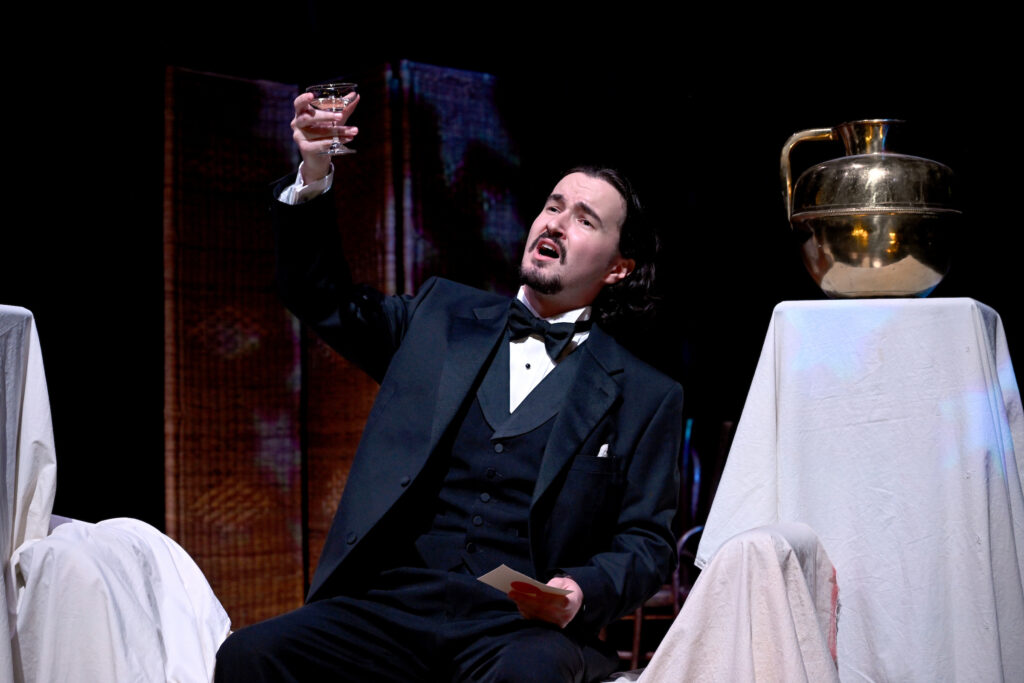
Joseph Ernst (Feri) in TOT’s The Czardas Princess. Photo: Gary Beechey
The chorus made up in precision and lusty tones what they may have lacked in numbers. All members were engaged participants in all the big numbers. Derek Bate led the 10-member orchestra with a practiced hand, knowing exactly when to relax tempi, or encourage an exciting accelerando. Concertmaster Mark Skazinetsky must be singled out for playing with gusto what amounted to any number of virtuosic ‘solos’, while intentional or not, given the small instrumental ensemble.
The continued success of smaller companies like TOT within a national context of ever-shrinking seasons and conservative programming cannot be taken for granted, and needs to be supported. Czardas Princess is the perfect antidote for ‘these times’.
Toronto Operetta Theatre’s The Czardas Princess continues its run with three more performances on January 2, 3 and 4 at Toronto’s Jane Mallet Theatre at the St. Lawrence Centre for the Arts.