This page is also available in / Cette page est également disponible en:
 Français (French)
-
Deutsche Grammophon3.5
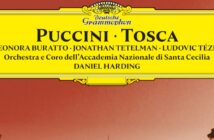
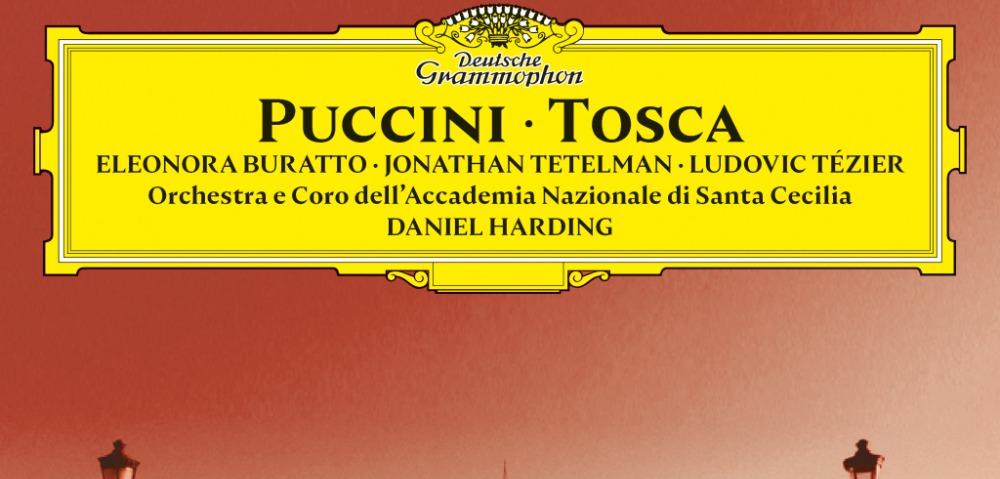
Puccini: Tosca
Eleanora Burrato and Alice Fiorelli, sopranos; Jonathan Tetelman and Matteo Macchioni, tenors; Ludovic Tézier, baritone; Giorgi Manoshvili, Davide Giangregorio, Nicolò Ceriani and Constantino Funicci, basses; Orchestra, Coro e Voci Bianchi dell’Accademia Nazionale di Santa Cecilia – Roma; Daniel Harding, conductor
Deutsche Grammophon, 2025
Does the world need another recording of Puccini’s Tosca? Probably not, as multitudinous versions are available. So, does anything set this new release apart from the crowd? In one major way, yes.
The performance was caught live last October at the orchestra’s home turf, the Santa Cecilia Hall. Time and place are noteworthy for several reasons, not least that they mark Daniel Harding’s debut as the orchestra’s musical director as well as a nod to the centenary of Puccini’s death. And, of course, it takes the opera to the city in which it debuted and in which it is set, each act taking place across a day and night in Rome in 1800. The quality of recorded sound is excellent in balance and clarity.
The overarching quality of the performance is easily summed up. It is measured and exquisite. Harding has obviously completely rethought how to approach Tosca, and his work is revelatory. He shines a light where gloom traditionally lurks and no detail remains unnoticed—it is like seeing a well-known painting cleaned back to its startling original colours.
One tiny example: in Act 2, Scarpia offers Tosca a glass of wine, just before her famous “Quanto? Il prezzo!” In the score his line is marked dolce, suitably oleaginous. For the first time ever I heard a brass G natural push to the front of the musical weave—a startling warning of Scarpia’s duplicity. In the same act, all of Tosca’s hysteria suddenly becomes music, rhythmic and measured against the orchestra. (Heretically, I seem to be the only person who finds the film of Callas and Gobbi in Act 2 of Tosca a rugby scrum both visually and aurally). The bells across Rome at the start of Act 3 are more precise than I’ve ever heard before. It is all fascinating.
There is one problem with such a revelatory orchestral approach, which is played to perfection: people keep singing over it. Harding conducts opera sporadically and the last performance of his I reviewed was Adriana Lecouvreur, filmed in Florence. It was a surprising choice for him but a huge success, and I remember noting that the orchestra stayed in the pit to applaud his curtain call. Here, it’s as though some of Adriana’s perfumed languor has drifted across to Rome, which really requires something more robust—an odour rather than a fragrance. Tosca is a brutal drama, a thriller—all sex, drugs and cantata. And, while I relish hearing it afresh, this reading does suffer from a certain dramatic inertia.
The cast is excellent. Eleonora Buratto is quite new to the title role and has everything it requires. Her soprano is strong and true up to her top C, and her tone is generally warm and generous. This Tosca is feisty and takes her chances. Buratto nails every note, where other sopranos often skate with dramatic intent mixed with wayward approximations. She never resorts to shrieking, in which regard she is quite rare, especially in Act 2. She really comes to life in the role when confronted with Ludovic Tézier’s Scarpia, an aristocratic sadomasochist who enjoys turning the thumbscrews. His baritone has vocal glamour mixed with suitable heft and, like Buratto, he benefits from Harding’s precise baton. The Cavaradossi, Jonathan Tetelman, gives a more generic reading of his role. It is beautifully vocalised, on the light side, but with clarity and pleasing forward placement with some thrust and great notes above the stave. The voice certainly has a good ring to it and Tetelman sounds young and vibrant. But he sounds less involved, as if he didn’t quite get the memo, though he does suddenly sound more committed in Act 3 and “O dolci mani” has a melting sweetness.
The supporting is cast is strong. Giorgi Manoshvili furthers his growing reputation as a desperate Angelotti, his moments with Cavaradossi full of drama that really does come through, and Davide Giangregorio makes a bumbling Sacristan. To sum up, this is a beautiful recording in many ways, but just lacking the fire in the belly that a great Tosca needs. Stick with your favourite recording, and perhaps even its runner-up. But Harding’s reading is remarkable for its illuminating attention to detail. One for the connoisseurs, I suspect.
This page is also available in / Cette page est également disponible en:
Français (French)