
Tuesday, June 3: Sham Rocks, the Rest Bomb
The final round of the Van Cliburn International Piano Competition features two concerto performances by each of the six contestants. Most pianists chose standard war-horse concerto repertoire: Tchaikovsky’s first concerto, Rachmaninov’s third, Brahms’s second, etc. There were a few daring outliers, however, including Aristo Sham’s Mendelssohn G minor concerto op.25, Vitaly Starikov’s Bartók second concerto, and Carter Johnson’s Ravel concerto for the left hand.
The first evening of these Cliburn finals featured one outstanding performance and two embarrassing ones. Missed notes, missed opportunities, missed entrances. Missed musical intent.

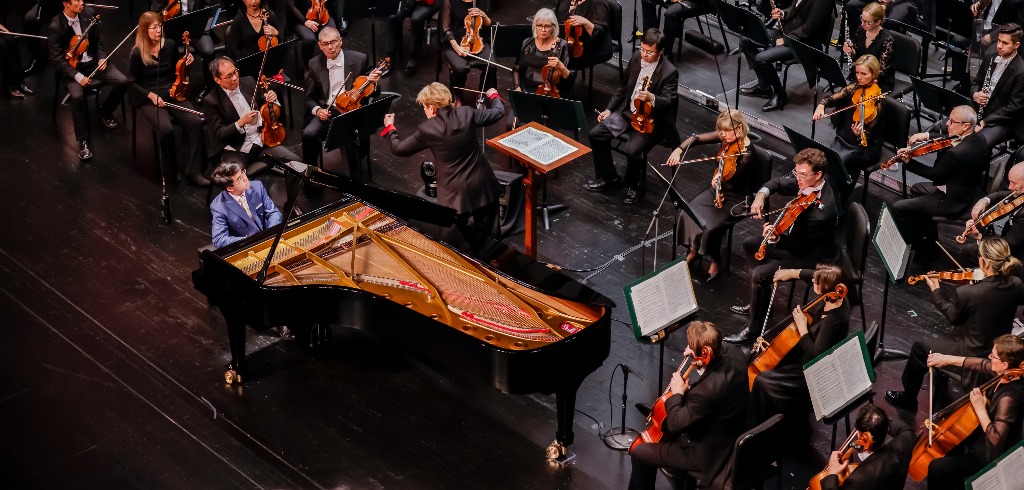
Aristo Sham with Conductor Marin Alsop and the Fort Worth Symphony in the finals of the Seventeenth Van Cliburn International Piano Competition. Photo: Ralph Lauer
Opening this highly anticipated event in front of a packed crowd at Bass Performance Hall was Hong Kong China’s 29-year-old Aristo Sham. Walking on stage dressed in an impeccable shiny blue suit and colourful stripy socks, he graciously and intently acknowledged Maestra Marin Alsop as a valued artistic partner. This classy move was well received by the public.
From the initial fiery cascading passages, Sham affirmed his command of the stage and of this historic moment for him. His confident, princely stage presence won over the crowd within moments. Mendelssohn’s concerto suited the candidate’s strengths: lovely phrasing, clear sound projection, and a brilliant and pearly sound. Sham was also the only pianist who had true chemistry with Alsop at the helm of the orchestra. The duo performed wonderful chamber music, blending the sounds of the piano with the orchestra in a bold, flawless, and passionate performance.
Yet, Sham is not a melt-your-heart type of performer. There is something almost prefabricated about his performance: he knows exactly what he will do, how, and when. More than anyone else, he puts on a great show, professional and reliable. A little bit like a smooth business deal.
Performances that leave you indifferent require a special skill too. A gift that the next two American contestants were determined to illustrate.

Angel Stanislav Wang with Conductor Marin Alsop and the Fort Worth Symphony in the finals of the Seventeenth Van Cliburn International Piano Competition. Photo: Ralph Lauer
Performing one of Beethoven’s masterpieces, Concerto n.4 in G major, op. 58, Angel Stanislav Wang started promisingly enough with the beautiful chordal opening. But things went south very quickly. For one, the pianist’s youth became evident in his delivery of passages at face value. Instead of poetry, intellect, drama, we heard scales and arpeggios follow each other without any raison d’être. Whatever Beethoven intended—it was not this.
What came next, was nothing short of a display of amateurism rarely heard at this stage in a competition like the Cliburn. In the middle of the first movement, an orchestra member spectacularly dropped what sounded like a loud and heavy percussion instrument. It added a touch of Stockhausen to shake up the monotony. Then came Wang’s memory lapse at the opening of the cadenza, one of the most dramatic parts of the entire work. The rest is best forgotten.
Wang’s redundant and undifferentiated sound confirmed my suspicion since hearing his first recital: he doesn’t know what to do when the music’s intent is not obvious. Even then, his main tool for expressing drama is erupting in passages with speed and loud dynamics. At some point, I heard a copious snore from one of my neighbours. An appropriate response to this performance.

Evren Ozel with Conductor Marin Alsop and the Fort Worth Symphony in the finals of the Seventeenth Van Cliburn International Piano Competition. Photo: Ralph Lauer
In an attempt to redeem his country’s honour, 26-year-old Evren Ozel walked on stage with confidence. Unfortunately, it didn’t take the first complete sequence of ascending chords in the famous opening of Tchaikovsky’s Concerto in B-flat minor to realize: this was the wrong concerto for him. While an excellent musician, Ozel doesn’t have the type of charisma and personality to excel in this work. Despite his technique and energy, it didn’t deliver.
Ozel’s strongest point is his ear for colours. His best moment came at the cadenza of the first movement when he miraculously opened the sound of the piano, listening to the voicing and colours throughout the registers. His natural sensitivity for Ravel, impressionistic Liszt, and late Beethoven allows him to excel in soft dynamics, subtle harmonic changes, and voicing. Ripping through the fast sections of the slow movement, Ozel played fast without real excitement in the wondrous and joyfully festive music. A sloppy beginning of the third movement did not improve the impression. He practised the notorious octave passages well; I’ll give him that. The rest was underwhelming.
Tuesday, June 3: The Starikov Show, Johnson Comes Close
The second night of these finals featured a much stronger overall batch of contestants: Russia’s Philipp Lynov, Russia and Israel’s Vitaly Starikov, and Canada and the USA’s Carter Johnson.

Philipp Lynov with Conductor Marin Alsop and the Fort Worth Symphony in the Finals of the Seventeenth Van Cliburn International Piano Competition. Photo: Ralph Lauer
Presenting Liszt’s Second Piano Concerto in A major, Lynov started well with a sense of drama and excitement. Soon enough, his weaknesses came to the forefront: a lack of collaborative ability and the necessary openness for generous music making. Much like in his Mozart concerto, Lynov doesn’t shine in an ensemble setting. He is a type of self-centred solo pianist who excels only when he can control all the elements of the performance.
There was not much exchange with the orchestra or with the conductor. The performance sounded made up of carefully pre-planned gestures, instead of feeling improvised and generous. In principle, Lynov should have everything to excel in this repertoire: the technique, the sound, the hair. What he lacks is the right kind of charisma for this music characterized by freedom, abandon and a wide-open heart. What every description of Liszt’s persona and playing conveys.

Vitaly Starikov with Conductor Marin Alsop and the Fort Worth Symphony in the finals of the Seventeenth Van Cliburn International Piano Competition. Photo: Ralph Lauer
As 30-year-old Vitaly Starikov walked on stage, one couldn’t help but wonder how he would physically manage Bartók’s famously knuckle breaking Second Concerto. After a little Victor Borge moment fussing with the piano bench, which warmed him up to the audience, Starikov fearlessly plunged into the depths of hell. Within seconds, this became an exciting performance.
Starikov may not have a huge sound, but he played his heart out, and killed the first movement cadenza. In the second movement, he took the performance to yet another level with brilliant, knife-cutting tension. Following an exciting beginning of the third movement, Starikov played the bejesus out of the concluding technically horrendous part. His entire performance was raw, deeply felt, and powerful; yet, his playing was never forced, tiresome, or irritating to listen. He understood this music, and gave an impactful, lively, and gripping interpretation on all levels: emotionally, architecturally, and in terms of his sound palette.
This is precisely that slight edge over a perfectly pristine and chiselled performance, such as we’ve heard a few so far. Despite a small decalage with the timpani and slightly under-projected moments due to a thick orchestration, Starikov’s was a medal contesting performance.

Carter Johnson with Conductor Marin Alsop and the Fort Worth Symphony in the finals of the Seventeenth Van Cliburn International Piano Competition. Photo: Ralph Lauer
Then came the real challenge for a critic: Carter Johnson’s performance of Prokofiev’s Second Piano Concerto op.16. Composed after the suicide of his best friend, Max, this is one of the composer’s darkest works. Johnson immediately showed that he is a powerful pianist, managing an effective emotional arch throughout the movement. While his cadenza was a bit messy, Johnson delivered a strong and emotionally charged performance.
Yet, after a brilliant second movement, one started to notice a pattern. While emotionally charged, Johnson’s performance grew tiresome and ineffective due to the lack of expressive variety. The tragedy and darkness of this music can hit you with a creepy, eerie chill. It can have sarcasm and some dark humour, with a sense of devilish fun at times. Finally, Prokofiev’s drama sometimes also manifests itself in a highly rational, cold manner which, paradoxically, provides that most touching, vulnerable, exposed, and delicate expression. None of this came through.
Johnson is a talented and thorough musician, and a powerful pianist, but one gets the feeling that this is not his musical language. Perhaps he didn’t have enough time to explore the variety this work has to offer. Even in the last movement, Prokofiev’s lyricism was not entirely committed. The final cadenza allowed more openness with strong, gripping, and poignant moments; Johnson showed more depth and nuance towards the end. Powerful, but too late, like an afterthought.
For all of our Cliburn reports, articles and videos visit Spotlight | Cliburn 2025