
This page is also available in / Cette page est également disponible en:
 Français (French)
Perhaps more than any other member of the orchestra, the flute carries a mythical flair. From the Neanderthal flutes discovered at Divje Babe cave in Slovenia, to the Greek myth of the god Pan who cast his seven-reed flute in the image of his unrequited love, to the tale of the Pied Piper of Hamelin who hypnotized the children of citizens who refused him payment after he freed their town from rats—the sound of the flute mesmerizes mankind.
The case of one of Serbia’s greatest flutists, Ljubiša Jovanović, is no exception. “My life’s path began when I heard the Berlin Philharmonic play at the BEMUS (Belgrade Music Festival) in 1972,” says Jovanović. “Herbert von Karajan conducted, and Sir James Galway played the solo flute. At 15 years old, this experience changed the course of my life. Every phrase I heard that evening remained engraved in my memory until this very day.”
A few years later, Jovanović joined the flute class of Prof. Miodrag Azanjac as an undergraduate student at the Music Academy in Belgrade (now Faculty of Music, University of Arts). A charismatic personality, Azanjac guided his talented newcomer to uncover the full potential of his natural musicality through the instrument.

Ljubiša Jovanović & students at summer academy in Beijing
A major shift in Jovanović’s early career occurred in May 1980 when famed French flutist Jean-Pierre Rampal arrived in Belgrade to play a recital. “He offered a master class to local students, for which I was selected,” he explains. The two worked for hours together in the Kolarac Foundation Concert Hall (which hosts the Belgrade Philharmonic). “Rampal was impressed with my sincere musicality and offered to introduce me to Christian Lardé, who taught at the École Normale de Musique de Paris,” says Jovanović.
At Rampal’s recommendation, Jovanović met Lardé the following year, and passed his entrance exam to join his international class in Paris. One of the jury members at his audition was the school’s director, the composer and music writer for Le Figaro, Pierre Petit, who insisted that the young flutist from Belgrade receive a full scholarship. This support allowed Jovanović to obtain the highly coveted Diplôme de concertiste two years later, a distinction given to only two or three of the most talented performance students each year.
After the conclusion of his studies in Paris, in 1983, Jovanović studied privately with Aurèle Nicolet for a year in Basel, Switzerland. Considered to be one of the greatest flutists of the 20th century, Nicolet taught generations of flutists from Emmanuel Pahud (Berlin Philharmonic) to soloists Irena Grafenauer and Marina Piccinini.
“My friendship with Nicolet was deep, sincere, and lasted until his death,” Jovanović recalls. “I can say that both Lardé and Nicolet, with their love, patience, and wisdom, left the deepest impact on me.” After three years abroad, he returned to Belgrade with a desire to pass on his experience to generations of talents in Serbia.
From 1988 to 1997, Jovanović spread his roots in his hometown through his appointment at the Radio Orchestra, then as solo flutist of the Belgrade Philharmonic, followed by teaching positions at the Faculty of Music in chamber music and flute performance—a post he occupies to this day. While sanctions imposed on the country during the wars of the 1990s brought severe limitations to the development of artistic life in Serbia, Jovanović kept performing extensively.
As his country progressively re-emerged in the early 2000s, a sense of hope gave new wind to his sails. To celebrate 25 years of artistic work in 2004, Jovanović invited Emmanuel Pahud and Sylvia Carredu to perform with him and the newly founded Camerata Serbica, a 45-member orchestra, in a filled-to-capacity concert at the 3,000-seat Sava Centre in Belgrade. Through his leadership, the orchestra brought some of the biggest names in music to Serbia: Luciano Pavarotti, Vladimir Ashkenazy, Sting, Andrea Bocelli, and others.

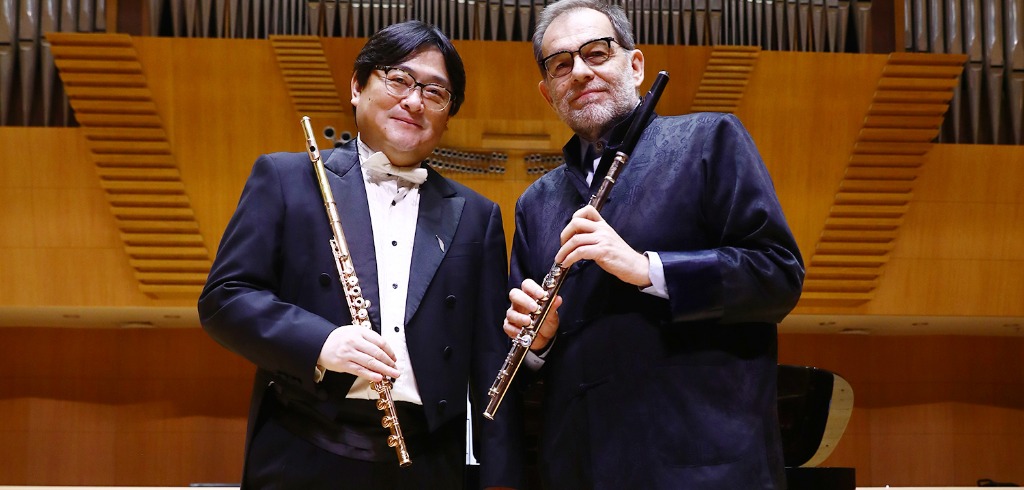
Guoliang Han & Ljubiša Jovanović
In 2005, as a jury member at an international flute competition in Bucharest, Jovanović encountered Guoliang Han, flute professor at the Central Music Conservatory in Beijing. “Han brought a phenomenal group of youngsters he had trained. Thanks to their playing quality, six of them were among the 10 finalists of the competition. This was a revelation for me,” says Jovanović. Recognizing the potential of the Chinese competitors, unlike other members of the international jury, Jovanović lent his support as they earned top prizes.
“Professor Han and I understood each other. Like me, he trained in the West, but chose to return to his own country instead of staying abroad,” explains Jovanović. A few months later, he received an invitation to teach a master class and play a series of recitals at the Beijing Conservatory. The warm reception of students and faculty grew into a collaboration between Jovanović, Han and their students who met in China every year over the last 20 years. This partnership culminated in an award given to Jovanović by the China Flute Association in recognition of his contributions to the Chinese flute community.
A Haynes artist since 2015, Jovanović plays on a Haynes flute, a wooden Sankyo flute, and two heads: a golden Faulisi and a wooden Mancke. “All musical life is the search for an ideal sound,” he says, recalling the years spent with generosity, empathy, and sharing his art with the world.
This page is also available in / Cette page est également disponible en:
Français (French)