Browsing: Lebrecht Weekly

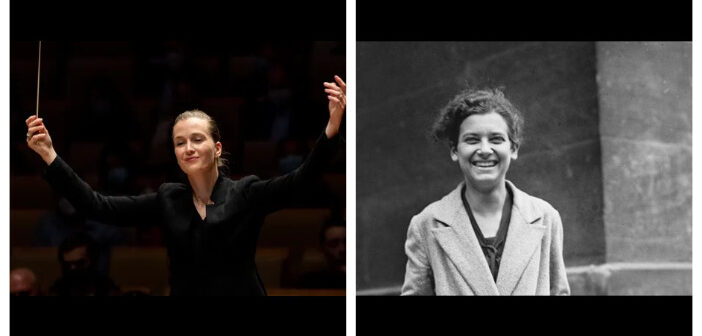
The second symphony by this unsung French composer has been included in this summer’s BBC Proms and I wanted to get familiar with it before deciding whether to go. Barraine (1910-1999) had an eventful life. Daughter of the principal cello of the Paris Opéra, she attended the same Conservatoire class as Olivier Messiaen and won the prestigious Prix de Rome. Her first symphony is dated 1931, the second 1938. She joined the Communist Party in the late 1930s and the Résistance during the German Occupation. Post-War she taught at the Conservatoire, was an inspector at the Ministry of Culture and…
Share:

Rachmaninoff had large hands and enormous fingers. He wrote concertos for himself to play. The third, in D minor, had its US premieres in Carnegie Hall with Walter Damrosch conducting the first run, Gustav Mahler the next. The concerto proved conspicuously more difficult than its predecessors to achieve with precision. A fear factor set in among lesser pianists. Rachmaninoff, though, was a generous man, quick to acknowledge when others played better than he did. He preferred Vladimir Horowitz’s recording of the D minor concerto to his own. Others who imprinted their take in the work down the ages include Emil…

Share:

If you had told me at the start of the week that I’d still be listening to Biber on Friday, my response would have been dusty and unprintable. Middle-European music before Johann Sebastian Bach has about as much interest for me as a squeezed-out tube of toothpaste. The world of Heinrich Biber, a Salzburg violin composer in the Italian style, was rendered obsolete by the birth in 1685 of Bach and Handel. Biber kept plugging away until 1704, just about long enough to see himself dwarfed by genius. His music, as much as I have heard, is unadventurous and ingratiating,…

Share:

What’s this record doing on my deck? I have listened to Furtwängler’s own recordings of his overlong second symphony and have heard it performed live by Daniel Barenboim with the Berlin Philharmonic without walking out. The works spends three-quarters of an hour going nowhere. Furtwängler composed it in Switzerland after fleeing Berlin in January 1945, abandoning his musicians to a desperate fate. The work propounds motifs of fate and destiny beloved of German composers from Schumann to Strauss, alternating massive ffffs and church-organ simulations, all the tricks of the orchestral trade. There are some tender woodwind strands in the third…

Share:

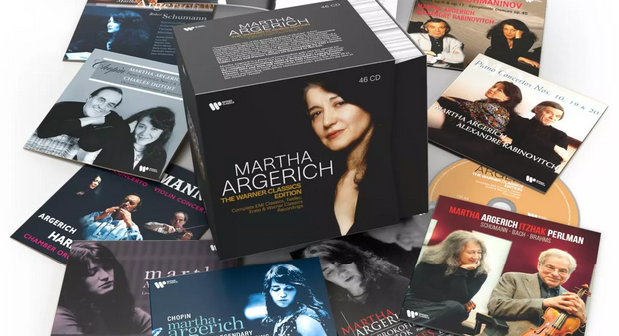
Some artists stop at nothing to get attention. Others shy away from it like birds of an endangered species. No prizes for guessing which category Martha Argerich belongs to. The Buenos Aires-born pianist has never given a sit-down interview in her life, never posed for cover shots, never taken a political stance. Despite these modest precautions, she became the world’s most sought-after keyboard artist. At 83, after bouts of ill-health, each recital she now gives seems like a miracle. The present box-set, combining former EMI, Teldec and Erato releases and her festival events at Lugano, is but a partial record…

Share:

The second cello concerto of Dmitri Shostakovich has never matched the first in public appeal or soloist appreciation. Premiered on the composer’s sixtieth birthday, at a concert where he was proclaimed a Hero of Socialist Labour, the concerto is ambivalent both in meaning and in its balance between soloist and orchestra. There are stretches where the cello is left to find its own way home as a huge orchestra sits idly by. Quite possibly a metaphor for Socialist Labour. Mstislav Rostropovich, for whom the work was written, made a hash of its first recording and the work has, to some…

Share:

Like every reviewer I love surprises, and nothing has surprised me more in a month of Easter Sundays than this delicate and brilliant pairing of Japanese and Viennese classical songs. The album notes are skimpy and mostly in Japanese so I’m guessing here, but I’ll credit the selection of songs as well as the performance to Misaki Kobayashi, apparently a soprano in the Berlin radio choir. The pairings are so smart they are practically symbiotic. Kobayashi opens with a springtime song by Rentaro Taki (1879-1903) and matches it with Beethoven’s little-sung Ich liebe dich. Who’d have thought? It works brilliantly.…

Share:

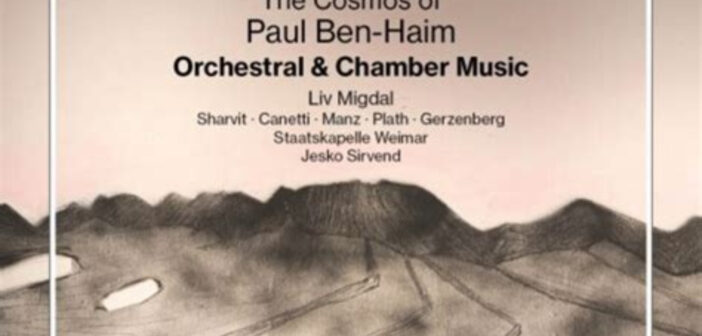
If you are looking for neglected stocks in these shaky times, you could do worse than sink a pair of ears into the music of Paul Ben-Haim. It seems to be heading for revival. Lahav Shani is recording the symphonies for DG and other works are popping up all over the place. This 145-minute compilation under review mingles orchestral and chamber music to positive effect, prompting this listener at least to reconsider some aspects of a much-misunderstood composer. A conducting assistant to Bruno Walter in Munich, Paul Frankenburger fled to Palestine when the Nazis seized power and changed his name…

Share:

It may be a bit early in springtime to be nominating an Album of the Year, but I’ll be very surprised if any release in the next eight months makes me sit up and take note with such awe and excitement as this absolute cracker from the Dutch label Pentatone. The composer turned 99 two months ago. He has been writing this piano series – the Hungarian title means ‘Games – since 1973, adding fresh episodes every now and then. There are 75 complete movements to this suite and another ten in manuscript. Kurtág may yet have more up his…

Share:

The most influential Irishman in the history of music is not Bob Geldof, Bono, Sinead O’Connor or the Dubliners, all of whom are famous as influenza, but a fairly obscure piano salesman who awoke a sub-continent to its creative potential. John Field was born in Dublin in 1782 to Anglican parents who took him to London to work for Muzio Clementi, Beethoven’s publishing partner and piano dealer. As a rep for the wealthy Clementi, Field travelled to Paris and Vienna before settling in St Petersburg, where he starred at the new-founded Philharmonic Society. Field gave three piano lessons to Mikhail…

Share:
1 3 4 5 6 7 57