
This page is also available in / Cette page est également disponible en:
 Français (French)
-
Fuga Libera4.5
Foccroulle/Jocelyn: Cassandra
Katarina Bradić, Susan Bickley, mezzo-sopranos; Jessica Niles, Sarah Defrise, sopranos; Paul Appleby, tenor; Joshua Hopkins, baritone; Gidon Saks, bass-baritone; La Monnaie Symphony Orchestra and Chorus, Kazushi Ono, conductor
Fuga Libera, 2025
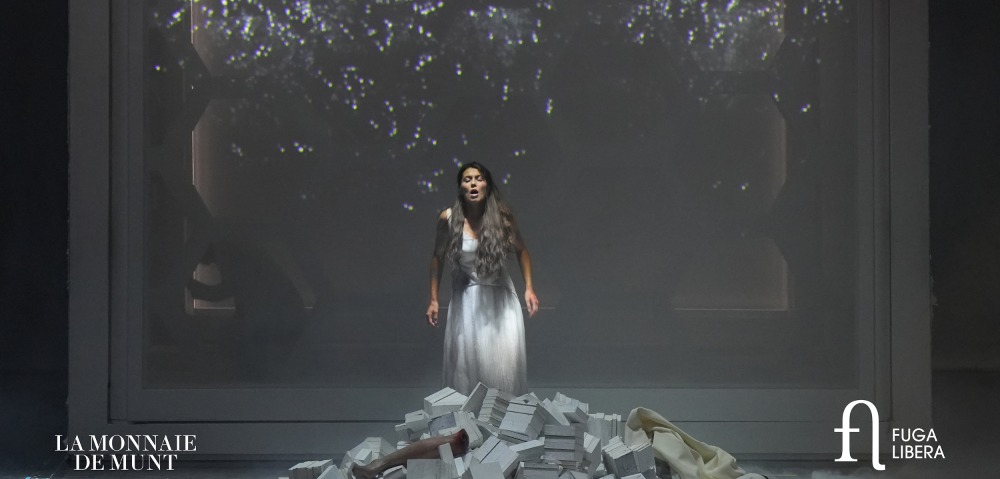
Cassandra is a 2023 opera in prologue and 13 scenes composed by Bernard Foccroulle, with libretto by Matthew Jocelyn. It weaves together the story of the Trojan Cassandra, as told by Aeschylus and others, with the story of Sandra, a climate scientist just completing her PhD about the disappearance of ice in the Antarctic.
So, two women with an accurate but horrifying message that no one wants to believe. There’s a secondary dichotomy between Sandra, scientist, observer, persuader, and her lover Blake who is an eco-activist; and also a classicist.
The opera is very cleverly structured with scenes from the lives of the two women and their families interleaved until, finally, they meet and Sandra realises that there is no god to “spit in her mouth.” She will not be silenced.
The parallels between the womens’ families are also interesting, with the father and mother played by the same singers in both cases. Priam and Hecuba come to realise that their story, as written by the poets, is exactly as Cassandra prophesied, while Alexander, Sandra’s mining executive father and her equally appalling mother Victoria, can only see glorious opportunity for profit in an ice-free Antarctica. Profits trump prophets every time. There are some neat plot twists and gut-wrenching surprises in there too, but I’ll resist spoilers.
Musically, it’s pretty much what I expect from a modern opera from continental Europe. The score is essentially atonal but the orchestral writing is multi-textured and very atmospheric with lots of tuned percussion. There’s no lack of lyricism either. The vocal line is mostly straightforward with only a few opportunities for display which means the text is clearly audible and since everyone in the cast has excellent English diction I didn’t need to refer to the libretto at all.
There’s also a playful link between text and music because the disappearing ice Sandra is studying is the Bach ice sheet, surrounded by Berlioz peak, Stravinsky inlet etc., and who wants to live in a world without Bach? And so basically we are played out to the chorus singing the German baroque master’s cantata “Ach wie flüchtig, ach wie nichtig” (“Oh how fleeting, oh how futile”).
The recording is well cast. Katarina Bradić’s dark mezzo as Cassandra contrasts nicely with the brighter tones of Jessica Niles as Sandra. Paul Appleby’s lyric tenor makes an attractive Blake. Gidon Saks, as the fathers, and Susan Bickley, as the mothers, vary up their delivery nicely to suggest two different but related characters. If there’s a villain it’s Josh Hopkins, whose stentorian baritone does double duty as Apollo, who is the one who cursed Cassandra, and the goon who heckles Sandra’s thesis defence. There’s also a brief cameo for Sarah Defrise as Sandra’s rather gormless sister. Oddly, she probably gets the showiest music!
This is pretty much everything I want in a modern opera. The story is compelling, important and beautifully crafted. The music is complex, textured, emotionally appropriate, lyrical and, for the reasonably open-minded, very accessible. It’s a long way from the “opera of the film of the book” that we see too often in North America.
The recording was made live at Belgium’s La Monnaie in Brussels in 2023, using the house orchestra and chorus conducted expertly by Kazushi Ono. The performance is well captured, with clarity and a realistic balance between voices and orchestra. It’s available as a two-CD set and digitally as MP3 and 44.1kHz/16bit FLAC/ALAC/WAV. I listened to the WAV version. There’s also a booklet with useful notes and a synopsis and there’s a downloadable libretto.
This page is also available in / Cette page est également disponible en:
Français (French)