
This page is also available in / Cette page est également disponible en:
 Français (French)
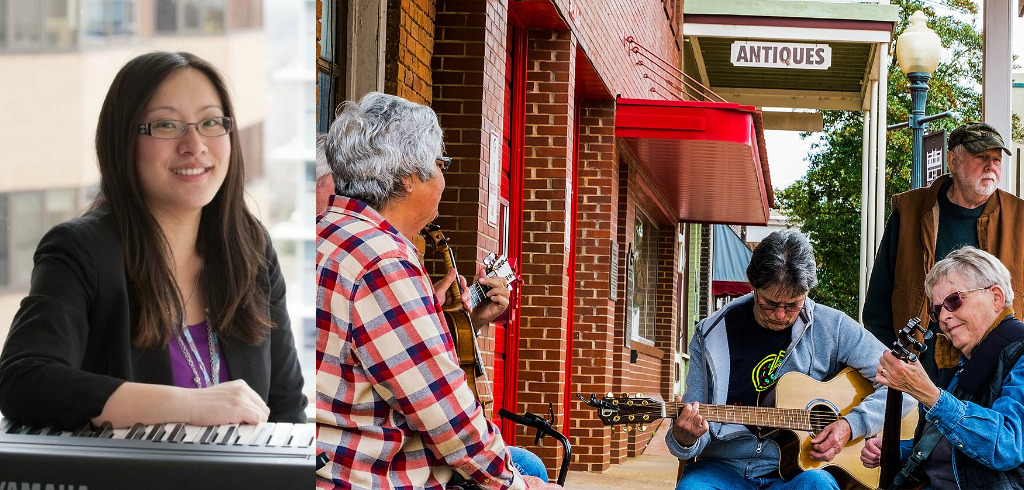
“I believe everyone can benefit from therapy, whether it be music therapy or verbal-based techniques,” says Kiki Chang, an instructor of music therapy at Capilano University in North Vancouver and the former president of the Canadian Association of Music Therapists. “You do not need musical talent or to have previous experience with music in order to benefit from music therapy.”

Kiki Chang
Chang says the aims of music therapy can vary, but common goals for older adults include expressing emotions, processing grief, reducing anxiety, and maintaining motor skills. Music therapists like Chang help participants to achieve their goals through a wide variety of methods. Those wanting to reduce their anxiety may listen to the music therapist—often a trained musician—play a familiar song. Alternatively, those aiming to maintain their motor skills may opt to play an instrument or tap their fingers along to the beat.
Chang shared the story of one particular client who stands out in her memory, a retiree seeking support for severe depression. “After retiring from work,” Chang explained, “he felt that his life lacked purpose and meaning.” Finding it difficult to speak about this experience, his clinical team referred him to Chang in the hopes that music therapy would help him with self-expression.
His experience is not uncommon among people undergoing what social scientists call a “major life transition”—i.e. a significant change in circumstance which alters the fundamental structure of a person’s day-to-day life. Older adults, in particular, experience many major life transitions as they navigate retirement, bereavement, and relocation. These events can increase a person’s risk factors for developing mental-health concerns, such as depression and anxiety.
Social isolation and the resulting loneliness are two of the most prominent risk factors among older adults. As individuals transition out of the workforce, they can lose access to the social roles with which they identified themselves for most of their lives. In Western societies where a person’s chosen field and career often defines who they are, retirement can lead to the loss of a sense of self. Without discovering new social roles, it is easy for older adults to feel adrift and distant from meaningful social connection.
Group and community-based interventions hold promise for mitigating these types of struggles. In order to address them, practitioners work on building up patients’ protective factors: the lifestyle traits which help address risk factors which increase the likelihood of developing major mental-health concerns. Music is one effective method of achieving this.

Photo: Tulane Public Relations
In her work with the retiree, Chang took this protective-factor approach and focused on helping him strengthen his social connections, both with her and with the important people in his life. Like in social settings, the music used in therapeutic settings can evoke emotion and build a closeness between people as they discuss a shared interest and passion for an art form. Chang believes that the therapeutic relationship between the music therapist and the participant is what distinguishes music therapy from other music-based activities. Music therapists and participants are able to build a one-on-one rapport through music and through other activities, like psychotherapy, also known as talk therapy.
She acknowledged, however, that such relationships do not always come instantly. In her work with the retiree, she said it took a few weeks to develop a therapeutic relationship, and for her to learn just how important music was to him. Slowly, she began to notice a pattern. “He could easily recall the song that was playing on the radio the first time he met his wife,” she said, “and his son’s favourite song when he graduated from high school.” She proposed that the two of them work collaboratively to create a musical autobiography consisting of recordings of songs he associated with various periods of his life.

Photo: Mushfiq Ali Khan
This is only one of the many forms that music therapy can take. Musical improvisation—using voice, instruments, and even nontraditional music-makers like household objects—is an increasingly popular technique among music therapists. Some music-therapy participants express themselves through a familiar instrument when words feel insufficient, while others learn an instrument for the first time as a practice in maintaining fine- motor skills. Some simply sit and listen to music therapists play familiar songs, a practice that can be helpful for maintaining memory and cognitive function.
Chang said the experience of working with the retiree was very impactful for her, as she hopes it was for him. “The last song of his musical autobiography was his wedding song and he expressed interest in singing the song himself while I accompanied him on the piano. We recorded the song together and he dedicated the autobiography to his wife, thanking her [for]standing by him.”
Find the Canadian Association of Music Therapists at www.musictherapy.ca.
This page is also available in / Cette page est également disponible en:
Français (French)