Salzburg is a fairy-tale city, though not—or at least not only—in the usual sense of being merely preserved, lacquered, and offered up to tourists like a confection behind glass. It feels, rather, as if it exists outside time altogether: not so much frozen in history as suspended above it. Here, history presents itself aesthetically.
Music does not simply inhabit the city; it circulates in its bloodstream. Nowhere is this more palpable than during the great festivals of Easter and Summer, when the place assumes its truest form. By day, Salzburg cheerfully commercialises the image of its most famous son, Mozart: his face smiles on chocolates, ice cream, shop signs, and giant Lego figurines, lending him the air of an 18th-century demigod as reimagined by a toy manufacturer.
By dusk, the city undergoes a transformation. The old town’s picturesque choreography gives way to a pilgrimage of the music-faithful toward the Festspielhäuser. Chauffeured cars draw up in glittering rows; elegantly dressed couples emerge as if stepping into a Lubitsch film. The glamour is so complete, so hermetically sealed, that the world beyond the city’s baroque facades begins to feel almost unreal. News of war, destruction, and the casual wiping out of civilisations is unable to breach this enclave of cultivated oblivion. Salzburg offers if not innocence, then at least a highly refined form of temporary amnesia.
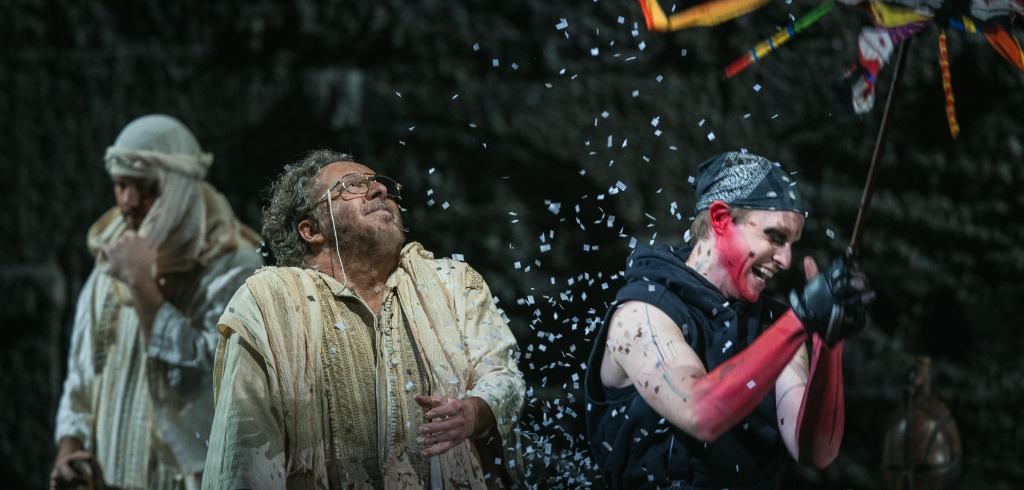
Even the ominous imagery advertising this year’s Osterfestspiele—drawn from Kirill Serebrennikov’s post-apocalyptic Das Rheingold — seemed less a warning than an instance of avant-garde chic. Apocalypse Salzburg-style arrives beautifully lit.
Founded in 1967 by Herbert von Karajan, the Easter Festival this year was crowned by the return of its founding orchestra, the Berlin Philharmonic, under Kirill Petrenko, and by the beginning of a new Ring cycle. But before gods and gold came another kind of immensity.
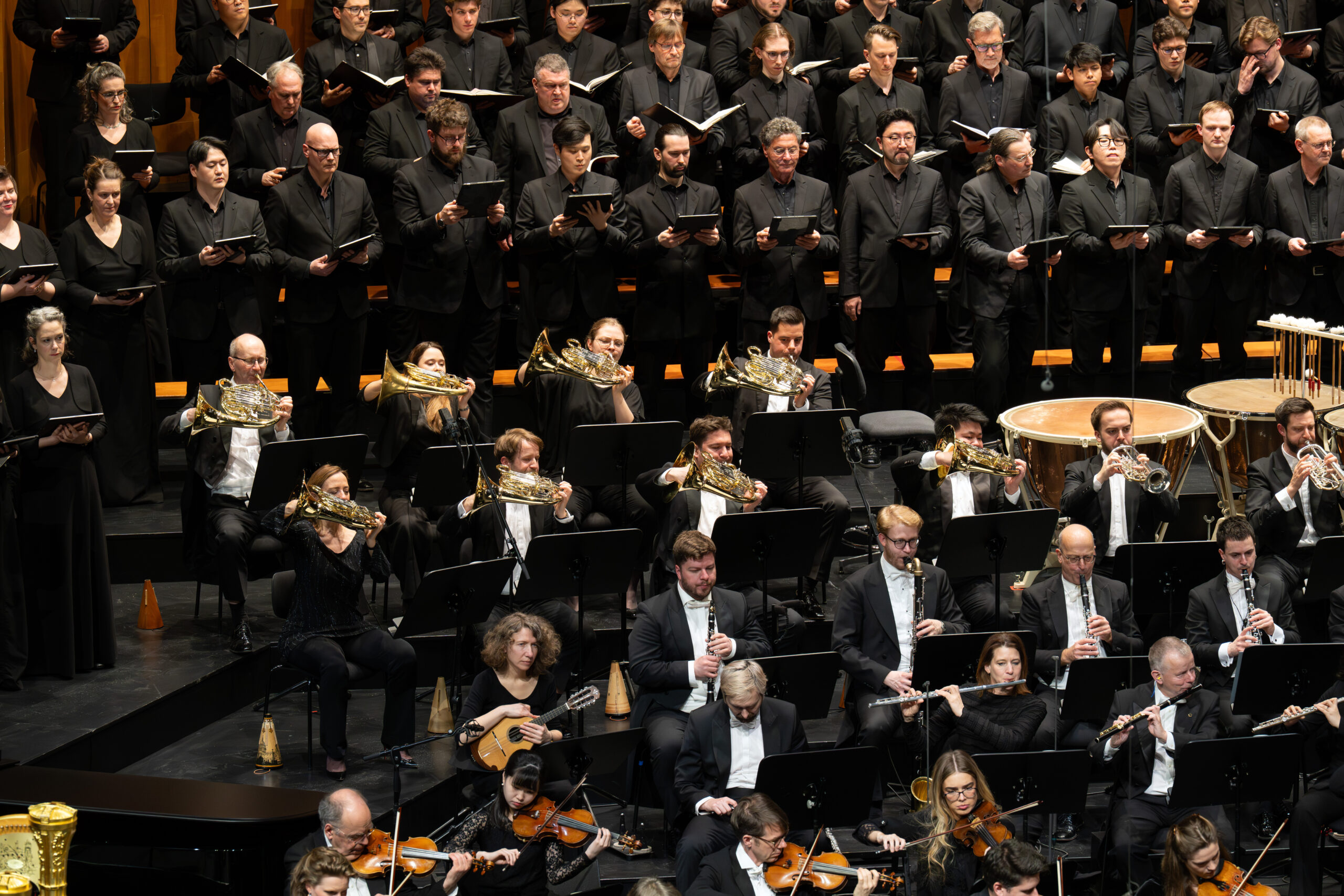
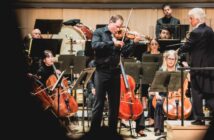
Berlin Philharmonic at the 2026 Salzburg Easter Festival. Photo: Monika Rittershaus
Mahler’s Eighth Symphony in the Grosses Festspielhaus (Apr. 3) was one of those rare evenings that render criticism faintly absurd. The hall, built for grandeur, seemed almost to inhale before the opening organ blast (though which, perhaps tellingly, this was the only moment in the evening that betrayed the slightest hint of understatement). After that, we were swept into an experience so physically overwhelming that descriptors such as “beautiful” or “impressive” are hopelessly inadequate. This was music as felt in the bones, the whole body vibrating under the force of Mahler’s sonic architecture.
Jacquelyn Wagner, Beth Taylor & Fleur Barron with Berlin Philharmonic at the 2026 Salzburg Easter Festival
Photo: Monika Rittershaus
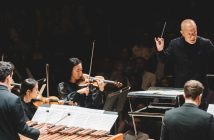
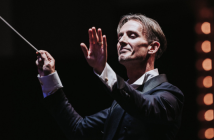
From my seat, close to the front, I could observe Petrenko’s conducting at first hand, which was an education in itself. Relatively small in stature, he nevertheless seems to harness the energy of a detonating star. He conducts with an intensity that never spills into showmanship. There is nothing exaggerated, nothing self-advertising. Every gesture is exact, efficient, and yet somehow balletic: a marvellous paradox of economy and visceral force.
What astonishes most is the sense of organic flow. In a work so vulnerable to monumental self-aggrandisement, Petrenko gave it momentum without haste, grandeur without bloat. Episodes blended seamlessly into one another, the vast spans held together by an inner pulse that never relaxed. This was especially vital in Part Two, where Mahler himself hovers perilously close to self-indulgence. On this occasion the symphony’s two halves felt utterly balanced: a true yin and yang, with sacred invocation and metaphysical ascent in perfect complementarity.
In lesser hands the second part can sprawl into a kind of celestial wallpaper. Under Petrenko it grew and unfolded with almost supernatural logic, as if the music were creating itself in real time. Everything felt developmental, necessary, inevitable. Contrasts were rendered in high definition: moments of blazing transcendence gave way to passages of exquisite stillness and serenity, which in turn re-ignited into cosmic awe.
Benjamin Bruns, Gihoon Kim & Le Bu with Berlin Philharmonic at the 2026 Salzburg Easter Festival
Photo: Monika Rittershaus
The soloists were uniformly first-rate, with tenor Benjamin Bruns especially unforgettable—ringing and resonant in the many heroic passages, yet capable of an almost angelic softness. The sense of ensemble was remarkable: soloists listening intently to one another, shaping phrases as chamber musicians might. The choirs, too, were immaculate, with diction of extraordinary clarity and an almost uncanny precision in the mysterious echoing passages of the second part. The children’s voices, suspended above the orchestral fabric, seemed genuinely otherworldly.
And throughout it all, Petrenko conducted with such noble authority that Mahler’s own annotations to the score seemed to offer the only adequate description: voll Anmut—full of grace. He did not appear to be interpreting the music so much as ushering it into being. As clichéd as it may sound, this was, quite simply, the experience of a lifetime.
The Salzburg audience, famously measured in its enthusiasm, took a moment to rise to its feet. One almost wanted to tap them on the collective shoulder and ask: if not for this, then for what?
From Mahler’s cosmic cathedral to Wagner’s mythic prologue, the transition was less abrupt than it might seem.
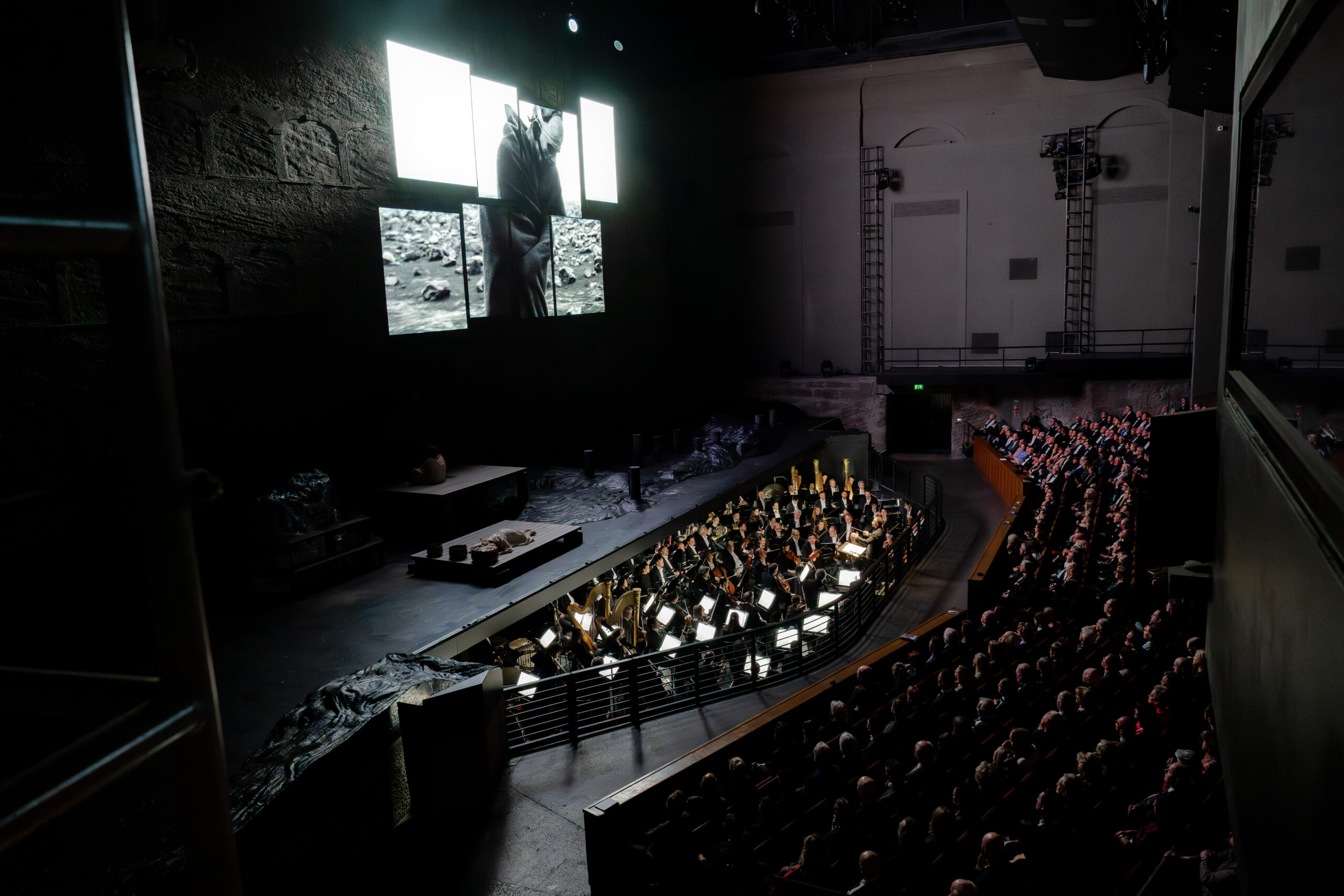
Salzburg Easter Festival’s Das Rheingold. Photo: Monika Rittershaus
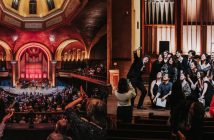
Whatever one’s reservations, Das Rheingold certainly made good use of the Felsenreitschule’s singular architecture. The immense breadth of the stage—and the visible presence of the orchestra — produced a divided but fascinating focus. It was certainly a great workout for the neck, forced to swivel from side to side from surtitles to action, and also upward toward the mobile projection screens, while the Berlin Philharmonic itself remained temptingly present in near-full view. But in truth, it was often the orchestra that provided the most compelling drama.
Having encountered Serebrennikov’s work in the context of Russian theatre, I had prepared myself for chaotic busy-ness. Even so, the production’s visual overload was striking. Framed by video of a naked male figure traversing a post-apocalyptic landscape of lava and ice, and populated on stage by figures of assorted civilisations—vaguely Arab, African, Hellenic and Slavic—it offered imagery that was undeniably arresting but at the same time morally and intellectually perplexing.
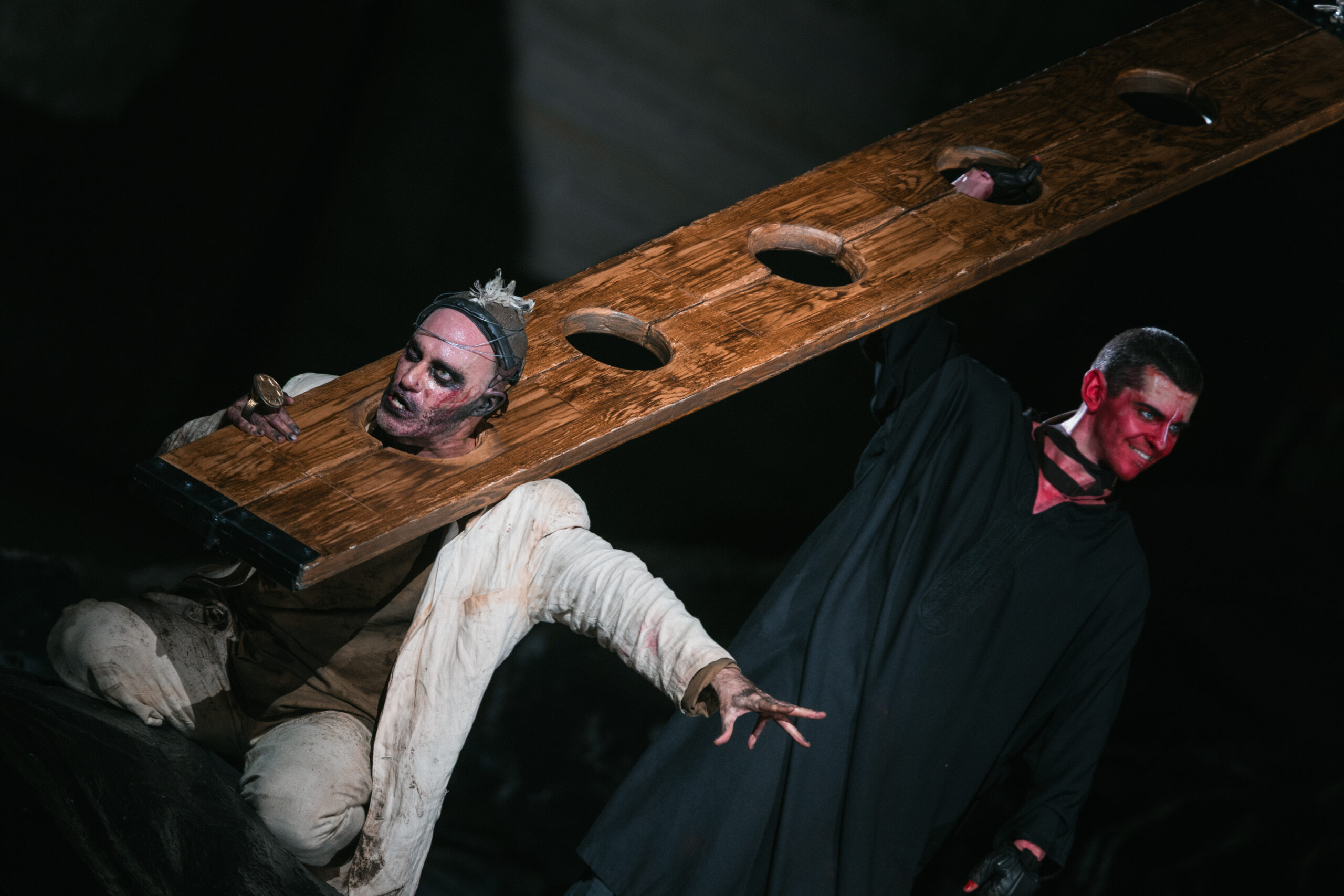
Leigh Melrose (Alberich) & Georgy Kuderenko (Performer) in Salzburg Easter Festival’s Das Rheingold
Photo: Frol Podlesnyi
The central problem was not ambition but cohesion. The symbolism seemed too easy, too scattered, too lightly assembled from the debris of “civilisation” as an aesthetic shorthand. At a moment in history when such language is being flung about with reckless abandon, its mish-mash tribalism registered as merely fashionable rather than profound. This is, perhaps, Serebrennikov’s Achilles Heel: a brilliant but insufficiently disciplined imagination. Wagner, whom the director in his interview for the booklet praised as a musical genius but not as a dramatist, was here subjected to a kind of corrective surgery. Yet his dramaturgical and ideological peculiarities are not flaws to be repaired; they are constitutive of his art and indissolubly wedded to his music. To seek to efface them is to dilute and blur what makes Wagner Wagner.
More than once, I found myself sympathising with those audience members around me who were ignoring the stage action concentrating on Petrenko and the orchestra.
And what a spectacle that was.
Petrenko’s sensitivity to the vocal line was masterly. He gave the singers room without ever sacrificing orchestral momentum. The Berlin Philharmonic played with astonishing range of colour and tensile strength: the famously silken strings, the gleaming brass, the subterranean growl of the lower registers, all placed at the service of a compelling musical-dramatic narrative.
Le Bu (Fasolt) & Patrick Guetti (Fafner) in Salzburg Easter Festival’s Das Rheingold
Photo: Frol Podlesnyi
Among the uniformly high-quality cast, Patrick Guetti’s Fafner stood out for its stentorian presence. Christian Gerhaher’s Wotan — introspective, psychologically shaded, almost lieder-like in its inwardness—offered something more nuanced than brute authority. Jasmin White’s Erda brought a moment of grave and ominous wisdom, and Brenton Ryan’s Loge was appropriately mercurial, quicksilver in both voice and movement. Leigh Melrose’s Alberich charted the role’s moral and emotional arc with tremendous force, his curse scene being one of the production’s undisputed highlights. At this moment the video projection came into its own: the image of soil pouring from a stripped, desolate Alberich against Icelandic wastelands was genuinely haunting.
Reports of boos for Serebrennikov on the first night came as no surprise. He was not brought to the stage at the performance I attended (Apr. 6). Petrenko, by contrast, was greeted with the kind of ovation that acknowledges not just success but comprehensive authority. If future instalments of the Ring in Salzburg remain an uncertain prospect, one thing is not: Petrenko and the Berlin Philharmonic will continue to enchant.
And enchantment, in Salzburg, always finds its way back.
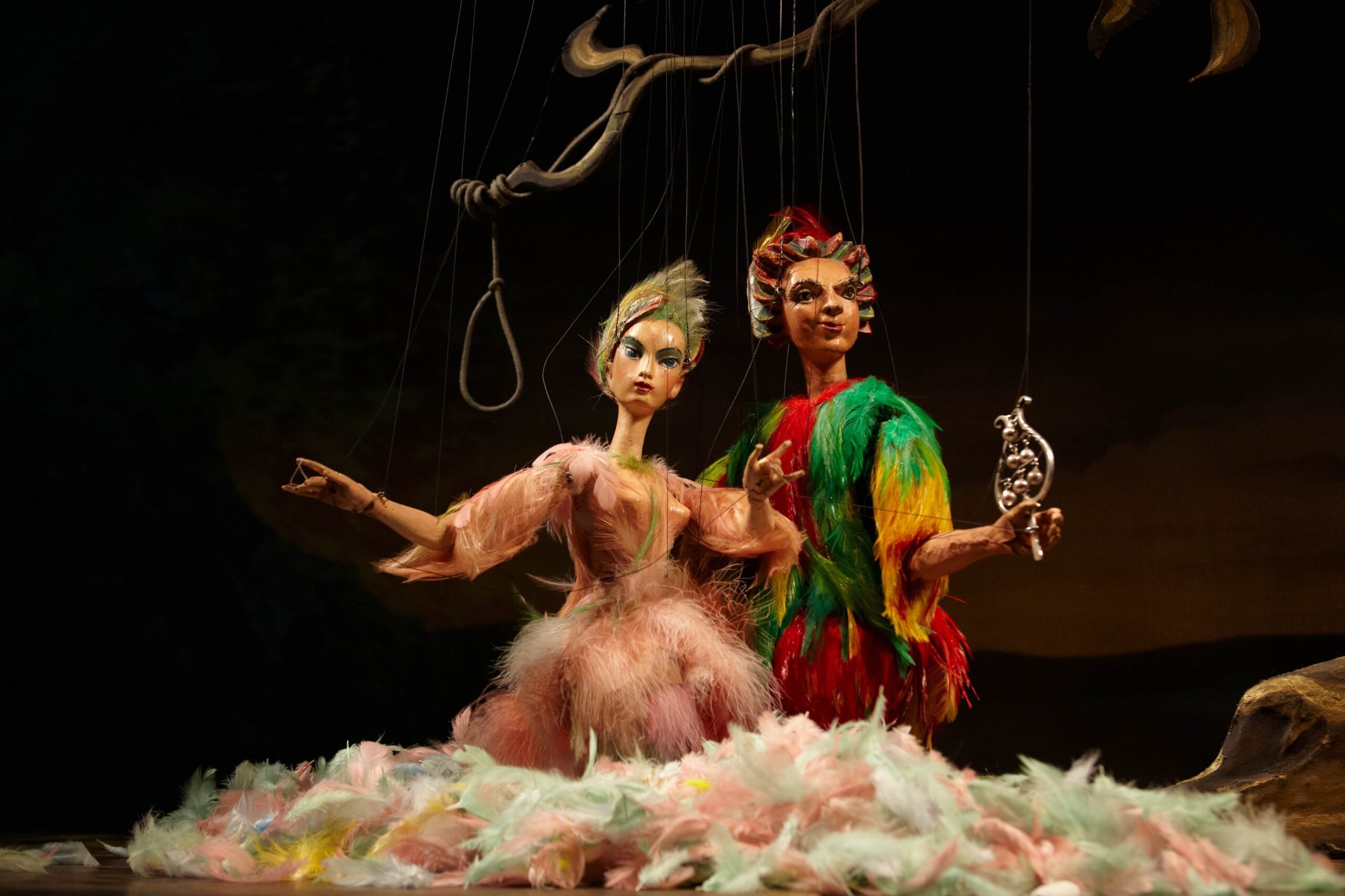
Papagena & Papageno in the Salzburg Marionette Theatre’s Magic Flute. Photo: Salzburg Marionette Theatre
Away from the festival, the Salzburg Marionette Theatre offers another face of the city’s magic—smaller in scale, of course, but no less profound. Founded in 1913 by Anton Aicher, and recognised in 2016 by UNESCO for its unique puppeteering technique, it preserves an art that is at once a living tradition and a miniature miracle.
I had the particular privilege of seeing something of this world from behind the curtain in a backstage tour led by the theatre’s artistic director, Philippe Brunner. Under such guidance, the place reveals itself as a workshop of miracles: strings, pulleys, miniature costumes, carefully preserved historical figures, and the undemonstrative inherited discipline of an art passed from one generation of puppeteers to the next.
The company’s Magic Flute is less like a performance than a gentle abduction into a parallel reality, one ruled by innocent wonder (seen Apr. 4). The Overture becomes a threshold, where the audience is invited to observe the two worlds at once, appreciating the mechanics as well as the scale of the puppets compared to the puppeteers. There are even some comic interactions as the marionettes get in the way of the crew setting up the stage. But as the music unfolds, the visible artifice quietly dissolves. Soon the marionette world is the only one that exists.
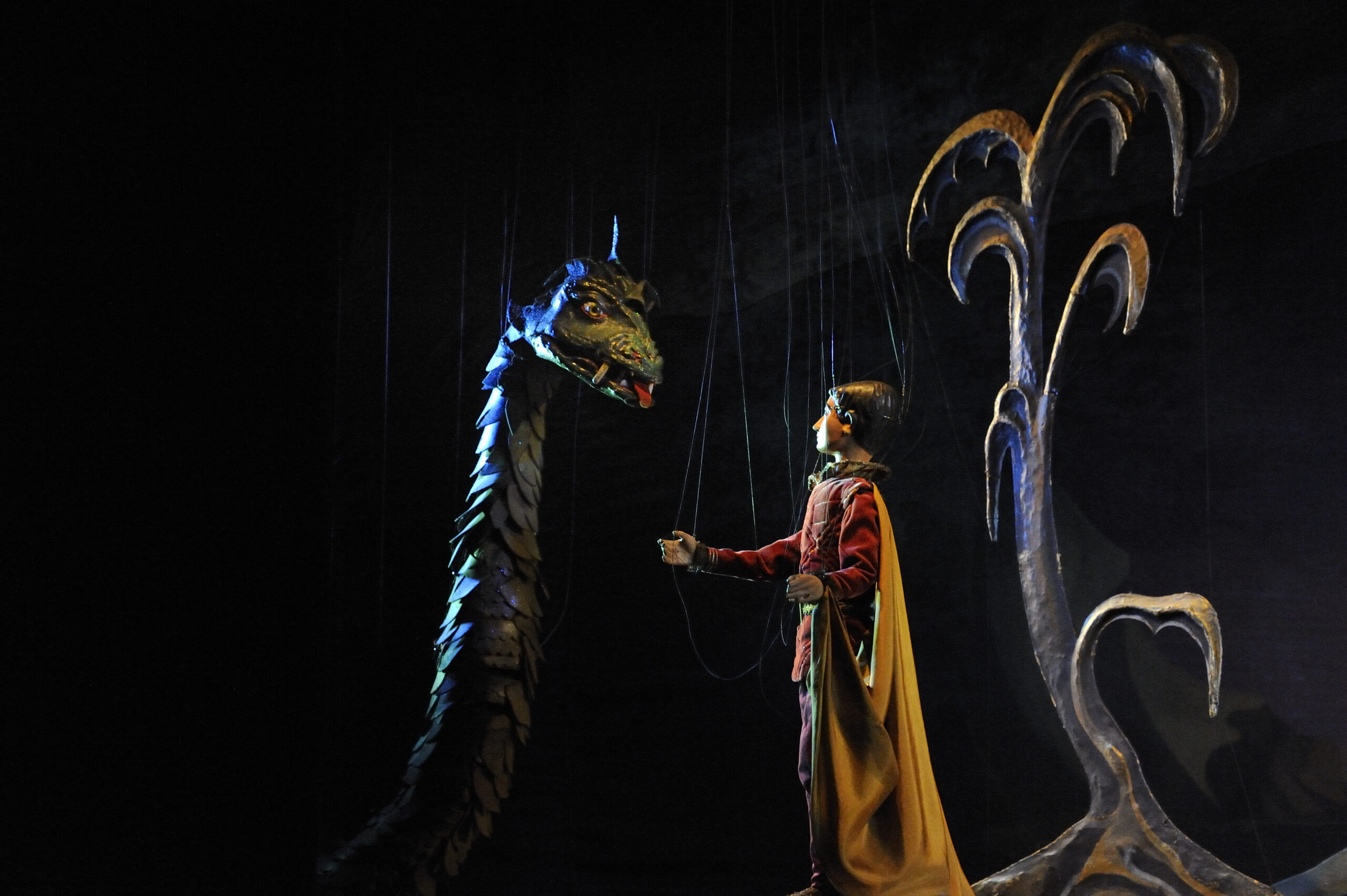
Serpent & Tamino in the Salzburg Marionette Theatre’s Magic Flute. Photo: Adrienne Meister
Crucial to the illusion is the soundworld. Rather than live singers, the production uses the celebrated 1950s Deutsche Grammophon recording conducted by Ferenc Fricsay, with a young Dietrich Fischer-Dieskau as Papageno. In his marionette form, Papageno is a triumph with the audience: his comically jagged gait and riotous costume make him instantly beloved. Yet the true marvel lies in the expressive refinement of the puppetry. Tamino and Pamina move with such lyrical grace that disbelief is willingly suspended. The Queen of the Night, darting across the stage with supernatural velocity, could be a role specifically designed for marionettes, before singers ever claimed it. Sarastro, by contrast, is all anchored majesty.
Mozart’s symbolist storytelling—trials by fire and water, love redeemed through sacrifice—acquires a strange contemporary poignancy. In a world so saturated with noise, cynicism and catastrophe, there is something profoundly moving in surrendering, albeit briefly, to the higher logic of enchantment.
Perhaps that is the city’s truest gift: not escapism exactly, but a reminder that beauty, ritual and artifice are not luxuries. They are among the civilised illusions by which civilisation itself survives, reducing demagoguery to its true miniature stature.
More on Salzburg Easter Festival’s 60th anniversary program in 2027 can be found here.