– Disclaimer: this review was written without knowledge of the jury’s selection of finalists
Chamber recitals shed a completely different light on a pianist’s personality than do solo performances. No hiding behind quickfire finger work, extravagant forte passages, or sappy melodies. Playing with other musicians requires the ability to listen to another part while managing your own, to share the spotlight at all times during ensemble work, and to provide the necessary rhythmic and harmonic stability, especially in the bass.
A piano and cello duo is tricky: the cello’s tessitura covers the middlemost part of the piano’s range, which is played the loudest and most frequently. Only the most careful balance will result in acceptable levels of ensemble performance.
Spread over five recitals, the second semifinal round saw contestants perform a selection of sonatas with cellist Rachel Mercer, a commissioned work by Iman Habibi, Fractures (2025), and two to three solo works of their choosing. As different facets of their personalities emerge, will the candidates surprise us or confirm the impressions they’ve left so far?
Semifinal VI: Derek Wang, Carter Johnson—with Rachel Mercer, cello
The first chamber recital opened on Oct. 18 with 27-year-old Derek Wang. Neatly dressed in a stylish two-piece suit, Wang played Schumann’s Toccata in C Major op.7 with confidence, natural phrasing, and precision. He delivered a highly personal world premiere performance of Habibi’s heartbreaking work. Wang permeated Fractures with deep sadness, reinforced by a fragmented structure and contrasting themes—angsty one moment, nostalgic the next. It remained one of the best performances of this work through the round.
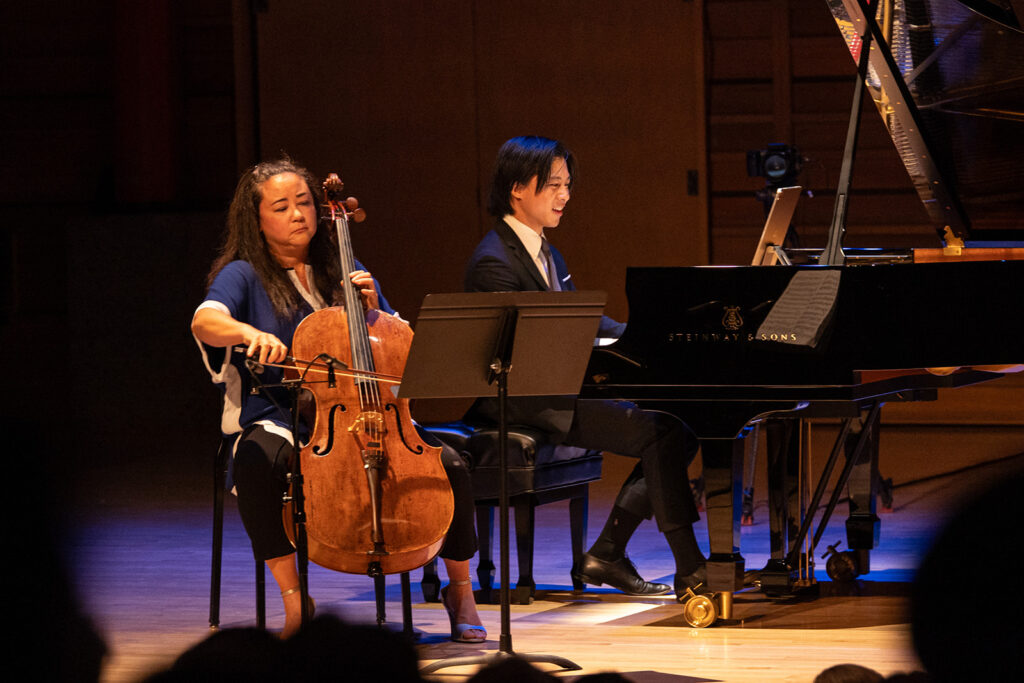
Derek Wang with Rachel Mercer
Unfortunately, the momentum ended with the duo portion of the recital. From the start, it felt like Wang and Mercer barely tried playing together as a unit. Two distinct prerecorded tracks of Rachmaninov’s Sonata for piano and cello in G minor Op. 19 would’ve sounded more cohesive. Not only do they have different temperaments, but Wang used every opportunity to outline the piano line at his partner’s expense. Perhaps realizing this, Mercer played in a disinterested way. Ending with Charles Ives’ The Celestial Railroad from Piano Sonata No. 2—just as bizarre now as it had been 100 years ago—Wang played with the aim of keeping the spotlight on himself rather than on the music. Mission accomplished.
From the opening of Prokofiev’s Cello Sonata in C Major Op. 119, 29-year-old Carter Johnson asserted his experience and sensibility in the ensemble context. He was possibly the only contestant who listened to the balance in the hall before going out to play—a smart move that paid off. His duo with Mercer gelled, allowing one another the space to express and create. An attentive collaborator both in the sonata and Ravel’s Pièce en forme de Habanera, Johnson filled his role with grace and maturity.
Carter Johnson with Rachel Mercer
Habibi’s Fractures sounded like a very different composition in his hands. While not as poignant as Wang’s interpretation, Johnson’s phrasing was natural, his sound deep and resonant. He brought a cohesive, architectural conception to the work. Closing the program with Ravel’s Valses nobles et sentimentales Op. 61 and a bouquet of Prokofiev’s works from op. 102, 52, 22, and 4—Suggestion diabolique—Johnson delivered a masterful, commanding, and electrifying performance proving, once again, that he is a candidate for the “complete artist.”
Semifinal VII: Yuanfan Yang, Ádám Balogh—with Rachel Mercer, cello
After a series of humorous technical hiccups related to video, sound, and lighting—worse was to come later—on Oct. 19, the audience welcomed 28-year-old Yuanfan Yang and Rachel Mercer. It took a minute of their playing to realize that this was not chamber music. It was a pianist and a cellist playing at the same time and in the same space. Mendelssohn’s Cello Sonata in D Major Op. 58 has a busy piano part that must be downplayed and adjusted to the cello’s lines. While Yang is an excellent pianist with all the tools at his disposal, he missed a simple equation: in chamber music, piano = mezzo forte and mezzo forte = fortissimo. Thanks to Mercer’s gorgeous solo in the Adagio, there was five minutes of greatness buried in 20 minutes of dreary fluff.
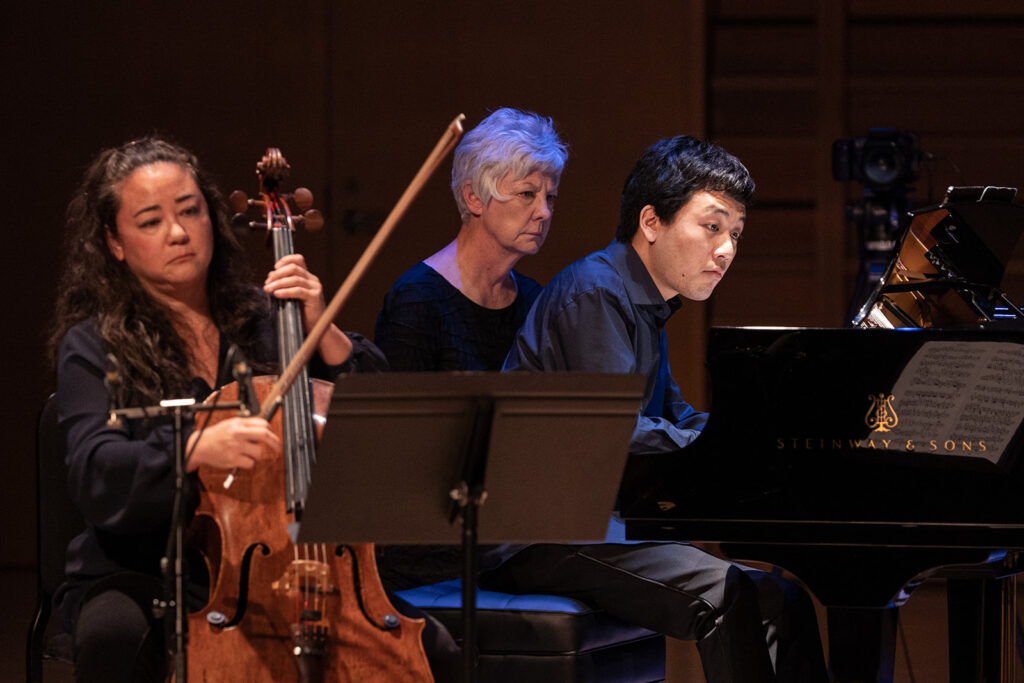
Yuanfan Yang with Rachel Mercer
After a forgettable performance of the Ravel, Yang played the commissioned work as if it was a sight-reading exercise. He would have gotten points had it been one. Clearly unprepared, Yang did not integrate the work’s expressive potential, playing beautifully only where the intent is obvious—in the slow part. Ending with Schumann’s Carnaval Op. 9, Yang produced a painstakingly ineffective interpretation of one of the most vibrantly creative musical works of the 19th century. A feat in and of itself.
Ádám Balogh at semifinal I
Following intermission, 28-year-old Ádám Balogh opened his program with Chopin’s Sonata in G minor for cello and piano Op. 65. Within seconds, Balogh confirmed that he is a true musician and an accomplished collaborative pianist to boot. One of the most natural musicians at this competition, Balogh helped produce a beautiful ensemble with Mercer, complete with perfect balance, and a delightfully Chopinistic touch. However, much like his solo recital, Balogh and Mercer eventually proved beautifully dull. They didn’t quite have the chemistry that a true duo should have, losing our attention before the end.
Then came the most gorgeous cello solo of all: Gabriel Fauré’s Après un rêve from Trois Melodies Op.7. Any attempt to describe that level of artistic beauty, other than “Rachel, marry me,” would be vain. Balogh proceeded with exquisite performances of Habibi’s Fractures, Debussy’s Images Book I, and Bartók’s Three Burlesques Sz. 47 Op. 8c. While not the most commanding presence, he is one of the most intelligent, thoughtful, and genuine musicians of the lot. Much respect to Balogh’s honest and sensitive music making.
Semifinal VII: Élisabeth Pion, Elia Cecino—with Rachel Mercer, cello
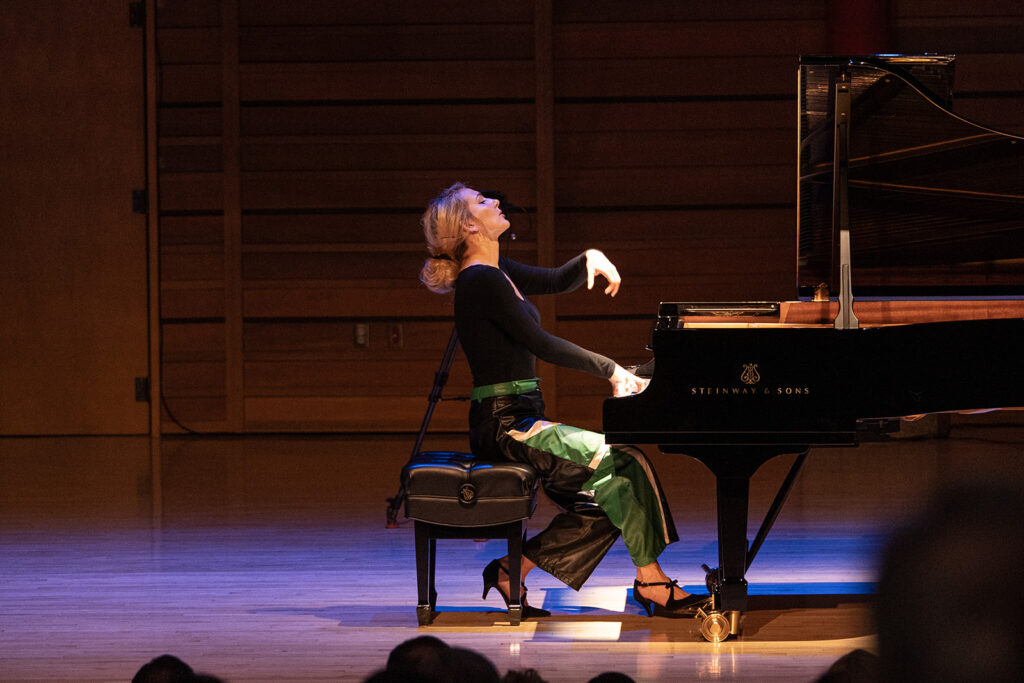
Élisabeth Pion
Oct. 19’s evening chamber semifinal brought the fashion statement of the week: Élisabeth Pion’s green and black leather pants, all in geometric figures. My compliments for a bold choice. The 29-year-old played Fractures by memory—the first contestant to do so. While struggling with some minor memory lapses, she brought out inner voices that we did not hear before. The music flowed naturally, a quality that sustained much of her interpretation of Ravel’s Miroirs. Yet, as lovely and fluid as her playing is, it became obvious that Pion relies on surface aesthetics. Her interpretation leaned on colours and indulgent timing, ignoring the loneliness, contemplation, desolation of Ravel’s music. Pion is a natural and talented virtuoso, but not a searcher for the unobvious or transcendental. Unfortunate memory and attention issues started to shake the foundations of her performance towards the end.
Then, from the opening bars of Rachmaninov’s Sonata for piano and cello in G minor Op.19, Pion and Mercer showed up for the goods: great ensemble work, perfect balance, right chemistry. In a chilling performance, Pion and Mercer inspired each other through mutual listening, interplay, and gorgeous musicality. A masterclass for all previous contestants and the first great chamber music performance at the competition.
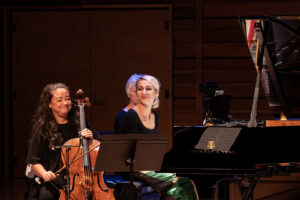
Élisabeth Pion with Rachel Mercer
Fate, however, had other plans. A nefarious deus ex machina appeared in the form of a confused page-turner. At first, she didn’t know if she should touch the screen once, twice, or swipe left to turn the page. Pion intervened a few times amidst cascading arpeggios up and down the keyboard—an impressing feat of coordination. Then, the inevitable happened: the page-turner accidentally closed the entire page by touching the wrong part of the screen. Pion’s hands jumped up for the save—but too late. The music stopped. Silence ensued. Mercer and Pion looked at each other, exchanging a few words. It took a few seconds for Pion to reset the pages in order and the duo resumed their high level of artistic performance.
The recital ended with Kreisler Schön Rosmarin from Alt-Weiner Tanzweisen, a difficult ensemble work, due to the subtle rhythmic demands of the Viennese Waltz. Despite excellent balance, there were rhythmic issues—and, unfortunately, no Viennese lilt.
After a brief intermission, 24-year-old Elia Cecino opened his recital with Beethoven’s Cello Sonata No. 3 in A Major Op.69. Cecino reminded us of what an exquisite musician he is. Playing with the clearest classical sound, he kept Mercer on her toes as they produced a fresh and vibrant performance. Cecino captivates with some unexpected accents, constantly creating suspenseful, interesting moments. He loves his own sound a bit too much for the chamber context but has the necessary spark of creativity to fuel live music making. A surprisingly successful duo: despite their different characters, they made each other better.

Elia Cecino at semifinal I
Cecino brought fresh ideas to his performance of Fractures, but he covered his mistakes one too many times. A tad arrogant one might object. He concluded his recital with Schumann’s Sonata No. 1 in F-sharp minor Op. 11. My admiration to this young man for a mature, patient, grand, and serious performance of this masterpiece. One of the most thorough musicians of the lot, Cecino played with brilliant energy, excellent tempi, and the right balance in all parameters: clear sound, character, lyricism, humour, elegance, and brilliance. Cecino was compelling in the third movement: especially as he used rests as vehicles for drama and tension.
Semifinal IX: Chaeyoung Park, Anastasia Vorotnaya—with Rachel Mercer, cello
The third semifinal day on Oct. 20 confirmed one empirical fact: women are more studious than men. All three female contestants of these semifinals played Habibi’s Fractures by heart and their performances were all the stronger for it. How many of the seven men deigned do the same? Not a single one. How many of them appeared to half sight-read the piece? More than they would care to admit. Good job guys in making us look lazy and entitled.
Wearing a long white dress contrasting stunningly with the grand piano, 28-year-old Chaeyoung Park gave one of the most compelling performances of Fractures. Her memory was stronger than Pion’s, and her interpretation fully integrated into a dramatic conception of the work. Then, Park proceeded to play the rarely heard Four Duets BWV 802–805 by J. S. Bach. The soft rounding off of phrases and neat shaping of dynamics was a bit mannered, but it was refreshing to hear some original Bach. Park’s disciplined, clear intent, and clean, crispy sound cleared the air from the mass of bombastic 19th and 20th century repertoire that has been shoved down our ears. She plays with peace, fine dynamic gradients, and taste—a gift to the audience.
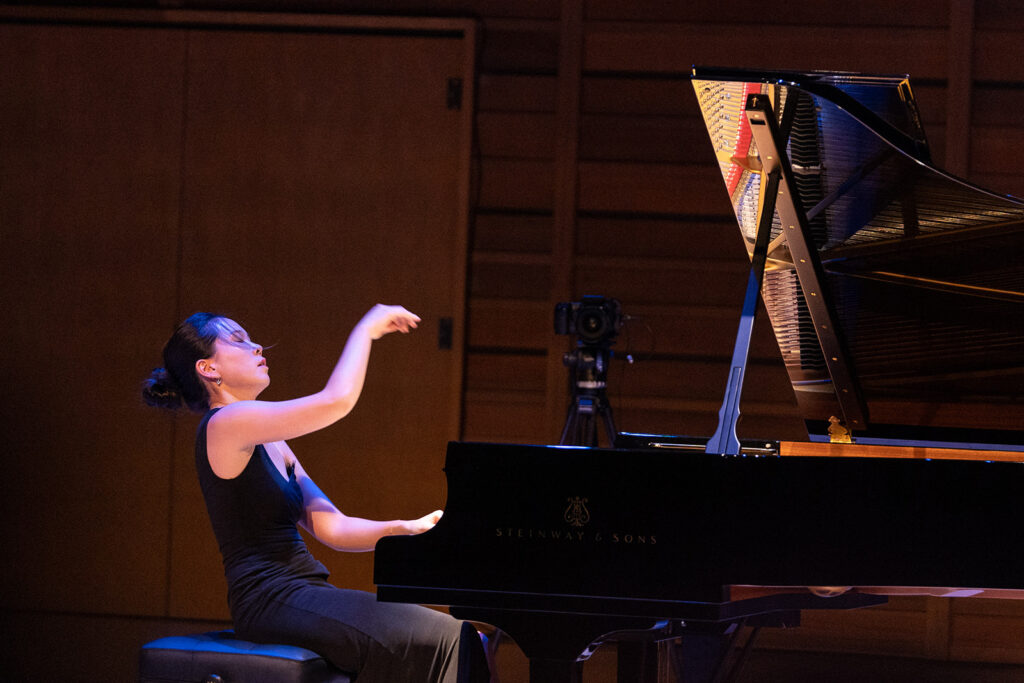
Chaeyoung Park at semifinal I
Park then played Sokolović’s Danse 5 from Danses et Interludes (2002)—an original and bold choice. The movement includes tapping on the wooden parts of the piano, a technique used to depict the muted steps of Serbian dancers (I’ve worked with the composer on this piece). Following with Debussy’s Pour le piano, one got the feeling Park might be a bit more of a competitor than a musician. Every gesture was tightly choreographed, almost overdone and demonstrative. While she has a sense of drama and a commanding stage presence, Park may not be the most spontaneous artist at this competition. Sometimes, less preparation and more freedom lead to the better musical path.
Despite these small misgivings, Park proved an excellent chamber collaborator to Mercer in their performance of Mendelssohn’s Cello Sonata in D Major Op.58. Their matching, bubbly and upbeat energy was perfectly suited to the opening Allegro assai vivace. Throughout the piece, her impeccable finger work, balanced sound, and rhythmically solid playing provided the right framework for Mercer’s artistry. Due to her lack of abandon, Park appears to be a more thorough than complete artist—a subtle difference. Nevertheless, her thoughtful program and mastery across a wide range of styles make her a clear finals candidate.
The second candidate of the afternoon, 30-year-old Anastasia Vorotnaya, brought the chamber ensemble to a whole other level. In a formidable performance of Rachmaninov’s Sonata for piano and cello in G minor, Vorotnaya showed herself as the best chamber musician of the competition. Good tempo, natural phrasing, sharp and exciting rhythmic feel, perfect balance with the cello part—she had it all. Together, Mercer and Vorotnaya flew through this enormous composition, completing what could easily be considered a reference interpretation of the sonata. Bloch’s Prayer from From Jewish Life was equally well played.

Anastasia Vorotnaya at semifinal I
Performing the Habibi by memory, Vorotnaya demonstrated gorgeous dynamic control, particularly in the pianissimo range. She excelled in the romantic, singing parts, and integrated the rest very well—a serious effort. She concluded her recital with Bacewicz’s Sonata No. 2 in E minor Op. 25, a work we have heard before played by Pion. The second hearing did not rectify the initial impression: ineffective banging and empty dramatic statements. Despite her high level of pianism, Vorotnaya’s limitations were obvious: it was much of the same loud playing we have heard over again. Curiously, she is the only candidate that excelled in the chamber setting at the expense of her solo performance. Vorotnaya flourishes when she complements another artist. When she’s alone on stage, her mind narrows towards achieving pianistic tasks.
Semifinal X: Giorgio Lazzari, Sandro Nebieridze – and Rachel Mercer, cello
The last two contestants to appear at the semifinal round on Oct. 20 were 25-year-old Giorgio Lazzari and 24-year-old Sandro Nebieridze. Lazzari’s performance did not bring anything new from his solo recital. A fine pianist and decent collaborator to Mercer, Lazzari plays brilliantly but selfishly, covering the cello’s range more than once. They did improve by the last movement, however, and delivered one of the best performances of Pièce en forme de Habanera by Ravel.
Giorgio Lazzari at semifinal I
The rest of Lazzari’s solo program could be summarized in one sentence: outward-projected playing that looks for effect and lacks patience, particularly in listening to rests. After playing through Habibi’s Fractures almost without a second thought, Lazzari performed an awkward early composition by Brahms, the Scherzo in E-flat minor Op. 4. Out of all Brahms masterpieces, he chose a bizarre, fast, jumpy, and excitable work—like the soundtrack of a cat and mouse cartoon. Then, in Prokofiev’s Sonata No. 7 Op. 83, we heard Lazzari at his most self-centred, evidenced by his interpretation of the famous third movement, Precipitato. Instead of pacing himself and wisely bringing the movement to an epic close, Lazzari exploded from the start. He had nowhere else to go but to end with a complete trashing of the music and the piano.
Thankfully, the evening was transformed by Sandro Nebieridze. The new Horowitz, in every sense of the word: stupendous technique, breathtaking tonal sensibility, captivating and surprising timing, and exciting rhythm. His long program did not tire the audience, it uplifted it.
Nebieridze proved an alert and sensitive collaborative pianist in Prokofiev’s Cello Sonata in C Major Op. 119. From the opening of the Andante grave, he produced limpid and transparent textures that contributed both to the music and the ensemble. The Moderato was imbued with Prokofiev’s mischievous spirit. Nebieridze’s creative playing brought unpredictable rhythmic and timing deviations that held our attention up until the final climax. These two natural musicians gave the best performance of Prokofiev’s sonata. Completing the ensemble portion with Kreisler’s Schön Rosmarin, Nebieridze was the only contestant who got Viennese lilt, on top of his attention to inner voices and humour. Kreisler would surely have approved.
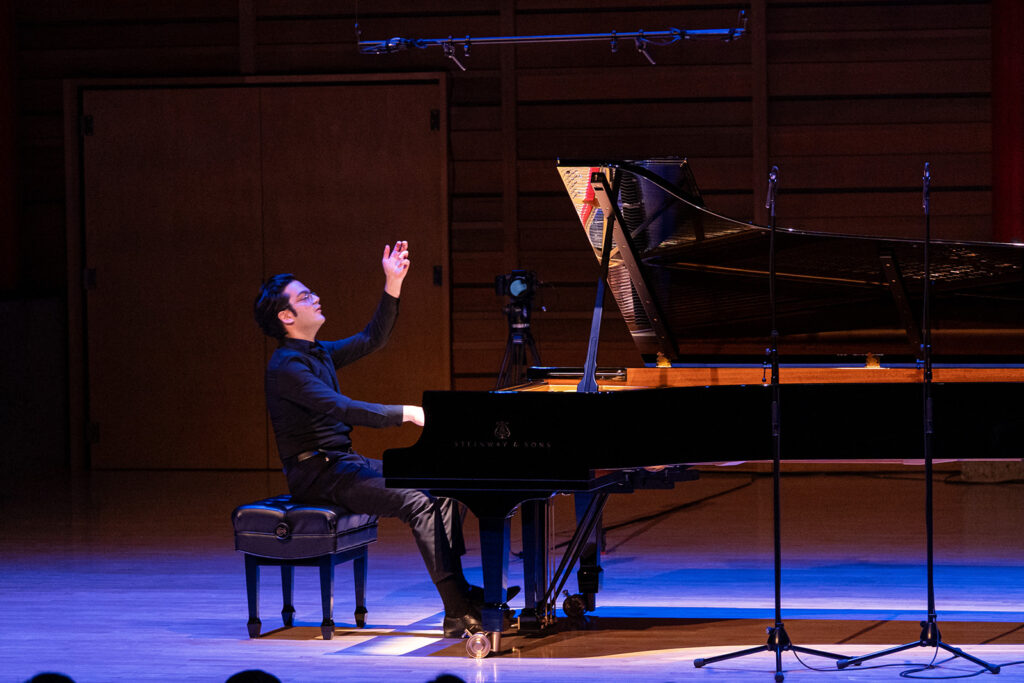
Sandro Nebieridze at semifinal I
Over the course of the final four solo works, Nebieridze left an indelible mark at this competition with his captivating music making. His rendition of Habibi’s Fractures was exciting, alive, creating moments of suspense. His Dionysian nature leaned a little too much on the showy side. With a big personality like his, one must be careful not to overdo it in terms of expressive devices at the expense of the work itself. Due to his risk taking, he’s not note-perfect—but it’s loveable. Proceeding with Mendelssohn’s Variations sérieuses in D minor Op.54, Nebieridze mesmerized with unpredictable and flexible timings, original interpretation choices and tempo. Rachmaninov’s arrangement of Mendelssohn’s Scherzo from Midsummer Night’s Dream showed his stupendous finger work, worthy of Rachmaninov himself. Ending with the latter’s Variations on a Theme of Corelli Op. 42, the young Georgian stallion delivered one of the most innovative performances of this work. Adding wise pacing to his vivid imagination and unharnessed temperament, the young man brought the house down. Besides Park’s Hammerklavier, this was the best solo performance of the competition.
Verdict 2: The Chamber and Solo Recitals
After a rigorous and illuminating second semifinal round, four worthy finals candidates emerge.
At first position, Chaeyoung Park. She commanded the most diverse repertoire, demonstrating depth, innovation, sensitivity, and a fine ear for silence, suspense, and drama. She is a fine chamber musician to boot. Only minor criticism: she is not as spontaneous as one would wish.
Then, Sandro Nebieridze stole the show with his original personality, generational talent, and creative musical choices. Equally comfortable in the spotlight as in the collaborative role, he exuded confidence at every step. Slight criticism: he does not command the widest range, limiting his repertoire to romantic and post-romantic works, except for Beethoven.
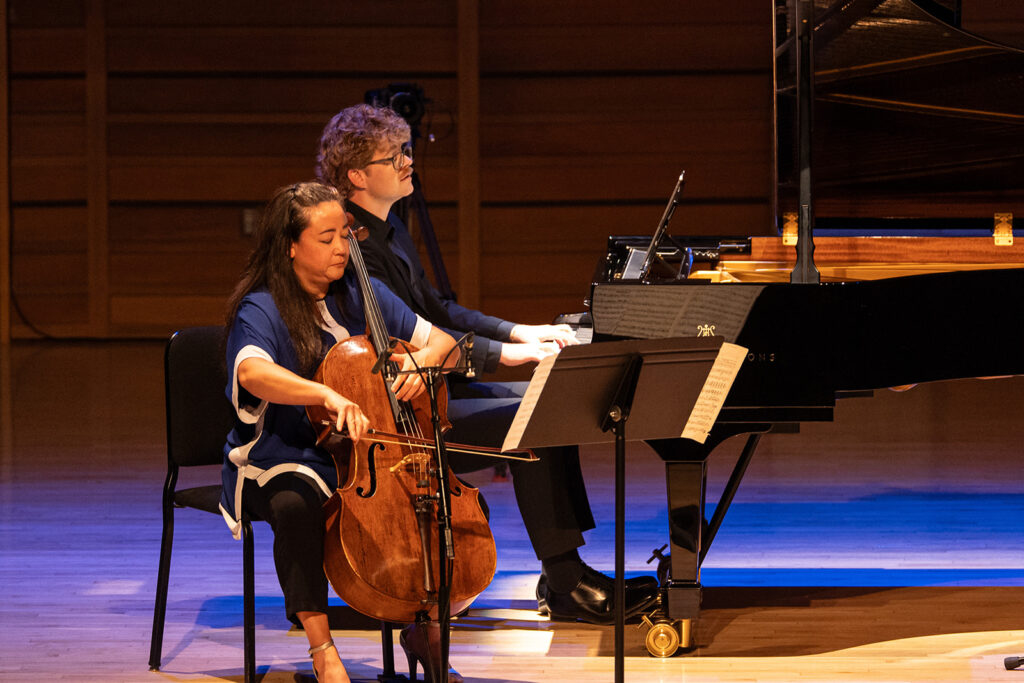
Carter Johnson with Rachel Mercer
Sharing third place are Carter Johnson and Elia Cecino. Both have strong, distinctive artistic voices who have demonstrated an all-around talent for solo and chamber music. Johnson is the more mature of the two, while Cecino has the edge in terms of youthful risk taking. I may choose Johnson as the third finalist, but I cannot say that my Canadian bias doesn’t play a role in my decision.
The rest have major flaws one way or another. All are virtuosi gifted with artistic qualities, but none of them are true candidates for “the complete artist,” given Honens’ criteria. More importantly—as a self-respecting critic—given the criteria for “completeness” that I have set at the onset of this series.
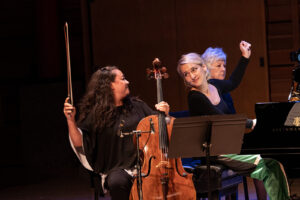
Élisabeth Pion with Rachel Mercer
Honourable mentions:
Best chamber performance: Anastasia Vorotnaya
Best commissioned work performance: Derek Wang
Most fashionable pianist: Élisabeth Pion
Audience Prize (I predict): Sandro Nebieridze