
This page is also available in / Cette page est également disponible en:
 Français (French)
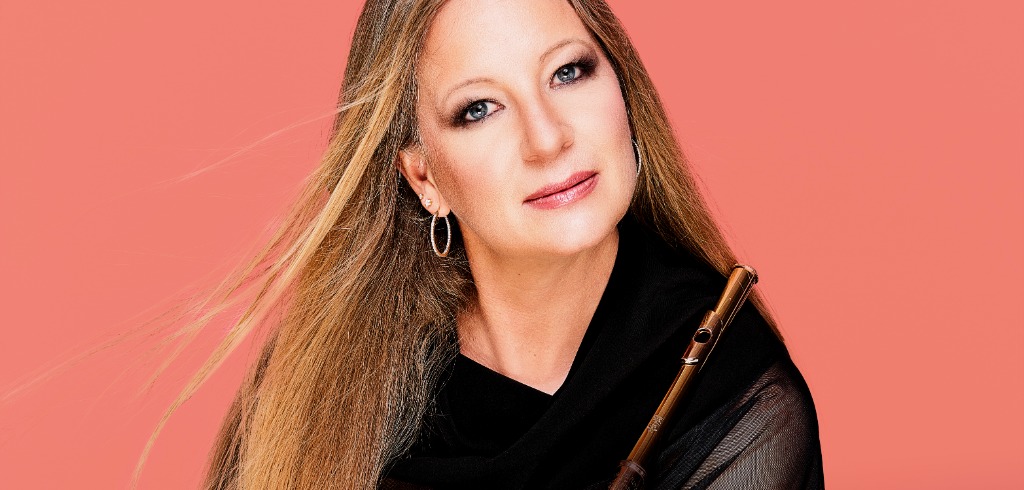
Thanks to Picnic Suite, a new digital album released in August by Nadia Labrie, listeners have been able to discover another work for flute, guitar and jazz trio with piano by French jazz pianist and composer Claude Bolling. This is the third instalment of a project dedicated to the composer who died in 2020—a project that will culminate in the release of a box set of three recordings to be released by ATMA Classique on Nov. 24, bringing together his complete works for flute.
Labrie’s latest album is part of the Flûte Passion series, which began in 2018 and has explored repertoires close to her heart: first Schubert, followed by Bach and Mozart. There is a change of tone here, with a surprising encounter between classical music and jazz. “After the Mozart album, I wondered what I wanted to say with my repertoire,” says Labrie. “Bolling is a composer I knew before, but I hadn’t really looked into him. My husband’s uncle used to hum some of his tunes to me, and I ended up taking an interest in him. I discovered some fabulous music that I think is very much like me: joyful, accessible, but at the same time with a lot of depth, dynamism and virtuosity. Playing with jazz musicians was a first for me, and it was a wonderful adventure. When you enjoy playing music, it’s always a good sign. I approach this music with a big smile. It speaks to me, and I imagine it also speaks to the people who attend our concerts, judging by the reception.”
Labrie talks about her new partners both on record and on stage, starting with Chilean guitarist Hugo Larenas. He contributed to the numerous guitar-flute duets within the seven movements of Picnic Suite, often marked by great speed of execution. “I had a lot of fun and found it very easy to play with him,” she says.
Jonathan Turgeon is on piano and Dominic Girard on double bass. Bernard Riche, meanwhile, was the first musician Labrie contacted for the first volume devoted to Bolling. According to the flutist, he manages to play with a delicacy on an instrument like the drums, which is not known for its subtlety. “He adds finesse. I think what he has done in this work and in the other Suites Nos. 1 and 2 that we have recorded is fantastic.”
Most of the pieces are structured around dialogues between the flute and guitar on the one hand, and the jazz trio on the other, including improvisation on the drums and even more so on the piano.
Labrie often has the opportunity to play with pianists, given the extant repertoire for her instrument. She also points out that, during her 20-year career, she formed Duo Similia with her sister, guitarist Annie Labrie. From this perspective, the flutist felt right at home in a more collaborative milieu. “The question was rather how to musically direct all these extraordinary musicians, who also had different visions of the work. It’s an act of co-creation, so everyone brings their own love for this music to it. That’s what makes it unique.”
In Picnic Suite, Bolling often uses the music of several masters who preceded him as a backdrop. “What I really like is his approach to melodies,” says Nadia Labrie. “It’s very melodious, very close to the heart. There is indeed a lot of influence from Johann Sebastian Bach, both in style and in the fugal parts, but also from Piazzolla, Dutilleux and all the great French composers who wrote for the transverse flute.”
Rococo, Madrigal, Canon, Badine—certain titles reflect this influence. For the penultimate movement, Tendre, the flutist plays exceptionally on an alto flute, separated by a fourth below the C flute. The result is a warm colour and a mellow character somewhat reminiscent of the sound of a saxophone. “We’re moving into something a little more internal, less airy, so the parallel with the saxophone is relevant. In comparison, the modern C flute is a much brighter instrument.”
Labrie recalls Jean-Pierre Rampal, the great French flutist of the 20th century, who was the first to commission Bolling to write a piece for flute and jazz trio. “With the first suite, Rampal enjoyed worldwide success and it appeared for over 10 years (530 consecutive weeks) in the American charts of the 40 best classical works. Later, in the 1980s, the composer wrote a second suite for Rampal and Alexandre Lagoya on guitar. The flutist even asked him to write another work with a jazz trio. He needed a little more of a challenge, some new scores. I did listen to his recordings because Jean-Pierre Rampal is the god of the flute—an inspiration to all flutists. We add our own personal touch, our own sound, our own sensitivity. It’s the same piece, yet a different piece with a different approach.”
A launch concert is being planned around the release date of the ATMA Classique box set. A tour is already scheduled in France in March, in addition to concerts in Quebec until April 2026. For more details, visit www.nadialabrie.com
Translation: Lilian I. Liganor
This page is also available in / Cette page est également disponible en:
Français (French)