

This page is also available in / Cette page est également disponible en:
 Français (French)
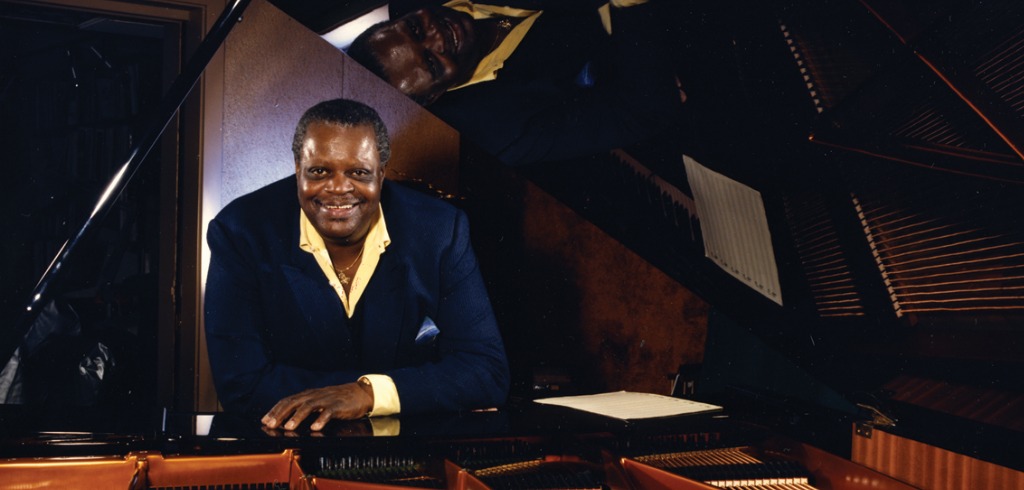
A flurry of agile fingers churning up notes at dazzling speed like a turbo butterfly flying over fields of black and white keys. Instant delivery of musical thought to hands that look like they could render anything at a moment’s notice. Such is the impact of Oscar Peterson’s piano playing, even 100 years after his birth on Aug. 15, 1925.
Peterson, who died on Dec. 23, 2007, transcended all barriers. A jazz pianist of historic proportions, he is revered by artists and musicians of all genres. Over the course of a career spanning more than six decades, he paved the way for young Black musicians during an era of racial segregation. A native of Montreal’s Little Burgundy, primarily an immigrant neighbourhood, Peterson is remembered and honoured this summer as an authentic Canadian legend.
Little Burgundy: Montreal’s Cradle of Jazz

Little Burgundy, Atwater St. looking north with train tracks. Photo: Courtesy of Nancy Oliver-Mackenzie
Born at a time when race informed most aspects of life in North America, Peterson grew up as the Great Depression spread its insidious waves across the continent. Fleeing prescriptive racial laws, poverty and prohibition, numerous families from the United States and the Caribbean flocked to Montreal, a city known for its nightlife, joie de vivre and opportunities. While relatively lax compared to the U.S., racism existed in all Canadian institutions, legislation, policies, and prevailed over the culture well into the 20th century.
In 1917, railway workers established the first Black labour union in North America to obtain better job protection and higher wages. In the 1920s, working for the railway was one of the few legitimate and respectable ways to earn a living for Black men. With stations for both national railways, Canadian Pacific (CP) and Canadian National (CN) in the vicinity, Montreal’s Little Burgundy became a haven for many immigrant and Black families. Among them were CP porter Daniel Peterson, his wife Kathleen, and their five children: Fred, Daisy, Charles, Oscar, and May.
The fourth of the five Peterson children, Oscar, showed early musical promise and determination. His only known teachers were his sister Daisy Peterson Sweeney and the Hungarian classical pianist, Paul de Marky. Through his own teacher, István Thomán, de Marky’s musical roots hail back to history’s first great piano virtuoso: Franz Liszt. While the full impact of this tradition on young Oscar’s pianistic education may never be known, the thoroughness and discipline of his classical training undoubtedly shaped his superlative command of the instrument. Another early influence was Oscar’s father, Daniel Peterson.
“Mr. Peterson was a very stern man who made sure all his children had a solid musical upbringing,” says jazz pianist Oliver Jones, Peterson’s friend nine years his junior, was also a colleague, and himself a Canadian legend. Peterson Senior likely pushed his youngest son to fulfil the extent of his natural talent beyond that of his siblings. “You must be the best, there is no second-best,” he told Oscar when discussing a career as a professional musician.
Talent—prized then as it is today—played a crucial role in social climbing and existential support for families walking a thin tightrope at the junction of sustainability, survival, and destitution. In this context, young Oscar was urged to make the best out of every opportunity, hone his talent, and start earning a living much earlier than might be expected.
Little Burgundy was home to organizations such as schools, churches, and jazz clubs that provided a safe space free of racial discrimination for Black Canadians. The community was close, and the church was central to life’s social fabric. Jazz blossomed in the suburb’s many clubs, notably Rockhead’s Paradise, the first Black-owned business. Montreal became one of the continent’s few jazz centres and boasted the best jazz in Canada, thanks to the frequent passage of American jazz legends on tour, opportunities for up-and-coming local musicians to hone their skills, as well as countless musical influences passing through an ever-expanding transportation system and radio broadcasts.
The environment formed the perfect petri dish for fostering a talent of Oscar Peterson’s magnitude. “My father always kept Little Burgundy very close to his heart,” says Céline Peterson, Oscar’s youngest daughter. “As he got older, he became more reflective. He would talk about what he loved about being home—which, to him, was not just Canada, but Montreal.”
Céline remembers being on tour with her father: “He loved taking elements of Montreal and Little Burgundy with him to other parts of the world. When he would meet people in Europe or in Asia who were from Montreal, it brought such a smile to his face. Then he would break out his French and that would make him very happy. It was something he carried within him with such immense pride.”

Oscar Peterson with his daughter Céline backstage at the Montréal International Jazz Festival (1995).
In the Footsteps of a Canadian Giant
While an outstanding pianist, improviser, and collaborative musician, Peterson’s eight Grammys awarded between 1975 and 1997 are testimony to the quality of his compositions, drawing upon his Canadian roots. “(Peterson’s) musical narrative weaves together this vast country of ours,” says drummer Jim Doxas.
“He’s written many large pieces of music—the Canadiana Suite, the Trail of Dreams—that have visualizations through music that go coast to coast, from Newfoundland and Prince Edward Island, all the way out to Vancouver and Victoria. Through his art, Oscar was able to tell a story that connects us in the same way that some people, say Joni Mitchell does. I think they’re both similar—not in their art form or in the way they express themselves, but in what they drew from their country,” adds Doxas.
Listening to Peterson’s live recordings from the 1960s onward, one is fascinated by the workings of a mind calibrated at hyper-human intensity, creating endless melodic pathways inside shifting harmonic labyrinths. This is the playing of a phenomenon that appears every now and then to spur the course of music history in a new direction.
It seems that fate played a role in Peterson’s rise from local to international star. One night, in the late 1940s, American jazz impresario Norman Granz heard Peterson’s live radio broadcast while on his way to the Montreal airport. As the story goes, he immediately instructed the cab driver to turn around and bring him to the Alberta Lounge in downtown Montreal where Peterson was performing. The ensuing bond between the two men launched Peterson into one of the world’s greatest jazz careers.
Hymn to Freedom
In 1949, Granz introduced Peterson as a surprise guest performer in one of his Jazz at the Philharmonic concerts at Carnegie Hall. From there, Peterson launched a series of collaborations and tours with the world’s leading jazz artists: Ella Fitzgerald, Louis Armstrong, Dizzy Gillespie, Lester Young, and Billie Holiday. Soon thereafter, he founded a legendary trio with double bassist Ray Brown and guitarist Herb Ellis.
Granz and Peterson also shared deep human values. “When we talk about Dad and the civil rights movement, I would be remiss if I didn’t mention Norman Granz,” says Céline Peterson. He was at the forefront of ending the segregation of audience members in concert halls, and providing equal pay and accommodations for the White and Black artists he managed. Granz and Peterson experienced many obstacles when on the road together, predominantly discrimination of all sorts including violent encounters with police and racial slurs.
“As Dad’s spotlight and notoriety grew, he was not going to stay silent on how these experiences affected him,” explains Céline. “Writing Hymn to Freedom framed how that part of his life and career would remain at the forefront for him. That song has reached so many people and it was proof since the day he wrote it that there are things more powerful than hate,” she says.
A Legacy Celebrated: The Oscar Peterson Centennial
Besides mesmerizing generations of music lovers with the total abandon of his improvisations and solos, Peterson blazed the path for many artists from his community and beyond. “What Oscar gave me was the greatest gift in the world: to let me know that a little Black boy who didn’t have any education was able to become one of the world’s finest,” comments Oliver Jones. “I’ve never seen anyone wrap themselves around and get inside the piano like Oscar did. He would sometimes play just one note and that would open up everything.”
The two legendary sons of Little Burgundy played their only concert together in 2004 at the 25th Montreal International Jazz Festival. “I think back to that wonderful concert,” says Jones. “We held on to each other as I thought: ‘That’s near 80 years of knowing this man and looking out for each over the years.’ I’m so thankful for all of this—my love for Oscar and for what he has accomplished.”
To help celebrate the Oscar Peterson centennial, Jim Doxas and Céline Peterson have co-organized a tour, the release of archival recordings, unpublished memoirs, and an exhibition of Oscar Peterson’s own photographs which he took over the course of his life. The tour, featuring many Canadian musicians as well as Peterson’s former quartet member, guitarist Ulf Wakenius, runs well into December 2025, and culminates with concerts at Toronto’s Massey Hall on June 14 and at the Montreal International Jazz Festival on July 1 and 4. Musicians include Robi Botos, Mike Downes, Jim Doxas, and for select dates, Lex French (trumpet, Montréal) and Paul Marinaro (vocalist, Chicago).
“From a musical director’s point of view,” says Doxas, “I’d like to highlight Oscar’s deep love for this country and his commitment to never forget his roots in Little Burgundy. He grew up just a few kilometres away from my home in Montreal. As a Canadian and a Montrealer, that brings great pride,” he says.
“The thing that I admire most about my father,” says Céline, “is remaining true to his authenticity. That is arguably the most important aspect of choosing to make one’s life within art. There was never another choice for him; he was always going to be exactly who he is—whether that’s musically, in conversation, and in standing for what he believed in.”
Extra Reading: Montreal in the jazz age : the Ajax label
This page is also available in / Cette page est également disponible en:
Français (French)