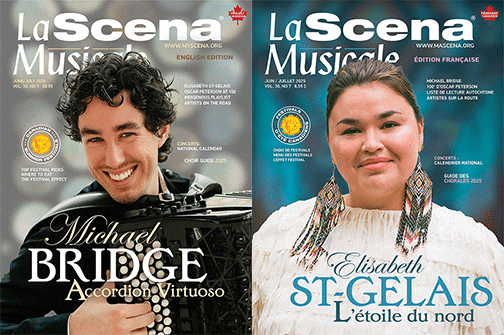
This page is also available in / Cette page est également disponible en:
 Français (French)
One must have several talents to be an accomplished artist: technical skills that make you rare and sought-after, perseverance, vision, a sense of showmanship to give the audience an exceptional experience—and, in addition, the ability to adapt to life’s circumstances.
In a nutshell, this is the philosophy and work ethic of Michael Bridge, who though Calgary-born and Toronto-based, has dedicated himself to the most Latin of musical instruments! “I’m generally the only one doing what I do,” he says of playing the accordion.
And Bridge does it well. In June, he kicks off his summer tour in Edmonton at the Summer Solstice Festival (June 19, 20, 22), moves on to Toronto for a concert with the Bruno-Bridge duo (July 6), and then plays at Stratford Summer Music (July 26). In early summer, he will participate in a gala concert celebrating the 10th anniversary of Gatineau’s Festival l’Art de la musique (July 10) and he returns to Quebec for the Carrefour mondial de l’accordéon in Montmagny, alongside his tour partner of nearly 15 years, clarinetist Kornel Wolak (Aug. 29).
“Kornel will make his official debut at Montmagny,” says Bridge. “I do half of my concerts with him—many in the States, South America, especially Europe, as well as in all the Canadian provinces. A few months ago, we went to Yellowknife for the first time.”

With clarinetist Kornel Wolak. Photo: Curtis Perry
The Live Experience
The accordionist already has a dozen albums to his name, notably with the Bridge & Wolak duo and the Ladom Ensemble, and keeps up a strong presence on YouTube, Spotify, and Apple Music. Concerts remain his essential driving force, where he finds the most satisfaction. “As artists and human beings, we’re here to strengthen interpersonal relationships and create interactions,” he says. “In a way, this is my mission as well as a motivation in my life. If we can stir up a feeling that unites us, if we can awake a sense of living together while respecting differences, then I’d say our mission is accomplished. In any case, we can only get there when we play live, for an audience.”
A Love of the Accordion
Wherever he goes, the accordionist draws from both the folk and classical repertoire, such as the Bach preludes that are one of his specialties. He also keeps a few surprises up his sleeve. “Young people, even (those) under 40, want to hear the accordion, know all its possible sounds, and insert it into different musical styles. Of course, the element of nostalgia is there in the texture of the sound, and that adds another level of appreciation.”
Over the past 20 to 25 years, Bridge has seen a steady revival of interest in the instrument. He’s obviously delighted, especially when he hears the accordion in TV commercials like the one for Geico Insurance!
Accordion – Concert Instrument
The accordion community has long sought to rejuvenate the instrument’s image and give it the seriousness it deserves, far from the French-style bal-musette and strap-on piano. “My professor at the University of Toronto, Joseph Macerollo, was perhaps the Canadian pioneer of this field. He taught accordion to almost everyone in my generation who embraces this way of thinking. Thanks to the efforts of all these people, leading institutions such as the Canadian Opera Company, the National Ballet of Canada, and symphony orchestras now have the accordion on their radar. They know that there are instrumentalists who specialize in this repertoire.

Photo: Curtis Perry
In May 2022, Michael Bridge was rushed to the Metropolitan Opera in New York to perform the virtuoso accordion part in Brett Dean’s Hamlet—a part that was deemed too difficult for the accordionist on hand! This experience, although atypical, allowed him to add another work to his repertoire of new works written for his instrument, which now includes about a dozen.
“It’s been a long time since I composed (music) myself,” he says. “I did it as a student, while today it’s mainly accordion arrangements, whether for my duo with Kornel or my digital accordion. That’s where I put my energy. I especially like to collaborate with professional composers who, after a whole process of exchange with the musician, learn how to write for the accordion. A composer who has never written for the instrument before brings a fresh perspective. Sofia Goubaïdoulina, a great exponent of contemporary music who recently passed away, comes to mind. She wrote 14 works (for accordion) throughout her career, including two concertos that are now among the finest works in our repertoire. Without these works, the accordion would not be where it is today. And they have even influenced the construction of the instrument.”
Digital Accordion
Speaking of innovation, digital accordions are now commonplace. The days of diatonic accordions, where changing the direction of the bellows changed the note, seem long gone. “This opens all the doors to sound exploration, including combining several sounds at the same time. Most of the time, it’s like playing five instruments at the same time. For example, on the right hand, I might use an accordion sound with the sound of an electric keyboard in the background. On the left hand, perhaps an acoustic bass, a guitar or piano chord, or some percussion. When I pull on the bellows, I control the nuance of sounds like the accordion, but if I hit certain buttons harder with my fingers, I can control the percussion sounds, including the piano. The big advantage over the diatonic accordion, and even the chromatic accordion with a button system, is that I can play several instruments at the same time. This allows me to make interesting crossfades. If I don’t move the bellows and just use my fingers, you’ll hear even more sounds. If I pull the bellows and press the buttons gently, it changes the sound completely.”
The old-fashioned version with a right-hand keyboard still exists, but Bridge says he started playing a button accordion early on, which has more octaves, and he initially perceived it as more virtuosic. “What defines a concert accordion is what’s called a chromatic bass—a large button that converts all the predetermined chords into individual notes. The instrument has a mechanism, which can be programmed on the digital accordion, that allows you to produce any chord in all possible inversions,” he adds.
Nostalgia

Photo: Curtis Perry
To achieve his particular brand of excellence, Bridge had to start young. He explains that his discovery of the instrument happened by chance at age five. “My parents had made an offer on a house in Calgary. The previous owners held a garage sale before our move-in date. My mother and her friend, who planned to rent a room in our basement for six months, went there together. A little self-conscious, my mother went hoping she wouldn’t be recognized. But they did recognize her. Asking why she came to the sale, my mother said she wanted to buy ‘this,’ randomly pointing to an item on the table. It was an accordion for $5. The friend accompanying her had played the accordion herself and my mother thought she could teach me a little. They bought the accordion, and embarrassed, quickly left. Long story short, this friend, who ended up staying with us for eight years, was essentially my first instructor.”
During his teenage years, Bridge had the chance to participate in several accordion festivals in Western Canada. He discovered a unified community he still holds close to his heart. “Among 500 older folks, there were maybe 20 young people, including myself,” he recalls. “I grew up with the feeling I had heaps of grandparents taking care of me and encouraging me. The feeling of community around the accordion was very strong for me. I also played classical piano at this age and was taking part in formal contests at the Kiwanis festival. This was the opposite of accordion festivals where we would play together around a campfire. (They were) all the more important to me and my family, since my parents were also there. This is what kept me pursuing this instrument for all these years.”
This same sentiment spurs him on today in his approach to teaching. He works with young people from all backgrounds, not only accordionists, by offering courses in music-career management. “Young people who want to be professional musicians are justifiably worried about the cost of living,” he says. “I teach them how to improvise in diverse musical styles. In a city like Toronto, you must put on shows for children, you must have expertise in lighting and projection design to put on a performance at a high technical and artistic level—this is what attracts people. It’s no longer enough to be a good musician. Knowing how to negotiate, sign good contracts, network, organize tours—all this falls under my responsibility as a teacher, I think. You also need to cultivate whatever sets you apart from other musicians. I like saying that I didn’t have many opportunities as an accordionist, but I can create opportunities that may come to fruition. With a little entrepreneurial spirit, we can make great things happen.”
The Accordion’s Impact on Well-Being
Bridge will always be able to count on his instrument, his loyal companion, to overcome doubts. “When we play the accordion, we embrace the instrument, but thanks to the straps, the instrument is also embracing us. It’s the best therapy out there. When something is on my mind or I’m stressed, I can play for just 10 minutes and feel better. Of course, this isn’t a solution, but it adds to my well-being especially with all its (vibrations). I’m also convinced that practising an instrument can change a person. I have to juggle two keyboards, a computer between my hands, the parts of five different instruments. This might take a certain type of brain, but at its core, manoeuvring this machine and keeping everything in your head at once surely develops aptitudes that aren’t innate.”
Translation: Isabel Garriga
This page is also available in / Cette page est également disponible en:
Français (French)