
This page is also available in / Cette page est également disponible en:
 Français (French)
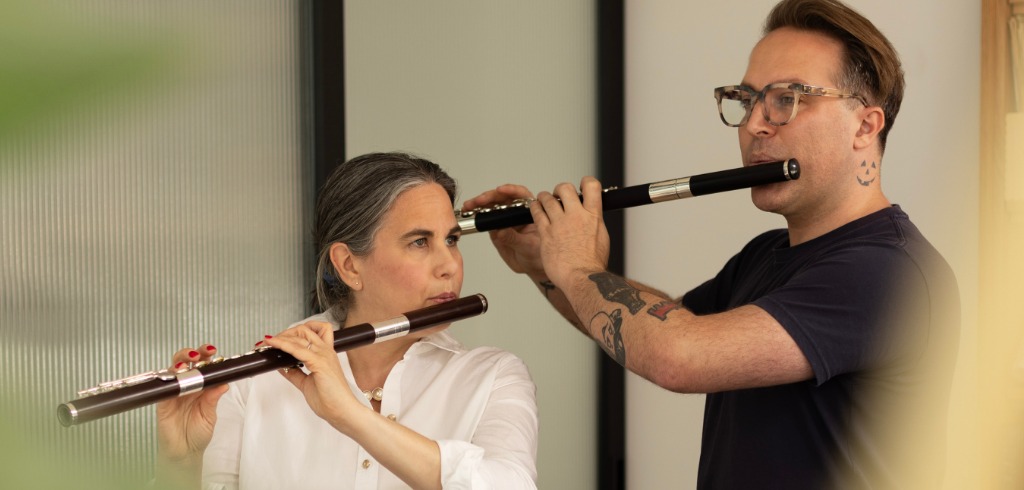
Mika Putterman does not identify with the stereotypical description of a flutist. When it was time to “choose a real instrument” after having played recorder in school, Putterman’s parents thought their daughter matched the description of flutists in Attarah Ben-Tovim’s book, The Right Instrument for Your Child. For Ben-Tovim, flutists are people prone to daydreaming and forgetfulness. Yet Putterman, founding director of the Montreal-based concert series Autour de la Flûte (ADLF), approaches the flute more as a hard-nosed detective than a dreamer with her head in the clouds.

Autour de la Flûte’s Kabarett Weill
Photo: Dominic Champagne
“I’m very intellectual,” she says. “I get all the facts and then play.” A specialist in historical performance, she is keenly interested in how music was performed at the time it was composed. A key resource for historical flutists is Johann Joachim Quantz’s treatise, On Playing the Flute. While Quantz’s text covers everything from embouchure to ornaments to the right temperament for a musician, history, it seems, is best told by its artifacts. For Putterman, the best way to uncover the past is to hold it in your hands—and bring it to life with your breath.
She felt an immediate and visceral connection with the baroque flute she tried as a student. “I took it home, and I played one note, and I could feel it vibrate under my fingers,” Putterman recalls. “It was made of wood. And then I put my metal flute down, and I didn’t touch it again for 15 years. This is my calling.” Early instruments are often made with different materials—wood, in the case of flutes—and have different tunings and configurations than their modern counterparts. All of this contributes to the instrument’s distinct character, one that seems to echo a distant time and place.
A Flute for Every Occasion
Part of the early musician’s task, as Putterman describes it, is “to match the right flute to the right era. What was Bach exposed to when he was writing the flute sonatas? Which flutes would he have known? And then we try to use models that are similar to that.”

Mika Putterman’s flute collection
Yet, models often raise more questions than answers. Putterman notes that “there were way more instruments that existed than we have modern copies of.” Flutes have undergone far greater transformations, unlike the violin which, barring some minor changes, has remained essentially the same since the 16th century. Aleks Schürmer, co-director of ADLF, explains how flutes with new technical capacities were always outshining last year’s model. “Most wind instruments,” he explains, “are more akin to an iPhone—every year we add more megapixels, better battery life. We add some features that makes it look like last year’s model is a little bit out of date. … A composer might realize, ‘Now we can do this,’ and the previous year’s instrument no longer serves that function.”
Despite the flute’s extensive alterations, most historical flutes today are copies of just a handful of originals. Yet, as Schürmer notes, the flute is among the oldest of instruments: 40,000-year-old flutes, made of bird bone and mammoth ivory, were found in prehistoric caves. In western classical music, however, the flute was relatively late to gain status as a solo instrument. “The flute tends to be an instrument that feels like it got added into the official list of real instruments quite late, given how old it is,” says Putterman. “And the reason for that is the flute’s not such a difficult instrument to play, as opposed to the oboe. A lot of amateurs play the flute. So a lot of the music was essentially for people just playing for fun.”
“An amateur,” Schürmer notes, “was always going to go out and buy the newest model.” A high-turnover market resulted in a lot of instruments being produced. Yet since the flute was less prestigious than other orchestral instruments, it was less likely to be preserved and passed down through the generations.
So, while many violins still in use date back to the 1600s, a flute from the Renaissance or Baroque periods is much rarer. Putterman, however, has an impressive collection of original flutes—including one from 1760 France.
She discovered this flute, one of only three known to exist, almost by accident. As a student in Paris looking for just the right flute to play music by 18th-century French composer François Devienne, she walked into a music shop owned by a former student of her teacher. There, the owner produced a flute his friend had unearthed in a cabinet drawer. “It was a treasure,” Putterman recalls. Holding an original, she explains, was a profoundly different experience than playing on modern copies. “I felt much more connected. … When you [play on]a copy, you’re asking yourself: Was it the model? The wood? The modern maker? What makes it unique? But there are too many questions—you’re too many steps away from the original instrument that you’re playing.”
Autour de la Flûte
Putterman’s zeal for all things flute-related—from its history, to the instruments themselves, and on to the repertoire—led her to start ADLF in 2004. The premise of the series is simple: the flutist “wanted to have a group where she could explore all the repertoire that was written” for the instrument.

Autour de la Flûte’s Bach électrique
Photo: Dominic Champagne
“I didn’t want to be locked down to a trio or quartet,” she explains. Flute repertoire—like the instruments themselves—comes in all shapes and sizes: “sometimes as a duet for two flutes and harpsichord, or it could have been seven instruments and flute.” So, she decided that “every program was going to be different, but they’ll all have flute in them.”
In the early days of the concert series, Putterman—shaped by her early-music studies in Brussels—focused mainly on baroque and early classical music. Slowly but surely, however, her repertoire grew along with her flute collection. When she began acquiring originals from the Romantic era—such as an ivory flute with silver keys—she also started expanding her programs to include composers such as Beethoven and Schubert.
It was in these early years that Putterman met Schürmer, a “superfan” who volunteered at her concerts. The two became best friends. Unlike Putterman, who came to appreciate the modern flute by working her way through historical instruments first, Schürmer began as a modern flutist. “I came to the baroque flute because of an overuse injury,” he explains. “I was literally paralyzed on the right side of my body from playing too much.” The baroque flute, which is smaller and projects less, is less physically taxing and provided him with “a way to keep expressing myself through the flute” during recovery.

Mika Putterman & Aleks Schürmer
Like Putterman, Schürmer has his own collection of original instruments. Yet his—which features a contrabass flute, a theremin, and an Ondes Martenot—is decidedly more contemporary. Alongside this, he is also a composer and arranger of contemporary and pop music.
Schürmer, Putterman notes, kept encouraging her to “go later, later, later … until now” in her repertoire choices. Since he became co-artistic director in 2021, ADLF has taken a whole new direction, diversifying their programs to include more contemporary and pop artists such as Philip Glass, Quincy Jones, and Björk. “Time always moves forward, right?” Schürmer muses. For him, early music is less about a fixed repertoire and more about an approach. “The question,” he asks, “is what does contemporary music sound like on period instruments? And what happens beyond that? And maybe even more interesting is, how do we take the principles of early music and apply them to all music?”
2025–26 Season
Whether it is Bach being played with electronics, Philip Glass on a baroque flute, or Selena Gomez arranged for flute and classical guitar, ADLF’s programs thrive on the juxtaposition of old and new. “We like to connect the dots,” explains Schürmer, “placing disparate things side by side to reveal either the hidden connections between them—or the ways they stand apart.” For their 2025–26 season, ADLF’s concert series revolve around Forces Majeures—people who’ve made an unparalleled impact in their field.

Autour de la Flûte’s Nuages sombres
Photo: Dominic Champagne
On Nov. 13, ADLF presents Mademoiselle, a concert paying homage to Nadia Boulanger, the renowned French pedagogue who taught many of the leading composers of the 20th century. In this recital, Putterman and Schürmer are joined by flutist and oboist Dylan Pinette and pianist Julien Saulgrain to present a program of music by Boulanger’s students. “This program highlights not only the importance of a particular woman,” says Schürmer, “but also how even a conservative 19th-century teacher could inspire students to head in wildly different directions: Philip Glass, Quincy Jones, Michel Legrand, Astor Piazzolla. These are radically different sounds, and yet Nadia Boulanger’s adherence to classical contrapuntal values is really obvious in their music.” In addition to the music of her students, selections from Boulanger’s letters and TV appearances will be read by Dominic Champagne.
Then, on March 12, Putterman is joined by guitarist Steve Cowan to present the music of singer-songwriters throughout the ages. “Putting Selena Gomez next to John Dowland may seem like a curious choice,” Schürmer notes. “This concert, Pleure moi une rivière, is sort of like a sad boy, sad girl mythology. John Dowland is very interesting. He is crying about love and loss in the 16th century, and Selena Gomez is doing it today.” While their musical language might be very different, the emotional experience of heartache is the same.
ADLF’s springtime concerts feature artists whose music is rarely seen in a concert setting. On April 9, Dance of the Dream Man presents the music of David Lynch and his longtime collaborator Angelo Badalamenti, performed by an ensemble of English horn, bassoon, clarinet, bass clarinet, saxophone, flutes, electric guitar, double bass, and drums. Though most people know David Lynch as a director, Schürmer explains how he was also a musician who made many albums and was deeply involved in the compositions for his films and TV series. “David Lynch—he’s like your favourite artist’s favourite artist. The ultimate big-A Artist. He’s done weird experimental improv noise music. He’s done pop music. He works in this jazz and neo-noir style— that Angelo Badalamenti sound.”
ADLF’s final concert on May 7 pairs the nature-infused music of Björk with the ancestral and ethereal voice of the flute. Pagan Poetry features an ensemble of seven flutes, from a rare treble flute—pitched between the standard flute and piccolo—to a massive contrabass flute, played for the first time in Montreal by Jeffrey Densham. “We have these crazy big flutes where even the key clacks make pitched noises you can really hear,” Schürmer remarks. The thrill of this program lies in the challenge of recreating Björk’s sound world—drums, electronics, strings, winds, and voices—using nothing but flutes.
Find Autour de la Flûte at www.autourdelaflute.com.
This page is also available in / Cette page est également disponible en:
Français (French)