
This page is also available in / Cette page est également disponible en:
 Français (French)
On June 2 and 3, the Conseil québécois de la musique (CQM) hosted its annual Grand Rendez-vous in Montréal at the Conservatoire de musique, two days of conferences, showcases, and conversations centred around one deceptively simple theme: how to communicate about concert offerings.
Attendees came from all corners of the music industry. Artists looking to get booked, presenters surveying the scene, agents advocating for their clients, arts administrators and marketers searching for effective strategies, and independent media observing the landscape. In essence, everyone was circling the same question: how do we speak about music in today’s world and how do we make audiences listen?
The most resonant answer came early on, during Dominique Morneau’s keynote, “Inspirer et convaincre: comment influencer positivement” (To Inspire and Convince: How to Positively Influence). In a session equal parts lecture and workshop, Morneau advocated for a shift in communication style: not by asserting, but by inquiring. He emphasized the power of open-ended questions, active listening, and being aware of one’s conversational stance. The idea is to assess when it’s time to lead and when it’s better to listen, but above all, to guide others toward insight by asking rather than telling. This subtle shift, he suggested, fosters a more empathetic and effective dialogue.
His metaphors landed with clarity: “We didn’t invent the lightbulb by perfecting the oil lamp.” And, “If the door is closed, we don’t continue banging on it, we go through the window.”

Étienne Denis. Photo: Courtesy of CQM.
That spirit of creative reinvention continued in Étienne Denis’ session on communication. Denis made a strong case for storytelling grounded in real human experience. Referencing the classic narrative arc of struggle to triumph, he urged participants to consider how vulnerability encourages audience connection.
He used the example of Céline Dion, the typical story about a young singer going from modest to international fame through hard-work and dedication. Some participants pushed back: do all stories have to be about suffering? Denis visibly softened his stance, pivoting toward composer narratives or contextual angles. The tension in the room was telling. As one attendee questioned the “simplistic” nature of this approach, you could feel the unspoken resistance to the concept of “marketing emotion.” And yet, data continues to show: audiences respond to stories of transformation, not perfection.
The push and pull between branding and artistry was also present in Olivier Laroche’s “Pimp ton Show” workshop. While the session drew skepticism for its overtly “pop” tone, Laroche offered practical advice on visual identity and presentation.
A talk by dancer, singer and harpsichordist, Dorothéa Ventura, brought things back to performance. The director of Les Idées heureuses, a baroque ensemble combining music, movement, and stagecraft emphasized that communication begins the moment an artist steps onstage. She described witnessing musicians make their entrance in a chaotic, unprepared way and feeling disengaged before the first note was played. “The devil is in the transitions,” she said, suggesting artists not only plan what they’ll play, but how they’ll move between pieces. This echoed Laroche’s point with Pimp ton Show: the way we frame our performance, visually, spatially, emotionally, is part of the message.

Frédéric Gonzalo. Photo: Courtesy of CQM.
Frédéric Gonzalo’s talk on AI brought the conversation firmly into the now. Referring to ChatGPT as a “virtual assistant on steroids,” he outlined how tools like it are already transforming communication workflows, particularly in content creation and promotional writing. Questions from the audience showed clear skepticism, concerns about job displacement, the flattening of artistic voice, and the risks of over-reliance. But as the room settled, so did a quiet realization: like the printing press or the industrial revolution, this change is not hypothetical. It’s happening. No one cheered, but no one truly challenged it either. The tools are here and those who work in the arts will have to decide not if they’ll use them, but how.
Beyond the lecture halls, the Rendez-vous offered a rich program of musical showcases. Each ensemble had thirty minutes to present their work: a tight window, but one used effectively.

Mikha.elles. Photo: Courtesy of CQM.
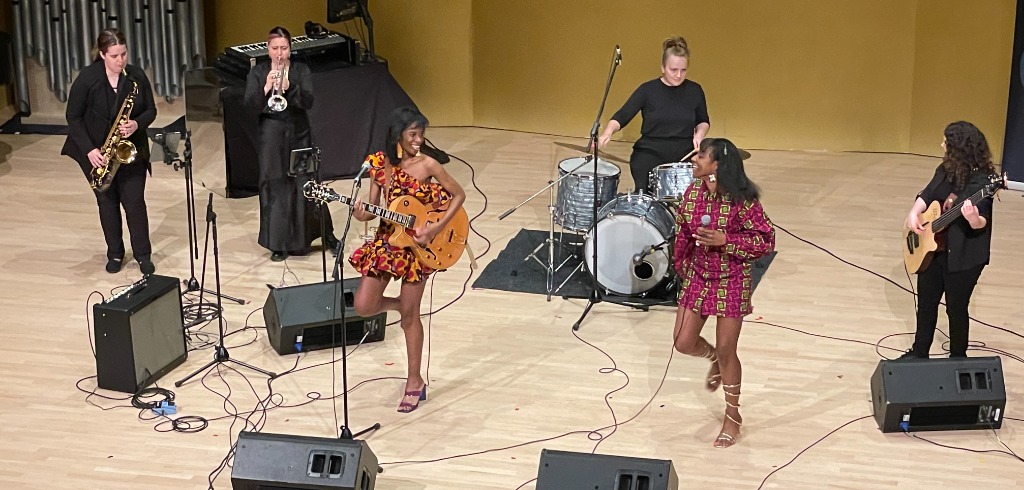
Mikha.elles offered Camino de mujeres, a world music program sung in French and Spanish and rooted in feminine lineage. Their original songs could easily land on a pop chart, yet they’re enriched with intricate harmonies and thoughtful arrangements. Solarium explored jazz textures and Quebec identity in Enraciné, while the refined vocal quartet Meslanges brought delicate humour and clarity to Puisque tout passe: la France en chansons. Bel and Quinn, sisters and collaborators, presented Dompter les cendres, an energetic set that would have benefitted from stronger sound engineering.
Ensemble Mistral honoured Astor Piazzolla with warmth and polish in Dans l’univers d’Astor. Konnecxion et la Bach-mobile, under the “Inspirations” banner, merged genres, a very entertaining ensemble led by OSM’S Organist in Residence, Jean Willy Kunz.

Ensemble Mistral. Photo: Courtesy of CQM.
Ensemble Renouveau, featuring sopranos Évelyne La Rochelle and Carole-Anne Roussel, cellist Simon Desbiens, violinist Jessy Dubé, and pianist Bruce Gaulin, delivered a theatrically immersive and vocally commanding performance with Contes et légendes. La Rochelle stood out for her lush vocal tone, impressive range, and precise coloratura. The program flowed seamlessly, striking a thoughtful balance between vocal and instrumental selections.
In contrast to the fully staged showcases, the présentations express offered artists a streamlined format, a chance to share their vision through a short pitch and video excerpt, without the demands of mounting a full performance. It’s a valuable space, especially for projects in development or those with complex multimedia elements.
Among the participants were Duo Airs with Marie-Annick Béliveau (Koperkus), Voces Boreales (Camino), La Nef (Baratin d’marins), and mezzo-soprano Stéphanie Pothier with composer Julien-Robert. Their project, De la mer aux nuages, stood out for its cohesion and sensory depth. It offered a seamless integration of live voice, electronic treatment, and oceanic video imagery that blurred the boundaries between art song, documentary, and immersive installation. Framed around the Saint-Laurent river as both subject and metaphor, the work offered not just beauty but urgency, an evocative reminder of what’s at stake.
In the end, the Grand Rendez-vous didn’t offer simple solutions, but it reframed the questions. As Morneau reminded us, communication is about empathy and the courage to listen before speaking. So what if we stopped refining the oil lamp, and finally asked ourselves what kind of light we really need?
For more on Conseil québécois de la musique visit www.cqm.qc.ca/en
This page is also available in / Cette page est également disponible en:
Français (French)