

This page is also available in / Cette page est également disponible en:
 Français (French)
To truly succeed in their craft, musicians need to pair up with the right instrument. Their artistry and technical skills are matched by their often-hidden counterparts, the technicians who devote their careers to constructing, maintaining and repairing the instruments that make the music possible.
For woodwind technician Julie Dubreuil, the inner workings of woodwinds are a fascinating puzzle to solve. During her 15 years in the field, including her time at Twigg Musique’s repair workshop, Dubreuil has developed a reputation as the go-to technician for Quebec’s professional woodwind musicians.

Julie Dubreuil at Twigg Musique
She says her work is “a weird mix between manual labour, puzzle-making and acoustics.” Her background as a musician—as well as a brief stint in computer science—lends her the eclectic blend of skills that seems to draw so many technicians to the field.
Jeff Willis, the supervisor at Long & McQuade’s Vancouver repair shop, has been a woodwind technician since 1998. But his interest began even earlier, during his primary school years, when he began collecting and taking apart instruments. “I played saxophone and flute in school,” he fondly recalls. “I purchased and repaired multiple instruments of the woodwind family to experiment with, at one point owning such oddballs as a contrabass clarinet and a sopranino saxophone.”
These oddball instruments—including the uncommon sopranino saxophone, which has seen its greatest popularity in rock music—are a departure from much of Willis’s daily work. He spends most of his time maintaining instruments that are used in school-band programs, ensuring that school-owned instruments are at their best for young musicians still learning to play. Dubreuil, too, highlights the important place that technicians play in music education. “We’re there to teach the students from the beginning that their instrument is their tool,” she says.
Even for seasoned professionals, technicians can act as an essential source of social and emotional support. “I have so many customers that come to me before auditions to soothe their anxieties,” says Dubreuil. “My job is to make their lives easier, and to make sure they can express themselves freely without anything in the way.” She speaks fondly of her connections with professional musicians and beginners alike, describing how the technician’s place in the music world spans far beyond a simple repair.
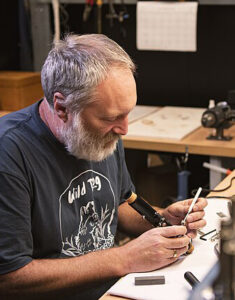
Woodwind technician Mark Rotenberry of Musical Instrument Repair Facility
Photo: Christopher Brecht
Though the classical-music world is increasingly recognizing the important place of technicians, there are no Canadian schools teaching the craft. As a result, Willis’s skills were built slowly through a combination of apprenticeships, personal study and a fair share of experimentation. Dubreuil, similarly, worked as an apprentice while she found her place in the field. Both technicians share that, in this field, they are never done learning. For woodwinds, the repair process can be particularly daunting. “There are so many parts on a woodwind instrument that it really opens up the possibilities of things that can be bent or damaged,” Willis says.
Sometimes, musicians ask Willis to restore, or even overhaul, vintage instruments. “These jobs take an enormous amount of time and concentration,” he says. To make the instrument “play and feel new again,” Willis may replace degraded materials, undertake complete bodywork or refit the instrument’s keys.
Dubreuil specializes in flute, piccolo, clarinet and bass clarinet, and relies on an ability to maintain intense focus. “You need to be a monk, sometimes. It seems like an easy instrument, just a tube with keys,” she laughs, “but it’s hard to fix such a simple mechanism!” Technicians must often disassemble large segments of woodwind instruments to make even minor changes. Even the smallest adjustment can make a profound difference in the seemingly-simple mechanisms.
Billy Turner, technician with Musical Instrument Repair Facility
Photo: Douglas Parker
For musicians looking to care for woodwinds, the two technicians share a few pieces of advice. They say that woodwinds should be swabbed clean inside with a cloth every time they are played, and that musicians should pay attention to how their instrument feels and plays in order to catch any issues early.
Artists should also seek routine, yearly maintenance for their instruments, especially woodwinds. “It’s a little machine with many complex mechanisms. You need to check up on it, just like a car,” says Dubreuil.
Pursuing maintenance proactively, rather than waiting for problems, can help keep your beloved instrument in your hands and out of the shop, says Willis. “Don’t wait for an emergency, because by then there’s bound to be several issues and you might need the instrument quicker than a repair shop can get it back to you!”
Most comfortingly, Dubreuil encourages musicians to seek support from a technician if they notice a decline in their ability to play. “Sometimes, musicians arrive feeling discouraged about their talent. When I hand them back their instrument, I see their eyes light up because they realize it isn’t them, their instrument just needed some maintenance! As a technician, I’m there to make sure they can express themself without anything getting in the way.”
This page is also available in / Cette page est également disponible en:
Français (French)