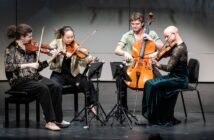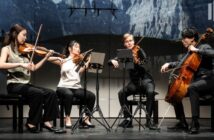
At 1 a.m. MDT Sunday Aug. 31, the Banff International String Quartet announced via email that the seven-person jury had selected three quartets to go on to the finals on Sunday afternoon. This was notwithstanding the use of a mathematical system to tabulate the cumulative scores from the judges’ assessments of the nine quartets in the initial four rounds. The system was meant to streamline the decision-making process and ideally, minimize heated discussions over who to advance. It still took more than two hours from the time the Cong Quartet finished playing Janáček’s String Quartet No. 1 in the fourth, Schubert/Beethoven/21st-century round, until the announcement was made.
The Arete Quartet, based in Seoul, KAIRI Quartet, based in Salzburg, and Poiesis Quartet based in Cincinnati will perform their own programs of no longer than 45 minutes, featuring at least three composers, on Sunday. Besides performing, each finalist will submit a written explanation for their curated program, answering the following questions: “Why these works? [and]What are you exploring or illuminating by the selections?” The audience will read their answers in the program.
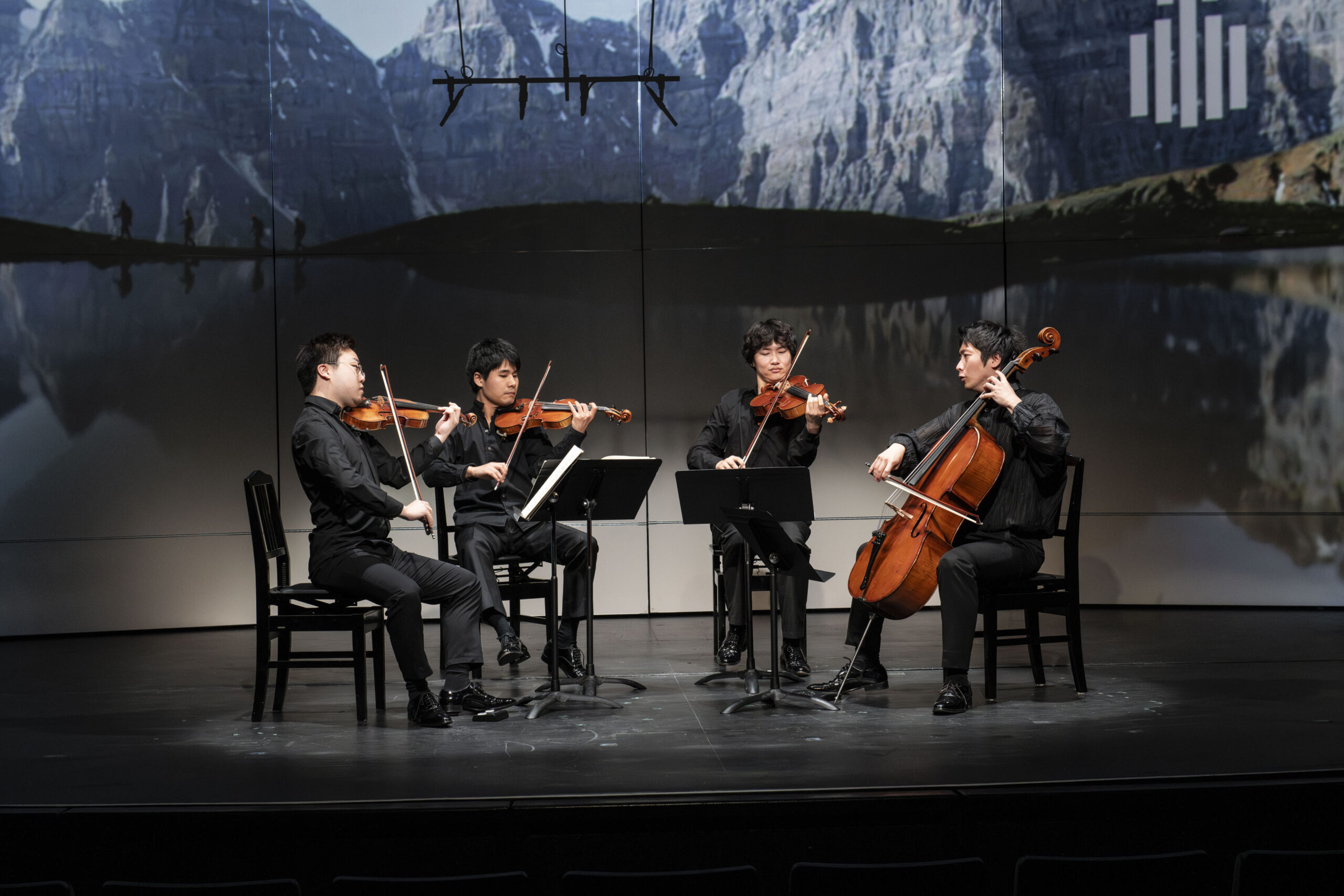
Quartet KAIRI at the Banff International String Quartet Competition (2025). Photo: Rita Taylor/Courtesy of Banff Centre for Arts and Creativity
KAIRI will play a portion of Wolfgang Amadeus Mozart’s String Quartet No. 21 in D Major, K., Toru Takemitsu’s Landscape, and Shostakovic’s String Quartet No. 8 in C minor, Op. 110. Arete’s program will feature Britten’s Three Divertimenti for String Quartet, a portion of Mozart’s String Quartet No. 19 in C Major, K 465, and Janáček’s String Quartet No. 1 “Kreutzer Sonata.” Poiesis has selected an all-contemporary program of Jerod Impichchaachaaha’ Tate’s Pisachi (Reveal) for String Quartet, Brian Raphael Nabors’ String Quartet, Joe Hisaishi’s String Quartet No. 1 – Phosphorescent Sea, and Kevin Lau’s String Quartet No. 7, Surfacing. Lau is a Canadian composer.
The three contenders look to enjoy a rocket-fuelled boost to their professional prospects if they win. Besides the three cash prizes—$25,000 Cdn for first, $12,000 for second, and $8,000 for third, as well as $4,000 for each of the best Haydn and new Canadian work’s performance—there are many other significant benefits. The other six quartets will each receive $5,000 for their efforts.
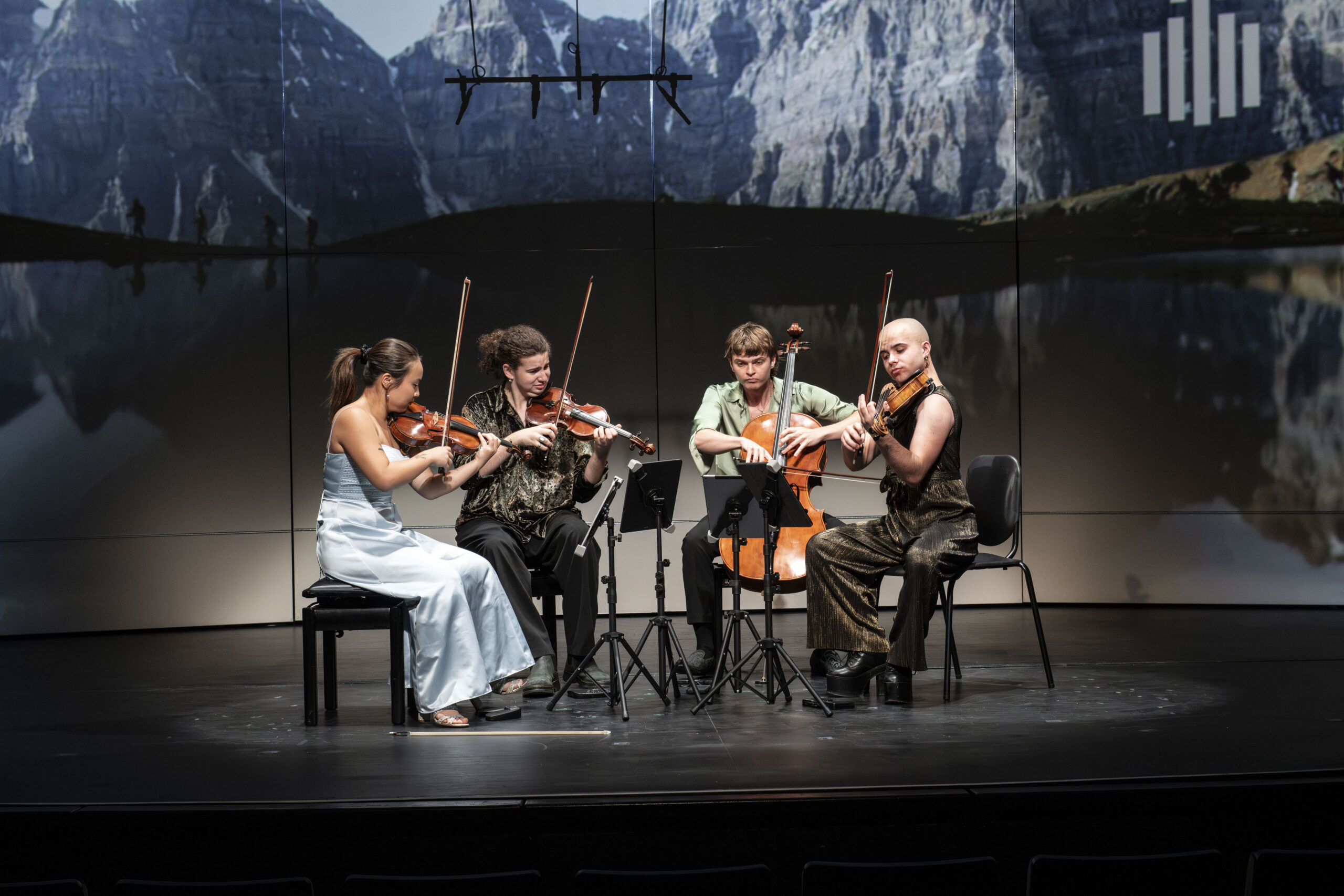
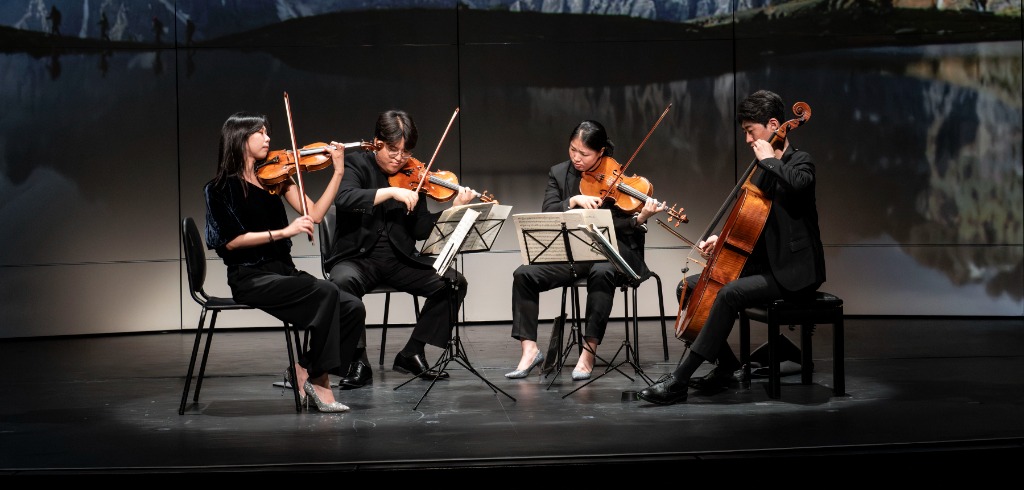
Poiesis Quartet at the Banff International String Quartet Competition (2025). Photo: Rita Taylor/Courtesy of Banff Centre for Arts and Creativity
Of the three finalists, Arete may have been the dark horse in the mix, although the Koreans have won several first-place prizes in past competitions. (That’s my view, anyway.) The jury’s voting procedures include considering not only the technical prowess and “unique artistic voice and presence,” of the ensembles, but also whether the first-place laureate is ready for a serious career launch. BISQC will arrange potentially 50 appearances with presenters in Europe and North America over the next three years, as well as a couple of residencies, a recording, and other benefits.
The winners were announced in the Jenny Belzberg Theatre on Sunday evening at 7:30 MDT. The finals were live streamed on the Violin Channel, theviolinchannel.com and the BISQC Facebook page.