The second phase of these Cliburn semifinals consisted of all twelve contestants performing a Mozart concerto with the Fort Worth Symphony Orchestra conducted by Carlos Miguel Prieto. The easiest job for a critic. Everything is clear, your soul is naked, there’s no place to hide. You can pedal yourself out of Chopin, rubato yourself out of Rachmaninov. But in Mozart, the towel is off: it’s doctor’s appointment time.
The Unbearable Lightness of Playing Mozart
How to evaluate the performance of a Mozart concerto? First, there is style. Classical performance follows some rules in articulation, dynamics, pedalling, touch, improvisation, and ornamentation.
Then, there is the ensemble work: a performance with orchestra is a large-scale chamber music collaboration, particularly with Mozart. Do the candidates demonstrate the ability to listen and respond to the orchestra? Are they communicating with the conductor? Or are they playing their solo part like they would in their practice room?
There is also a question of character and touch. Mozart’s trickster, tongue-in-cheek, sometimes surprisingly crass personality needs to come through as much as his anguish, elegance, grandeur, and sensitivity. A pianist’s touch must reflect these nuances, changing sometimes within an instant.
Finally, cadenzas offer each pianist the opportunity to demonstrate their creativity, not only in their choice of cadenza, but also in their ability to rework the concerto’s themes according to their perspective or their taste.
For those candidates who navigate these criteria with aplomb, they will sparkle. The others will be still. Painfully so.
Is your Mozart sparkling or still?
Day 2 (May 29): Philip Lynov, Chaeyong Park, Vitaly Starikov, and Carter Johnson
Performing Mozart’s Jeunhomme Concerto, K.271, 26-year-old Philipp Lynov from Russia opened the concerto marathon with a rigid, and inflexible performance. While each note sounded pearly clear, his interpretation was like a beautiful iceberg. Chiselled and heavy, it lacked the Mozartian warmth and freshness. Lynov’s awkward stage presence and his use of Mozart’s own cadenzas did not help. Still.
Next was South Korea’s 27-year-old Chaeyong Park with the D minor K.466. Wearing a stunning yellow and black elaborate sleeveless dress, Park performed with much more flexibility and a lighter, more appropriate touch. Her communication with the orchestra and the conductor was more natural and responsive, approaching a chamber ensemble performance. However, her performance did not feel too personal, as if she hid behind the lovely gestures. Despite the undeniable strong points, and her use of Robert Levin’s cadenza, it did not deliver. Still.
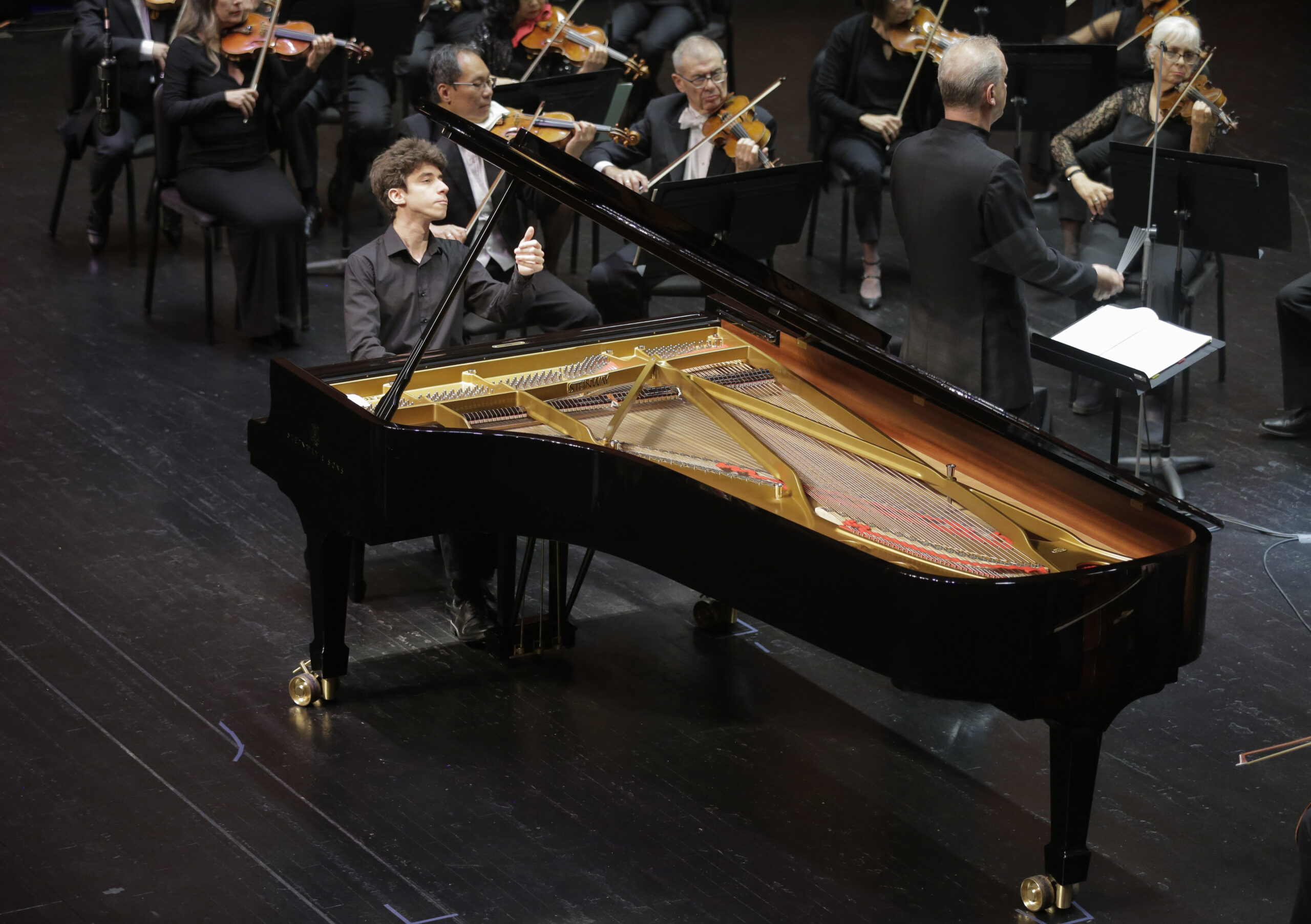
Vitaly Starikov performs a Concerto with conductor Carlos Miguel Prieto and the Fort Worth Symphony Orchestra. Photo: Ralph Lauer
After intermission, came Russia and Israel’s Vitaly Starikov (30) with the A major concerto, K.488. Walking slowly towards the keyboard, one feels a sense of ambiguity before he even plays the first notes. Yet, his opening passages sparkled with Mozartian spirit. The lightness, freshness, and musicality of his performance invigorated our ears and minds. He played naturally and from a personal place, using Mozart’s own cadenzas. A lovely and inspired performance if a bit caricatural and over productive. A noteworthy subtlety. Sparkling.
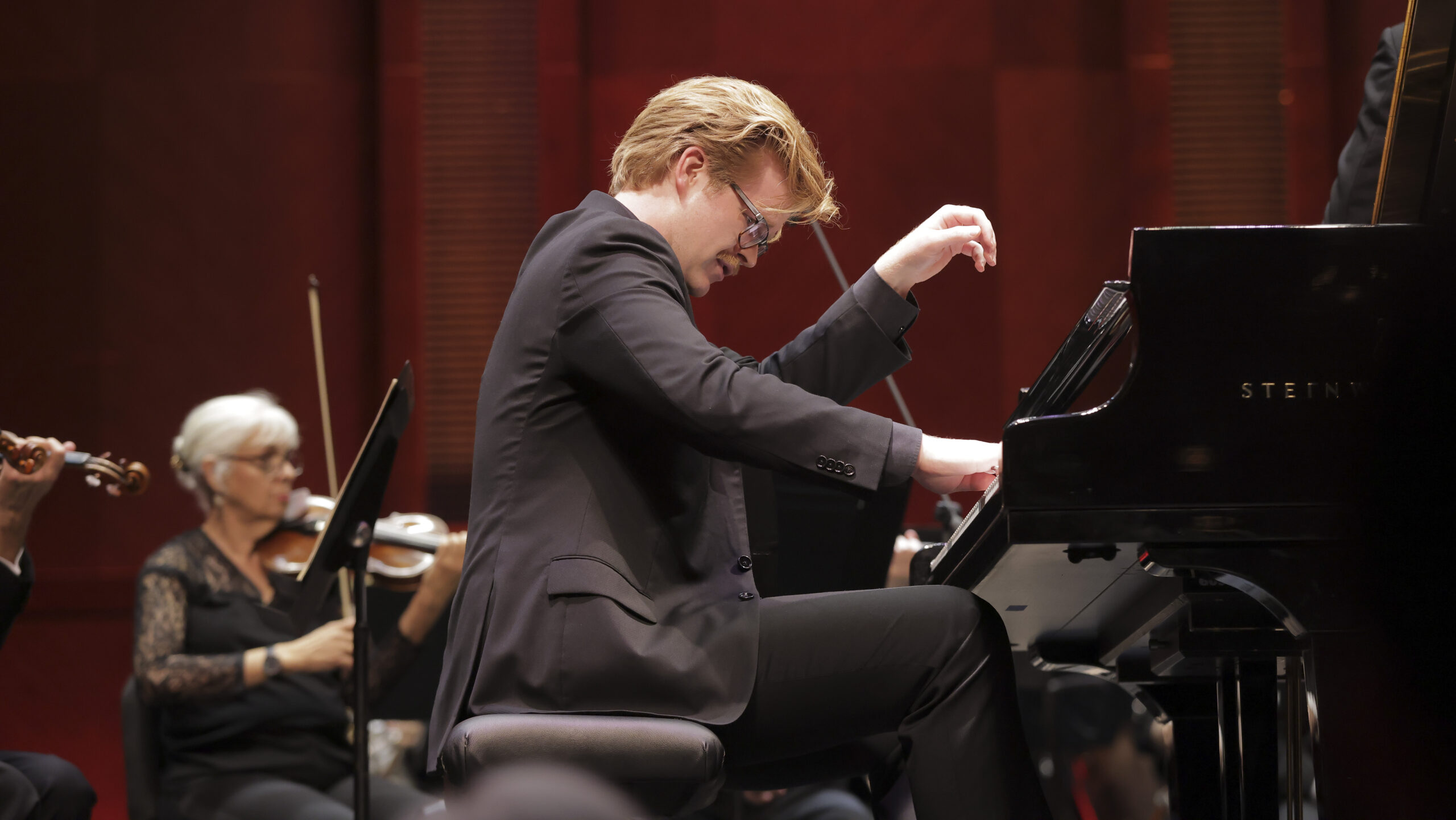
Carter Johnson performs a Concerto with conductor Carlos Miguel Prieto and the Fort Worth Symphony Orchestra. Photo: Ralph Lauer
The final contestant of this first day was Canada and the USA’s Carter Johnson (28). Playing the E-flat major concerto, K.482, Johnson shocked at first by not shaking hands with the concertmaster. An unfortunate omission. However, he redeemed himself by playing confidently, clearly, and with style. Johnson listens to himself and isn’t in constant production mode: he allows for feedback of his own sound to settle before engaging in the next phrase. Johnson isn’t obstructed by style; he lets it express naturally. Given his use of his own cadenza in the first movement and pianist David Fray’s cadenza in the third, Johnson’s Mozart was the most modern of the four. A serious performance—although lacking a bit in ensemble work. Sparkling.
View: Cliburn 2025 Semifinals Concerto 1 | Keys View
Day 3 (May 30): Aristo Sham, Elia Cecino, Piotr Alexewicz, and Yangui Cai
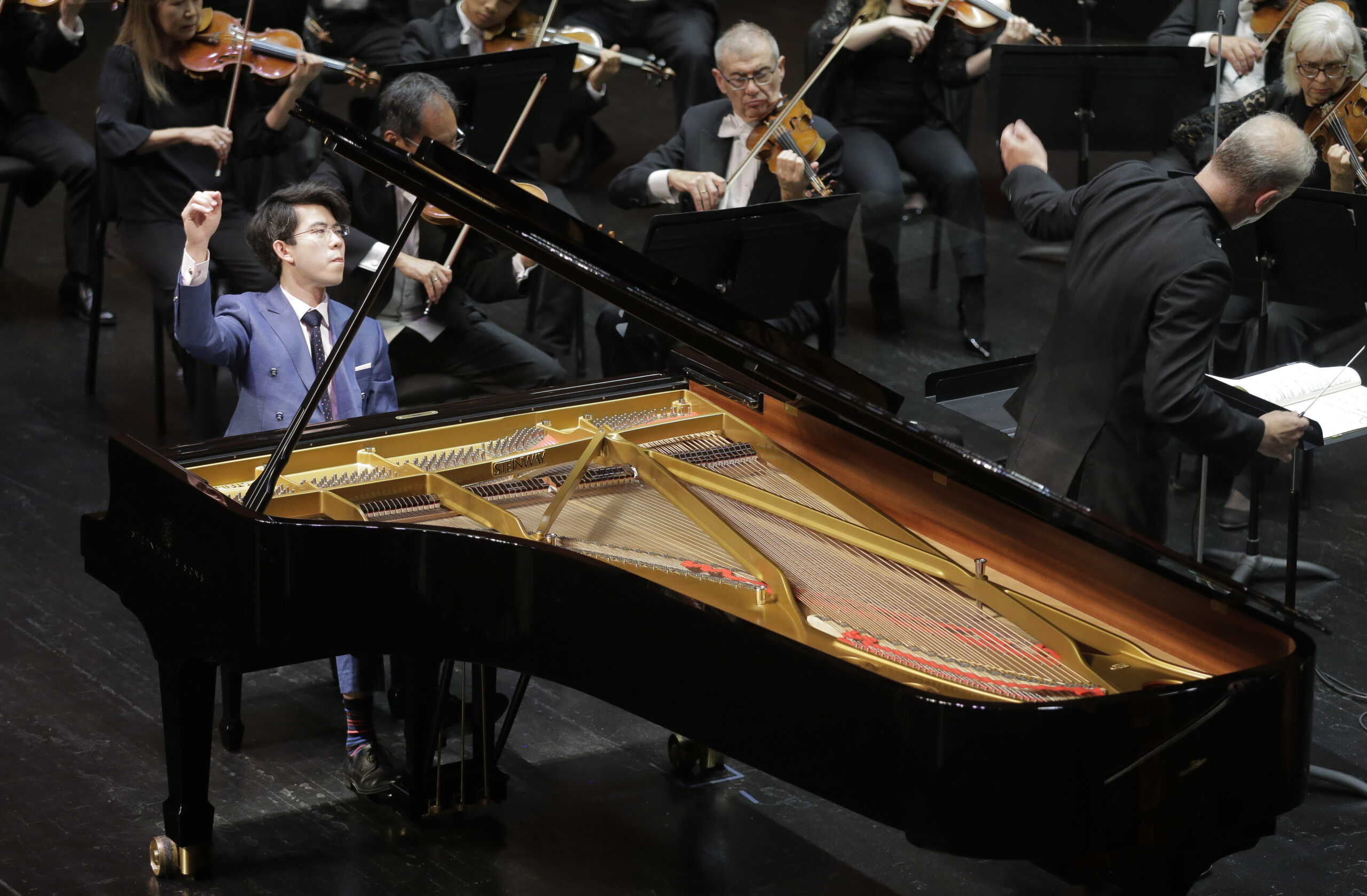
Aristo Sham performs a Concerto with conductor Carlos Miguel Prieto and the Fort Worth Symphony Orchestra. Photo: Ralph Lauer
On the second night of these Mozart festivities, the 29-year-old Artisto Sham walked on wearing an impeccable dark blue suit, and very nice, red stripy socks—a nice touch. He proceeded to deliver a spectacular performance of the Concerto No. 23 in A major. Playing with great pace, clarity and confidence, Sham demonstrated the most experience with an orchestra. His was the first chamber music performance of concerto playing and remained the standard for the rest. Sham played with the freedom and confidence of a prize winner. We didn’t see this side of him at his recital and it was great to know that he is a complete musician. Sparkling.
Next came Italy’s 23-year-old Elia Cecino wearing a wavy, red pirate shirt curiously reminding one of Jerry Seinfeld (for the initiated few). He left a similar impression as he did at his recital: free loving but weird. His performance was somewhat romantic, and his tone was on the harsher side. Cecino improved towards the end, particularly after Schiff’s explosive cadenza. With more time and experience, he will surely become an interesting pianist. Still.
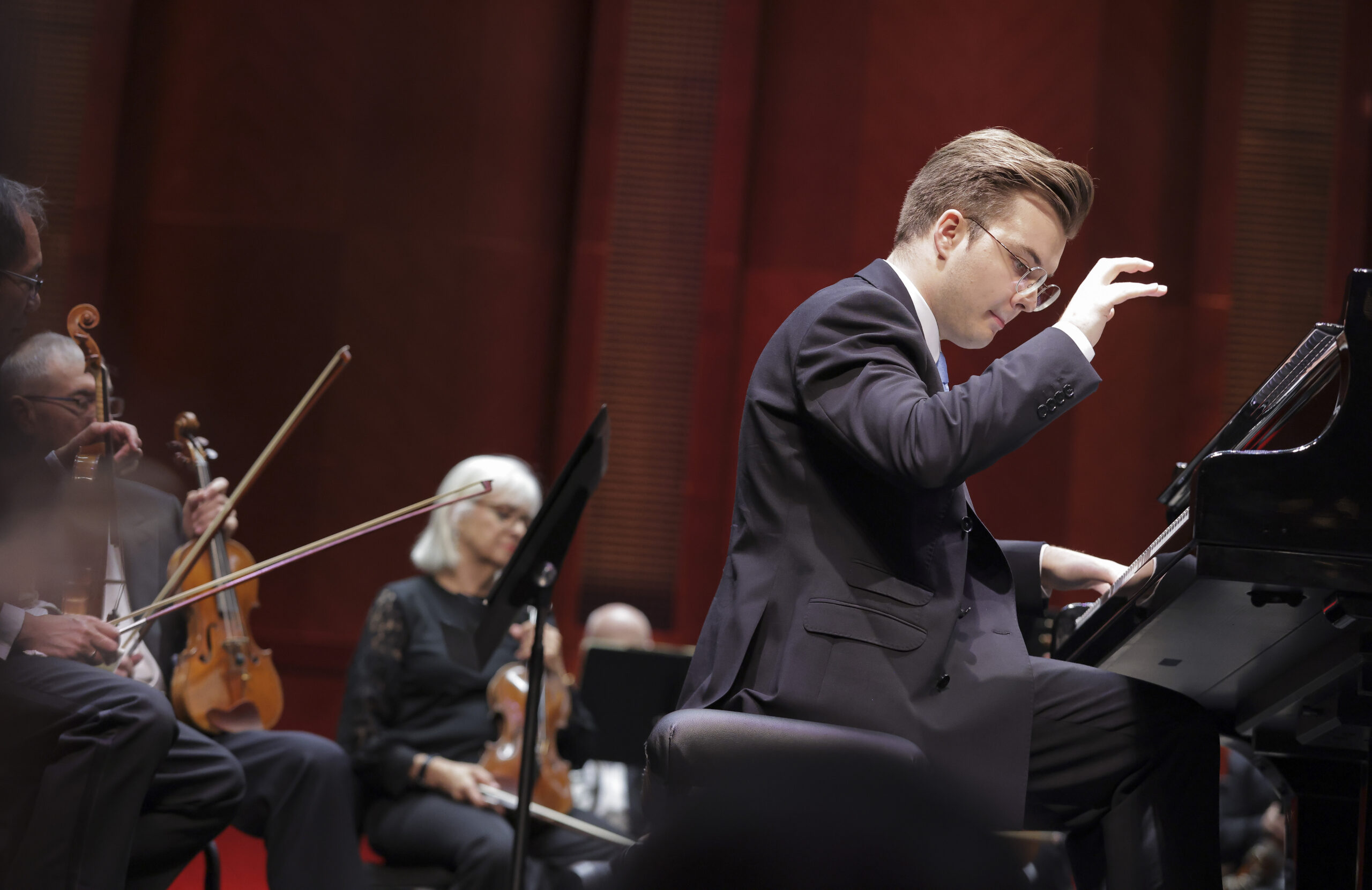
Piotr Alexewicx performs a Concerto with conductor Carlos Miguel Prieto and the Fort Worth Symphony Orchestra. Photo: Ralph Lauer
Then came the light. Poland’s 25-year-old Piotr Alexewicz delivered the perfect Mozart concerto in his rendition of the B-flat major K.595. He showed the right balance and the loveliest sound. The spirit was right on: beautiful, relaxed, sensitive to all turns and nuances. He made the orchestra sound better. An ideal Mozart. Sparkling.
Closing the night was China’s 24-year-old Yangrui Cai. While an excellent pianist, Cai did not distinguish himself in the C major Concerto K.503. Cai didn’t capture the focus of the previous contestant, did not show a particularly interesting personality nor charisma. He played well, but the orchestra was just a soundtrack over his solo part. Still.
View: Cliburn 2025 Semifinals Concerto 2 | Keys View
Day 5 (May 31): Angel Wang, Jonas Aumiller, Yanjun Chen and Evren Ozel
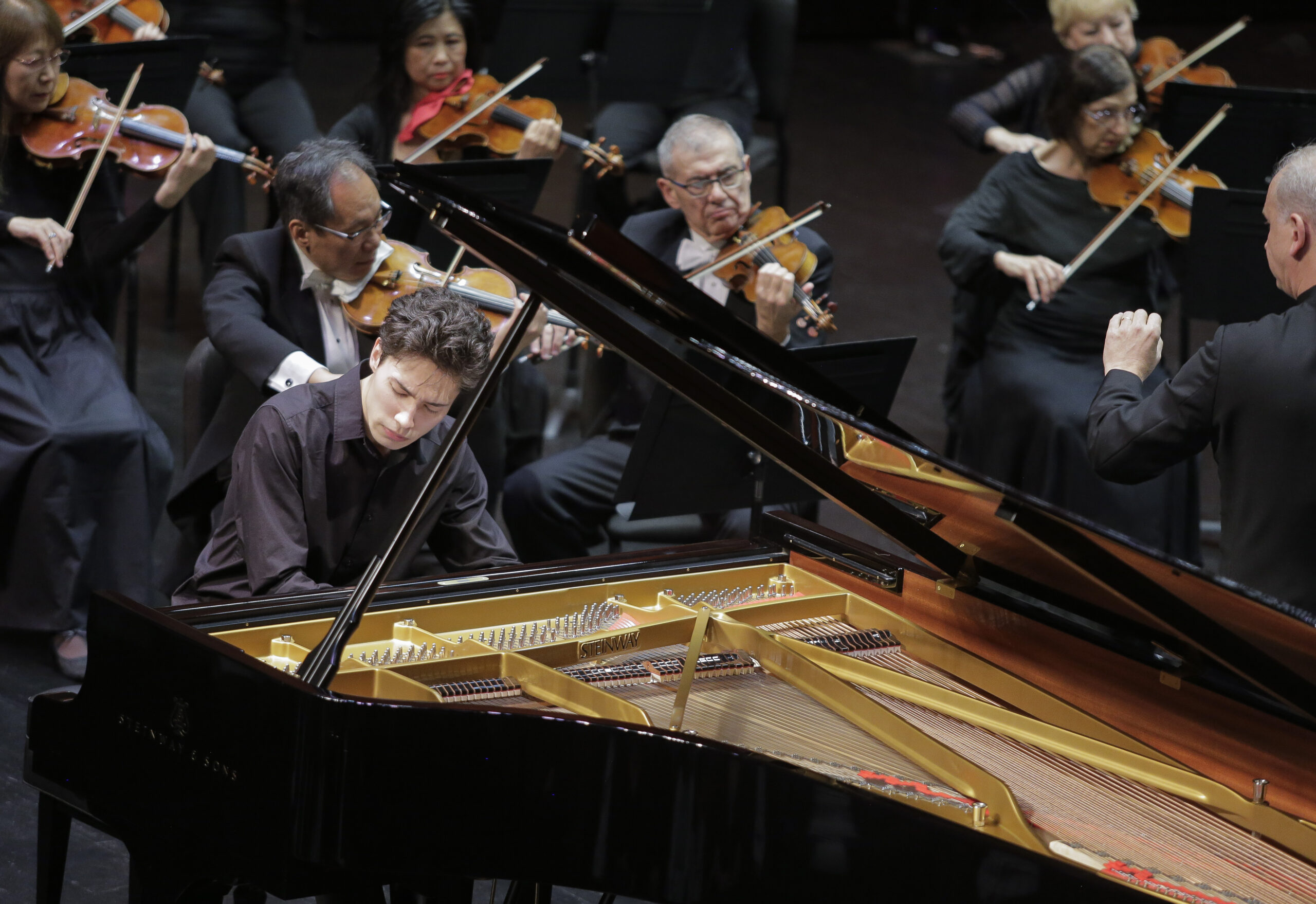
Angel Stanislav Wang performs a Concerto with conductor Carlos Miguel Prieto and the Fort Worth Symphony Orchestra. Photo: Ralph Lauer
Opening this last day of Mozartiana, Angel Stanislav Wang (22, USA) came in confidently with his now familiarly beaming smile. He performed Concerto No. 20 in D minor with excellent musicality, tempo, touch, and pace. Just as he had been at his recital, he was present and engaging and demonstrated wonderful sound projection in the hall. He played Beethoven’s cadenza with fire and assurance.
Nevertheless, Wang is not a natural Mozart interpreter nor a chamber musician. Despite the undeniable qualities, he may not have enough maturity to reach beyond the obvious layers of musicality. One starts to hear a little too much of the same. Sparkling, like a day-old soda.
Walking in wearing a sharp, finely tailored suit, Germany’s Jonas Aumiller asserted his calm, cultivated, and mature stage presence within a few steps. After a few awkward opening phrases in the Concerto n.27 in B-flat major, K.595, Jonas began to make chamber music. His wonderful and civilized playing radiated a quiet focus. He has the stage presence of a seasoned concert artist, one we would hear over again. He allows the quiet grandeur of Mozart’s music to speak, spreading calm, beauty, serenity through Bass Performance Hall. Aumiller displayed once more his creative capabilities by performing his own original and inventive cadenza. Sparkling.
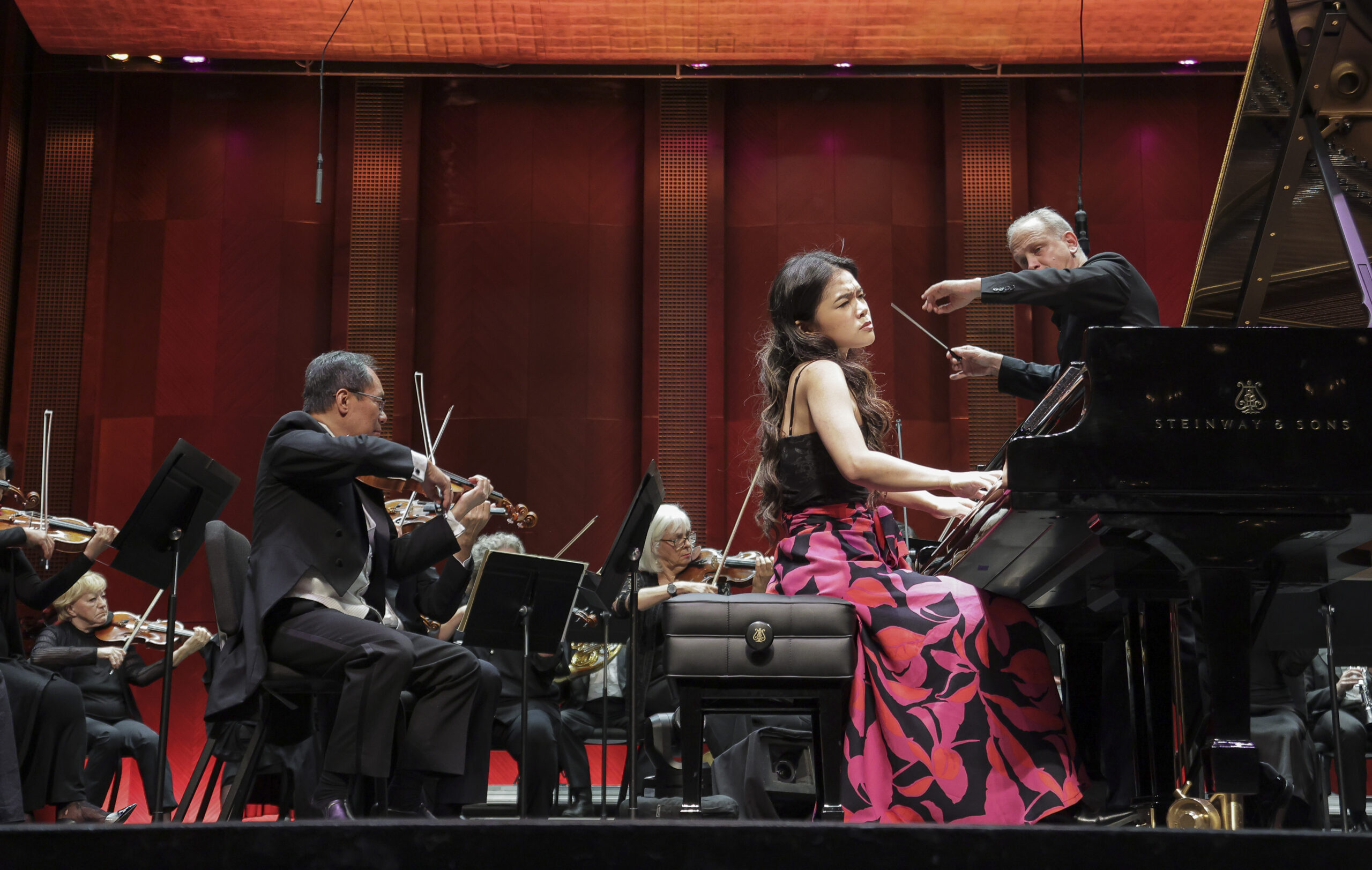
Yanjun Chen performs a Concerto with conductor Carlos Miguel Prieto and the Fort Worth Symphony Orchestra. Photo: Ralph Lauer
After intermission, came the biggest surprise of this entire series of concertos: China’s 23-year-old Yanjun Chen. After her wayward recital, Chen came with one mission: go big or go home. Her dress said it all: a blinding fashion statement in black and bubble-gum pink colours. Chen delivered a surprisingly captivating performance of the Concerto n.23 in A major. Every phrase exuded life, youthful energy, and a sheer delight to be on stage. Her powerful tone in the second movement was invigorating: she did not shy away from making sound in Mozart. How refreshing after hearing so many contestants limited by the confines of “style.” I salute her huztpah—she’s asserted her star power. A highly charismatic performer, and the wildest card among the contestants, Chen distinguished herself. Sparkling.
Finally, the evening closed with the USA’s 26-year-old Evren Ozel. His rendition of the Concerto n. 25, C major, K.503, was excellent, polished, stylistic, and beautiful. But, particularly after Chen’s Mozart, it sounded conservative if a bit boring. Everything was played with the same level of polish, yet nothing stood out. A serious musician, he was also less charismatic and less fun. Even his own cadenza did not help. Still.
In all fairness, he was the last participant of the evening and of the entire series. Perhaps some fatigue impaired my patience at this point. Critics are humans, after all.
View: Cliburn 2025 Semifinals Concerto 3 | Keys View
Mozart concerto preferences:
- Yanjun Chen
- Aristo Sham
- Jonas Aumiller
- Piotr Alexewiz
- Carter Johnson
- Vitaly Starikov
- Angel Wang
- Evren Ozel
- Chaeyon Park
- Philip Lynov
- Elia Cecino
- Yangrui Cai
For all of our Cliburn daily reports, articles and videos visit Spotlight | Cliburn 2025