Wednesday, May 28, 2025 – Welcome to La Scena Musicale’s reviews of the semi- and final rounds of the Van Cliburn International Piano Competition, one of the world’s most prestigious events on the classical music competing circuit. Occurring every four years, it is perhaps best compared to the US Open in tennis—one of four (or five) most competitive and historically significant piano competitions in the world. Arguably, the others would be the Tchaikovsky Competition in Moscow, Russia, the Queen Elizabeth Competition in Brussels, Belgium, and the Chopin Competition in Warsaw, Poland. Following this comparison, the Leeds Competition in Leeds, England may be equated to the ATP Finals.
See Spotlight | Cliburn 2025 for articles, reports and videos
The Van Cliburn takes place in Fort Worth, a pleasant, medium-sized city in northeastern Texas. A sense of Texan pride surges from every corner: trademark cowboy hats, flags, emblems—traces of an identity recognized the world over. The first impression of the competition is that it seems well-oiled and welcoming: a dedicated team of volunteers and personnel attends to every aspect of this complex machine. Yet, this is only the tip of the iceberg.
The Van Cliburn Competition has become a major industry player thanks in no small part to the innovations brought forth by its CEO, Montreal’s own Jacques Marquis. After spearheading the Orchestre Métropolitain, the Jeunesses Musicales du Canada, and the latter’s Concours musical international de Montréal (CMIM), Marquis arrived at his current post in 2013. As detailed in LSM’s article published last March, the CEO’s contributions count the exponential increase in the competition’s global viewership through digital media partnerships, the launch of the Cliburn Junior contest, the Cliburn Agency, and robust fundraising and visibility campaigns.
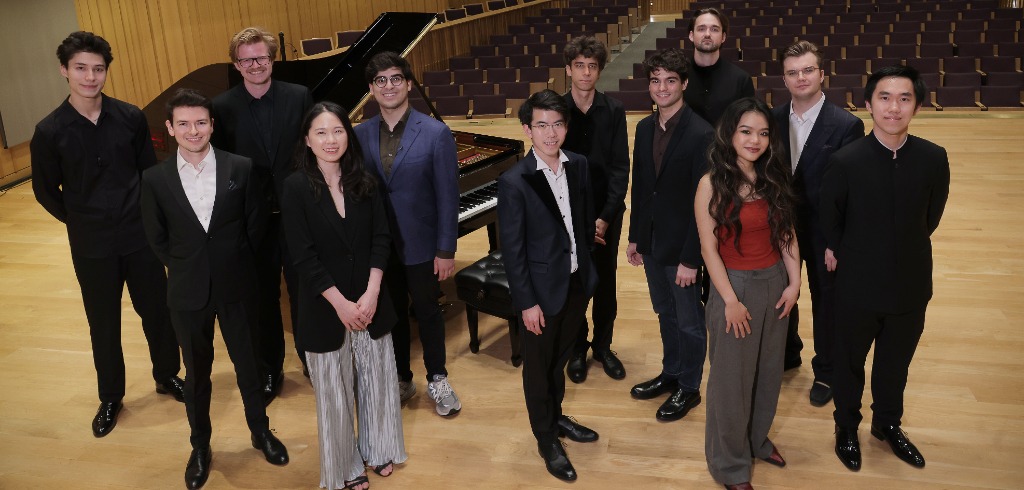
Glancing at the bios of this year’s twelve semi-finalists, one quickly recognizes a pattern of achievement that can be summarized thus: started listening to Mozart concertos while an embryo; discovered their passion for Rachmaninov at one year old; started learning to play piano at two (self-taught, of course); began their first official lessons at three with Arthur Rubinstein; won their first international competition at 10 (out of 55 other prizes); and enrolled in Juilliard where they studied piano, composition, physics, chemistry, law, literature, and 16th-century Renaissance painting. Oh, yes, and has been awarded last year’s Nobel Prize. No big deal: that’s just the average Van Cliburn contestant.
Yet, out of these exemplary and eerily similar bios (ChatGPT anyone?) seem to emerge two profiles: those for whom the piano has been the single strongest guiding force since learning to walk; and a select few who dared admit that they hold a variety of other pursuits and hobbies—such audacity!
Among the repertoire listed, these prodigies routinely play some of the most technically and artistically demanding works in the repertoire. The only three Beethoven sonatas that we will hear in these semi-finals are the Appassionata, the Hammerklavier, and the Sonata Op. 111. Ravel’s Gaspard de la nuit appears twice, other than La Valse and Jeux d’eau (come on, easy peasy). One contestant is performing all 12 of Chopin’s Etudes op.25, while another is presenting Rachmaninov’s Etudes-Tableaux op.39. I’m only surprised that no one is playing all Chopin Etudes, Rzewski’s hour-long The People United Will Never be Defeated, and Bach’s Goldberg Variations. While juggling three plates and five tennis balls at the same time, obviously.
At this point, a question arises: what will distinguish one contestant from another in the eyes of the jury and of the wider public? A few speculative possibilities come to mind. One: those contestants who disturb the jury the least will pass on to the next round. Not too much personality, not too much freedom, not too much style—just the golden, untouchable middle. Second: contestants with all the qualities plus a little personality will move on (i.e., just enough to distinguish themselves from the lot, but not enough to arouse any questions about their perfectly integrated style following established performance norms, whatever those may be). Third: contestants with ironclad political ties among the jury will advance. It’s hush-hush, but we all know it—connections not only help make the difference, they are the difference.
One story that has been circulating concerns the elimination of Madelene Ho of Malaysia. In a provocatively titled article published in Slippedisc, “Van Cliburn is numbed by lack of buzz,” Ho received high praise from its author, Normand Lebrecht, and Anna Geniushene, concert pianist and 2022 Van Cliburn silver medallist. Lebrecht’s influential column reads as follows: “… Magdalene Ho, was dubiously eliminated after a first-round performance in which she showed more character than all the rest put together. [Non-judging pianist Geniushene] summarised: ‘She has something that maybe 0.1% of pianists have: real spontaneity, and that rare “silent intensity” that doesn’t impose itself—it simply exists.’”.
While I have not heard Ho’s preliminary round performance, I must take into consideration the opinion of such esteemed colleagues while reviewing the next two rounds. After all, taste is subjective—my own as much as anyone else’s. Unlike the Gram Slam, which is mostly determined by quantitative measures of competitors’ skills within a clear and limited set of rules—those of a tennis match—a music competition is mostly a matter of intangibles. All contestants admitted to an international competition can play the piano with ease and fluency. Yet, the number of variables needed to succeed is so high that one may even question the decision these young people make to put their careers into the hands of a jury’s sometimes questionable decisions, behind-the-scenes influences, or pure chance. Such is the nature of this business.
Tonight, the first semi-final recital features Hong Kong’s Aristo Sham and Italy’s Elia Cecino. Let’s go.
Watch live and on demand at www.cliburn.org
See Spotlight | Cliburn 2025 for articles, reports and videos